The question of whether baptism can save you is one that has resonated deeply within religious traditions for centuries. It’s a profound inquiry that touches upon the very core of what it means to be saved, to find spiritual redemption, and to enter into a covenant with the divine. For many, baptism is not merely a ceremonial washing but a sacred rite of passage, a visible sign of an inward transformation, and a cornerstone of their faith journey. Understanding this question requires delving into the theological underpinnings of various religions, examining the symbolic significance of the ritual, and considering the multifaceted nature of salvation itself.
This article aims to explore this pivotal question in a comprehensive and accessible manner. We will navigate the diverse perspectives on baptism and its role in salvation across different Christian denominations and touch upon related concepts in other faiths. Our goal is to provide a clear, informative, and relatable understanding of why this ritual holds such significant weight for believers and to explore the nuances of can baptism save you in the context of faith and practice. We’ll consider the beliefs surrounding this practice, the transformative power attributed to it, and the relationship between outward action and inner spiritual reality.
Theological Foundations: What Does Baptism Symbolize?
At its heart, baptism is a powerful symbol of new life and spiritual purification. Across many Christian traditions, it represents several key theological concepts. Primarily, it symbolizes our union with Christ in his death and resurrection. When a person is immersed in water, it’s seen as a symbolic death to their old, sinful self. Emerging from the water signifies a resurrection to a new life, made possible through Christ’s sacrifice. This act is often described as a washing away of sins, a spiritual cleansing that marks a fresh start.
Furthermore, baptism is understood as an entry into the Christian community, the Church. It’s a public declaration of faith and a commitment to follow Jesus Christ. This communal aspect is crucial; it signifies becoming part of a larger family of believers, bound together by shared faith and purpose. Can baptism save you from the consequences of sin? For many, the answer lies in the belief that baptism is the outward manifestation of an inward repentance and faith, a step that God honors and uses to initiate salvation. Think of it like this: a wedding ring is a symbol of a marriage commitment, but it’s the commitment itself, the vows exchanged, that truly bind the couple. Similarly, baptism is a visible sign of a deeper spiritual reality.
Baptism and the Forgiveness of Sins
One of the most significant aspects of baptism, particularly in some theological frameworks, is its connection to the forgiveness of sins. Many believe that through baptism, believers are cleansed from original sin and any subsequent transgressions. This is not to say that baptism is a magical incantation that automatically erases wrongdoing, but rather that it is a divinely appointed means through which God applies the atoning work of Christ. For instance, in Acts 2:38, Peter tells the crowd, “Repent and be baptized, every one of you, in the name of Jesus Christ for the forgiveness of your sins, and you will receive the gift of the Holy Spirit.” This verse is often cited to support the idea that baptism is intrinsically linked to the remission of sins.
However, the precise nature of this connection can vary. Some traditions emphasize that baptism is the moment of salvation, where the sinner is justified and regenerated. Others see it as a sacrament that seals a covenant, a pledge of God’s grace that confirms the believer’s faith. For those who believe can baptism save you, it’s often understood as an essential step in obedience to Christ’s command to be baptized (Matthew 28:19). This obedience, rooted in faith, is seen as integral to the salvific process, not as a work that earns salvation but as a response to God’s grace. It’s comparable to opening a door to let someone in; the action of opening the door is necessary, but it’s the invitation and the willingness of the person to enter that truly matters.
Beyond individual purification, baptism serves as a gateway into the covenant community of believers. It’s the formal act of joining the Church, the body of Christ on earth. This inclusion signifies a shared destiny, mutual support, and participation in the spiritual life of the community. Can baptism save you in the sense of isolating you from the world and placing you under God’s direct protection within His people? Many would say yes, as it marks a transition from walking in darkness to walking in the light of God’s presence among His chosen. This is a profound blessing, as the strength and guidance found within the community are vital for spiritual growth and perseverance.
This communal aspect is not merely about social belonging; it’s about spiritual interconnectedness. When one is baptized, they are not just joining a congregation; they are becoming a member of the universal Church, united with all believers throughout history and across the globe. This interconnectedness is vital for spiritual health. Consider a single tree versus a forest; the forest provides a more resilient ecosystem, offering protection and shared resources. Similarly, the Church, initiated through baptism, offers a supportive environment for believers to thrive. Therefore, the question of can baptism save you also encompasses the idea of being saved into something greater than oneself – a redeemed community.
Diverse Perspectives on Baptism and Salvation
Understanding can baptism save you necessitates acknowledging the diverse theological interpretations within Christianity, and even parallels in other faiths. While the ritual of baptism is widely practiced, its precise theological significance and its role in salvation are subjects of ongoing discussion and varying belief. These differences stem from varied interpretations of scripture, historical development of doctrine, and emphasis on different aspects of faith. Exploring these perspectives offers a richer understanding of the question.
It’s important to realize that no single denomination holds a monopoly on truth, and respectful dialogue about these differences is crucial for spiritual growth and understanding. The essence of faith, regardless of specific ritual interpretations, often points to a deeper connection with the divine that transcends mere outward actions. Therefore, while the question of can baptism save you is central, the answer is often nuanced by the broader context of faith, repentance, and God’s grace.
Infant Baptism vs. Believer’s Baptism
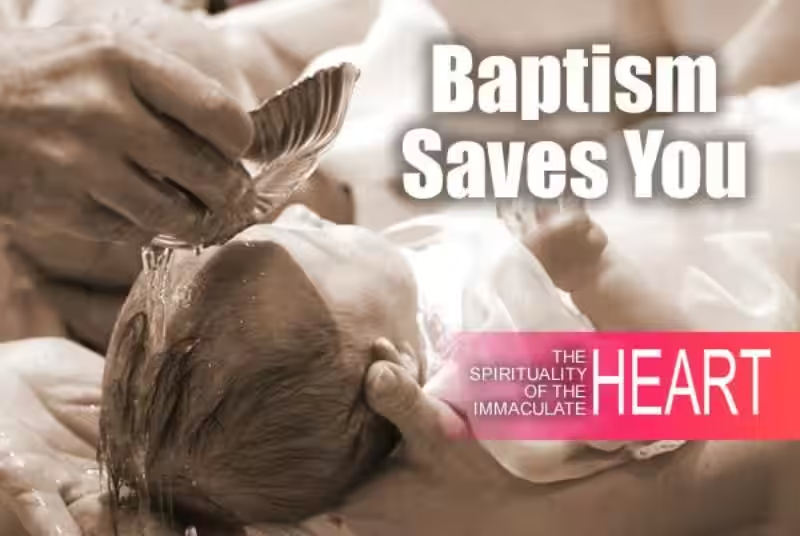
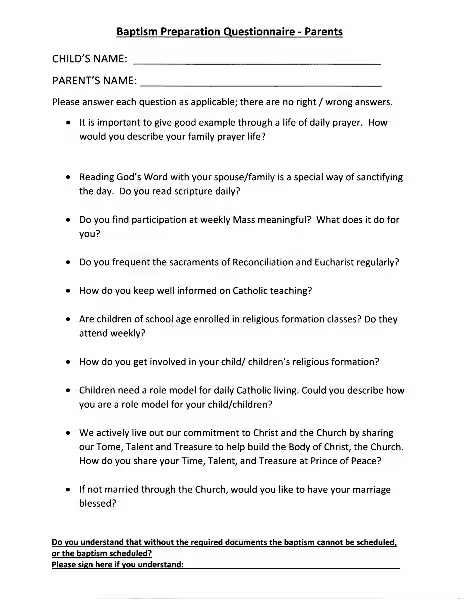
A primary point of divergence lies in the practice of infant baptism versus believer’s baptism. Infant baptism, common in traditions like Catholicism, Orthodox Christianity, and some Protestant denominations (e.g., Lutheran, Methodist), asserts that baptism is a sacrament that imparts grace and washes away original sin from birth. Parents and godparents make professions of faith on behalf of the infant. The belief here is that baptism can save you by initiating you into God’s covenant from the earliest possible moment, even before conscious decision. For example, an infant receives the benefits of citizenship upon birth, a status that is later affirmed by the individual.
Conversely, traditions like Baptist, Pentecostal, and non-denominational churches generally practice believer’s baptism. This approach emphasizes that baptism should follow a personal profession of faith and repentance. The individual, having consciously accepted Jesus Christ as their Savior, is then baptized as an outward sign of their inward commitment. In this view, can baptism save you is directly tied to personal faith and a conscious decision to follow Christ. It’s akin to signing the contract for a house after you’ve decided you want to buy it; the signing is the affirmation of your prior decision. This emphasis is on the individual’s active participation and understanding of the commitment.
The Role of Faith and Grace
Regardless of when baptism occurs, the overarching theme in most Christian theology is that salvation is ultimately a gift of God’s grace, received through faith. While baptism is a significant ritual, it is rarely seen as the sole determinant of salvation in isolation from faith and repentance. Many theologians would argue that can baptism save you is best understood within the broader context of God’s salvific plan, which involves His unmerited favor and humanity’s response of faith. For instance, many scriptures speak of being saved “by grace through faith” (Ephesians 2:8-9). Baptism, in this light, is often considered the sacramental sign or seal of this grace and faith.
Some traditions hold that while baptism is a powerful means of grace, it is God’s sovereign grace that ultimately saves. Baptism is seen as an obedient response to God’s command and a participation in the mystery of Christ. The question of can baptism save you is therefore answered with a qualified “yes,” contingent upon the presence of faith and God’s gracious intent. It’s like taking the prescribed medicine when sick; the medicine is a means of healing, but it’s the body’s response, aided by the medicine and the doctor’s expertise, that brings about recovery.
Beyond Christianity: Similar Rites and Concepts
While the question “can baptism save you” is predominantly a Christian one, the concept of ritual purification and spiritual initiation holds significance in various religious and spiritual traditions around the world. These practices, though different in form and theological context, often share the underlying idea of a transformative moment that marks a person’s spiritual journey and their relationship with the divine or the sacred. Examining these parallels can offer a broader perspective on the human desire for spiritual cleansing and belonging.
These rituals often serve as a visible marker of a significant transition, a commitment to a particular way of life, or a means of seeking favor or protection from higher powers. The universality of such practices suggests a deeply ingrained human need to mark and solidify spiritual progress through outward actions and communal participation. Therefore, while not a direct answer to can baptism save you, understanding these related concepts enriches our appreciation for the profound significance of sacred rituals.
Purification Rites in Other Religions
In Judaism, the practice of mikveh (ritual immersion) is a significant purification rite. It is used for various purposes, including conversion to Judaism, after menstruation or childbirth, or after contact with a corpse. While not directly a salvific act in the Christian sense, it symbolizes a return to a state of ritual purity and a reconnecting with God. For a convert, the mikveh is a crucial step in becoming part of the Jewish covenant community, signifying a new spiritual beginning.
Similarly, in Islam, Wudu (ablution) and Ghusl (full body washing) are performed for ritual purification before prayer. These acts are seen as essential for approaching Allah with a clean body and mind, symbolizing a cleansing of impurity and a readiness to engage in worship. While not directly about salvation from sin in the same way as baptism, these acts are vital expressions of devotion and obedience, which are central to a Muslim’s relationship with God and their path to spiritual fulfillment. The question of can baptism save you is different, but the underlying principle of purification for spiritual engagement is present.
Across many indigenous spiritual traditions and some forms of Eastern religions, initiation ceremonies play a vital role. These ceremonies often involve symbolic death and rebirth, the receiving of sacred knowledge, or the marking of a transition into adulthood or a new spiritual role. For example, some Hindu traditions have initiation rites where a guru bestows a mantra or sacred thread, signifying a spiritual awakening and a commitment to a particular path of devotion.
These rites are often seen as transformative, marking a person’s spiritual rebirth and entrance into a deeper understanding of reality. Can baptism save you? In the context of these traditions, the initiation ceremonies serve a similar purpose of marking a profound spiritual shift and integration into a sacred order. They are not about escaping damnation per se, but about entering into a fuller, more conscious spiritual existence. It’s about moving from one state of being to another, a transition often seen as profoundly significant.
Conclusion: Faith, Ritual, and the Journey of Salvation
The question of can baptism save you is a deeply personal and theologically rich inquiry that has captivated believers for millennia. While the answer is not a simple “yes” or “no” that applies universally, the profound significance of baptism in many religious traditions is undeniable. It serves as a powerful symbol of new life, spiritual purification, and incorporation into a covenant community. Its meaning is intricately woven with the concepts of faith, grace, and repentance, forming a central pillar in the journey of salvation for countless individuals.
Ultimately, whether baptism directly saves is a matter of theological interpretation, but its role as a visible sign and a means of grace is widely acknowledged. For many, it is an essential step in their spiritual walk, a public declaration of their commitment to God, and a tangible experience of His transformative power. The journey of salvation is multifaceted, encompassing both outward acts of devotion and inward transformation of the heart, and baptism stands as a sacred testament to this ongoing, profound journey.
Frequently Asked Questions: Baptism and Salvation
Can baptism save you?
The role of baptism in salvation is understood differently across various Christian denominations. Some believe that baptism is a necessary sacrament for salvation, symbolizing the washing away of sins and a new spiritual birth. Others view baptism as an outward sign of an inward faith and commitment to Christ, and therefore not the direct cause of salvation itself. In these traditions, salvation is primarily understood to be received through faith in Jesus Christ alone.
What is “religion” in the context of baptism and salvation?
“Religion” in this context refers to the organized system of beliefs, practices, and rituals that a particular Christian denomination adheres to regarding baptism and its connection to salvation. Different religions (denominations) have distinct theological interpretations of scripture and tradition which lead to varying doctrines on who is saved, how salvation is achieved, and the specific role of sacraments like baptism in that process.