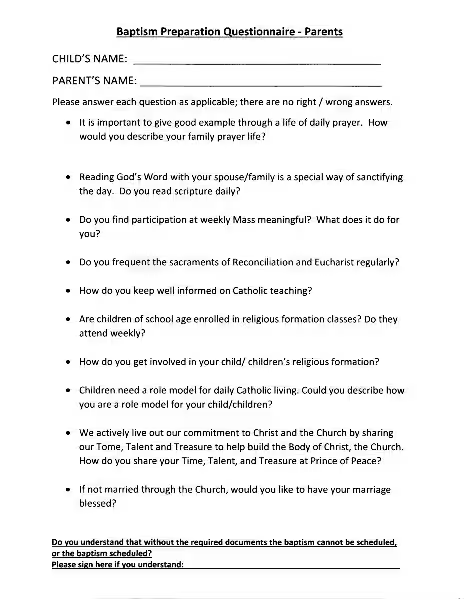
The act of baptism is one of the most recognizable and significant rituals across a vast spectrum of religious traditions. Yet, for many, the “baptism question” – what it means, who it’s for, and why it’s performed – remains a point of curiosity, confusion, or deep personal conviction. Whether you’re considering baptism yourself, exploring different faiths, or simply seeking a deeper understanding of religious practices, delving into the multifaceted nature of baptism can unlock profound insights into faith, community, and spiritual transformation.
This article aims to demystify the baptism question by exploring its historical roots, theological significance, and practical implications within various religious contexts. We’ll navigate the common queries surrounding this ancient rite, offering relatable explanations and illuminating examples to help you grasp its enduring importance. From the initial decision to be baptized to its lifelong impact, we’ll examine the journey of faith that often accompanies this sacred ceremony.
At its core, baptism is a ritual, often involving the use of water, that symbolizes a profound spiritual transition. Think of it like a public declaration of a new beginning, a visible marker of an inward change. Across different religions, the specific interpretations and outward expressions of baptism may vary significantly, but the underlying theme of purification, dedication, and initiation is remarkably consistent. It’s not just a symbolic cleansing; for many, it represents a tangible step in their relationship with the divine and with their faith community.
The primary purpose behind performing baptism is to signify a person’s entry into a religious community and their commitment to its beliefs and practices. For Christians, it often symbolizes the washing away of sins and an identification with the death and resurrection of Jesus Christ. In other traditions, it might represent spiritual rebirth, a covenant with God, or a purification from impurities. The “baptism question” then becomes about understanding this deeper meaning – is it about personal choice, familial tradition, or an obligatory step for salvation? This initial understanding is crucial for appreciating the weight and beauty of the ritual.
Baptism in Christianity: A Central Sacrament
In Christianity, the “baptism question” is particularly central and often debated among denominations. For the vast majority of Christian traditions, baptism is considered a sacrament, an outward and visible sign of an inward and spiritual grace. It’s a public act of faith that marks a believer’s new life in Christ. The act of immersion in water, or having water poured upon the head, is seen as a powerful metaphor for being cleansed from sin and having one’s old self buried, only to rise again in newness of life, much like Jesus’ resurrection.
Theological interpretations within Christianity lead to different practices and understandings of baptism. Infant baptism, common in Catholic, Orthodox, and many Protestant denominations, is seen as a sign of God’s grace extended to a child and a welcome into the covenant community. The “baptism question” here often revolves around parental faith and the child’s future commitment. In contrast, believer’s baptism, practiced by Baptists, Anabaptists, and others, emphasizes a conscious decision of faith by the individual before baptism, typically performed on adults or older children who can articulate their belief in Jesus Christ. This highlights the personal nature of the commitment and the “baptism question” of individual readiness and understanding.
The Meaning of Water and Immersion
Water is the universal symbol of cleansing and purification, and its use in baptism is no accident. Think of how rain washes away dust and grime from the earth, or how a shower refreshes and revitalizes us. In baptism, water signifies the washing away of the spiritual “dirt” of sin and the impurities that separate us from God. This act of cleansing is not merely superficial; it’s understood to be a divine act of spiritual renewal, a tangible representation of God’s grace at work in an individual’s life.
The method of baptism—whether by full immersion, pouring, or sprinkling—also carries symbolic weight. Full immersion, often preferred in traditions practicing believer’s baptism, is seen as the most complete representation of dying to the old self and being resurrected to new life. However, even pouring or sprinkling is considered efficacious by many, as it still visually conveys the cleansing and the initiation into the faith. The “baptism question” about the mode of baptism often sparks lively discussions, but the underlying significance of water as a purifying agent remains a constant across these variations.
While Christianity is perhaps the most widely associated religion with baptism, the concept of ritualistic cleansing and initiation through water exists in other spiritual traditions, albeit with different terminology and theological nuances. The “baptism question” in these contexts might be phrased differently, but the underlying desire for purification and a closer connection to the divine is evident. Understanding these parallels can broaden our appreciation for the human yearning for spiritual wholeness.
For instance, in some forms of Judaism, the mikvah, a ritual immersion in a specially constructed pool of water, serves as a means of purification for various reasons, including conversion to Judaism, after menstruation, or after childbirth. While not directly termed “baptism,” the symbolism of cleansing and spiritual renewal through water is undeniably present. Similarly, in some indigenous spiritual practices, water ceremonies are performed to cleanse, heal, and connect individuals with the spiritual realm. These examples demonstrate that the “baptism question” is not confined to a single faith but touches upon a universal human experience of seeking purity and belonging.
Conversion and Initiation Rites
One of the most common scenarios where the “baptism question” arises is during conversion to a new religion. For individuals seeking to formally join a faith community that practices baptism, this rite often serves as the official entry point. It’s a public declaration of their newfound beliefs and their commitment to follow a new path. This is particularly true in Christianity, where baptism is a prerequisite for full membership in many churches and a visible sign that one has accepted Jesus Christ as their Lord and Savior.
The process of conversion and the role of baptism can be deeply personal and emotionally charged. The “baptism question” for a convert often involves grappling with the meaning of their past life and embracing the promises of their new faith. It’s a rite of passage that signifies a break from the old and a commitment to the new, often accompanied by a sense of peace, purpose, and belonging within their chosen religious community. This transformative aspect makes baptism a profoundly significant event for those who undergo it.
Common Questions Surrounding Baptism
The “baptism question” is rich with inquiries that arise from genuine curiosity and a desire for clarity. People often wonder about the age appropriateness of baptism. For infants, the question is often about the faith of the parents and the child’s future commitment. For adults, it’s about personal understanding and willingness. Then there’s the question of frequency: is baptism a one-time event, or can it be repeated?
Another common area of inquiry concerns who can perform baptism. Is it limited to ordained clergy, or can any believer administer the rite? The “baptism question” also extends to the purpose of baptism for salvation. Is it a necessary condition for entering heaven, or is it a symbol of salvation already received? These are important theological questions that have been pondered for centuries and continue to be a part of the ongoing dialogue within religious communities.
Who Can Be Baptized?
The “baptism question” of “who can be baptized?” is answered differently depending on the denomination and theological perspective. As mentioned earlier, Christians debate the inclusion of infants versus requiring explicit personal faith. Some traditions believe that baptism is a covenant sign, extended to the children of believers as a promise of God’s grace, and that the child’s faith will develop later. Others insist that baptism should only be administered to those who can consciously profess their faith in Jesus Christ.
For those converting to a faith that practices baptism, the primary requirement is often a sincere belief in the tenets of that faith and a willingness to commit to its teachings. This usually involves a period of instruction and preparation, often called a catechumenate, where individuals learn about the faith and are guided in their spiritual journey. The “baptism question” for a convert is about their readiness to embrace this new identity and their understanding of the responsibilities that come with it.
The distinction between infant baptism and adult baptism is a significant point of discussion within the “baptism question.” For parents who choose infant baptism, it’s often seen as a way to bring their child into God’s covenant and the community of the church from the earliest possible age. They are making a promise on behalf of their child to raise them in the faith, trusting that God’s grace will be at work in the child’s life. This is a deeply held belief for many, rooted in the idea of God’s unconditional love and the church as a spiritual family.
In contrast, adult baptism emphasizes the personal decision of faith. An individual, having reached an age of understanding and maturity, makes a conscious choice to follow Christ. This is often a powerful and deeply emotional moment, as the person publicly declares their commitment and repentance. The “baptism question” here is about the individual’s informed consent and personal conviction, signifying a deliberate step into a new life of discipleship. Both approaches are seen as valid and meaningful within their respective traditions, highlighting the diversity of ways faith is expressed.
Is Baptism Necessary for Salvation?
The “baptism question” of whether baptism is absolutely necessary for salvation is one of the most complex and debated theological issues. In many Christian traditions, baptism is seen as an essential step in the process of salvation, a visible sign of the inward transformation that occurs through faith in Christ. It’s often understood as an ordinance commanded by Jesus himself, and therefore, disobedience would be detrimental to one’s spiritual well-being.
However, other Christian traditions hold that salvation is primarily by grace through faith alone, and while baptism is important and commanded, it is not an absolute prerequisite for salvation. They might argue that in cases where baptism is impossible or where an individual expresses saving faith before being baptized, God’s mercy can still extend to them. The “baptism question” here often leads to discussions about God’s sovereignty, the nature of faith, and the interpretation of biblical passages. It’s a question that touches upon the very heart of what it means to be saved and how one enters into a right relationship with God.
The Role of Faith and Grace
Ultimately, for most religions that practice baptism, the ritual is understood to be deeply intertwined with the concepts of faith and grace. Grace is the unmerited favor of God, a gift freely given. Faith is the human response to that grace, a trust and belief in God’s promises and power. The “baptism question” often boils down to how these two elements interact within the ritual.
In many Christian perspectives, baptism is seen as a channel through which God’s grace is conveyed to the believer, and faith is the receptivity to that grace. It’s not that the water itself has magical properties, but rather that God, through the act of baptism and the faith of the individual (or their sponsors), bestows His grace. This understanding emphasizes that baptism is both a divine action and a human act of obedience and commitment, a beautiful interplay of God’s initiative and our response. The “baptism question” is thus a journey into understanding this profound spiritual dynamic.
The Lifelong Impact of Baptism
Beyond the ceremony itself, baptism often marks the beginning of a lifelong spiritual journey. It’s not merely a one-time event but a foundational commitment that shapes a believer’s understanding of themselves, their relationship with God, and their role in the world. The “baptism question” extends to its ongoing significance, how it influences daily life and decisions.
For many, baptism serves as a constant reminder of their identity in Christ and the promises they have made. It can be a source of strength during challenging times, a comfort in moments of doubt, and a motivation to live a life that honors their faith. The symbolic washing away of sins and the new life in Christ are not just abstract concepts but lived realities that can empower and guide individuals throughout their lives. The “baptism question” thus evolves from understanding the ritual to living out its implications.
Baptism is a powerful declaration of spiritual identity. It signifies belonging to God and to a community of believers. For Christians, it means being incorporated into the body of Christ, sharing in His life and mission. This sense of belonging can be incredibly grounding, offering support, fellowship, and a shared purpose. The “baptism question” then becomes about how this new identity shapes one’s interactions and their place in the broader world.
This newfound identity often translates into a desire to live according to the values and teachings of their faith. It can inspire acts of service, compassion, and justice. The “baptism question” isn’t just about a personal transformation but also about how that transformation impacts the community and society at large. It’s a call to be a visible sign of God’s love and presence in the world, a testament to the transformative power of faith.
Continuing the Journey of Faith
The “baptism question” doesn’t end after the water has dried. It is the starting point for a continuous journey of faith. Over time, believers are encouraged to deepen their understanding of their faith through scripture, prayer, and participation in their religious community. Baptism provides the initial spiritual foundation upon which this growth is built.
This ongoing journey involves striving to live out the commitments made at baptism, facing personal challenges, and seeking to grow in spiritual maturity. It’s a process of learning, unlearning, and relearning, guided by the principles of their faith. The “baptism question” ultimately leads to a profound exploration of what it means to live a life dedicated to God, a lifelong pursuit of holiness and service, marked by the transformative grace symbolized in their baptism.
Frequently Asked Questions: Baptism
What is baptism?
Baptism is a religious ritual, usually involving water, that signifies cleansing, rebirth, and initiation into a religious community. Different religions have varying interpretations and practices surrounding baptism.
Why do people get baptized?
People get baptized for a variety of reasons, depending on their faith. Common reasons include:
* Symbolic cleansing and purification: Washing away of sin.
* Spiritual rebirth: Entering into a new life in Christ or with God.
* Initiation and belonging: Becoming a member of a church or religious community.
* Obedience to religious teachings: Following the commands of their scripture or religious leaders.
* Public declaration of faith: A commitment to God and their religious beliefs.
Is baptism a requirement for salvation?
This is a question with diverse answers across different Christian denominations. Some traditions believe baptism is a necessary sacrament for salvation, while others view it as a symbolic act that follows salvation. Many emphasize faith in Jesus Christ as the primary means of salvation.
What are the different ways baptism is performed?
The method of baptism varies. Common practices include:
* Immersion: Fully submersing the person in water.
* Affusion (Pouring): Pouring water over the head.
* Aspersion (Sprinkling): Sprinkling water on the head.
The choice of method often depends on theological interpretations and traditions of the specific religious group.
Who can be baptized?
Generally, individuals who profess faith in the religion and its core tenets are candidates for baptism. This can include adults making a personal decision or infants, whose baptism may be seen as a dedication and a sign of God’s covenant, with the understanding that they will be raised in the faith.
Does baptism have to happen in a church?
While baptism often takes place in a church setting, it can also be performed in other locations where water is available, such as rivers or natural bodies of water, especially if the context requires it or for symbolic reasons. The presence of a religious leader and the intention behind the act are generally considered more significant than the specific location.