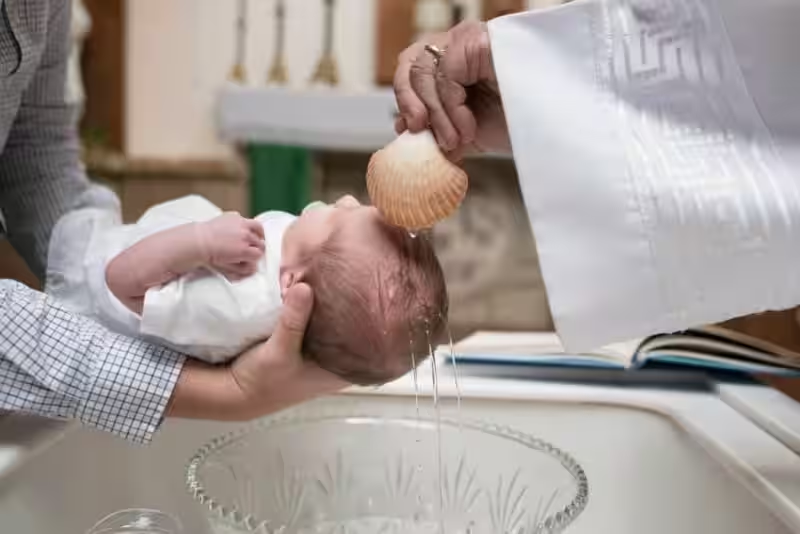
The act of baptism, a sacred rite in many faiths, signifies a profound spiritual cleansing and a welcome into a religious community. It’s a moment often filled with joy, reverence, and a tangible sense of new beginnings. But as you ponder this significant sacrament, a natural question arises: who can do a baptism? The answer isn’t a simple one, as it varies considerably depending on the specific religious tradition. Understanding these distinctions is crucial for anyone considering baptism for themselves or for a loved one, offering clarity and insight into the spiritual leadership within various faiths.
This exploration will delve into the roles of clergy, ordained ministers, and sometimes even lay individuals across different religious landscapes. We’ll uncover the theological underpinnings that dictate who is authorized to perform this vital sacrament, touching upon the authority, training, and spiritual lineage that often accompany these roles. Whether you’re a member of a particular faith, curious about another, or preparing for a baptism yourself, this article aims to provide a comprehensive and accessible guide to the essential question of who can do a baptism.
The Authority to Baptize: Clergy and Ordained Ministers
In the vast majority of Christian denominations, the primary individuals authorized to perform baptisms are ordained clergy. This includes priests, pastors, ministers, bishops, and other designated spiritual leaders who have undergone specific theological training, examinations, and have been officially ordained by their respective church bodies. This ordination signifies a formal commission by the church to administer sacraments and to shepherd the congregation. The belief is that these individuals act as representatives of God and the church when performing this sacred rite.
The rationale behind this exclusivity often stems from the understanding of baptism as a sacrament, a visible sign of an invisible grace. The ordained minister is seen as having the proper authority and understanding to convey this grace. For instance, in the Catholic and Orthodox traditions, only a priest or bishop can validly baptize under normal circumstances, though in emergencies, any person, even a non-baptized individual, can perform a baptism if they intend to do what the Church does and use the Trinitarian formula (in the name of the Father, and of the Son, and of the Holy Spirit). This emergency provision highlights the profound importance of baptism itself, while still underscoring the standard practice of a designated minister.
Catholic and Orthodox Traditions: The Priest as the Ordinary Minister
Within the Catholic Church, the ordinary minister of baptism is a bishop, a priest, or a deacon. These individuals are ordained and have received the authority to administer the sacrament through their office. When a bishop or priest performs the baptism, they are acting in persona Christi Capitis – in the person of Christ the Head – symbolizing the Church’s role as the Body of Christ. Deacons, while not ordained for the priesthood, are also empowered to baptize, typically assisting the parish priest and ministering to the community.
As mentioned, a crucial exception exists: in cases of necessity, such as a life-threatening situation for an infant or an adult in danger of death, any person, regardless of their status or even their faith, can perform a valid baptism. However, this requires specific intentions: the person must intend to do what the Church intends when it baptizes, and they must use the proper Trinitarian formula and pour or immerse the person with water. This emergency baptism is recognized by the Church and ensures that no one dies without the grace of baptism. This demonstrates the profound emphasis placed on salvation and the Church’s desire that all have access to this foundational sacrament. Therefore, while clergy are the usual celebrants, the spirit of God’s mercy extends to extraordinary circumstances where lay individuals can be instrumental.
Protestant Denominations: Variations in Practice
Protestant denominations exhibit a broader range of practices regarding who can do a baptism. While most ordained pastors or ministers are the primary officiants, some traditions allow for a greater role for lay leadership. In many evangelical and non-denominational churches, for example, baptisms are performed by the senior pastor, associate pastors, or elders who have been recognized and appointed by the congregation or church leadership. The emphasis here is often on the pastoral leadership team’s spiritual maturity and their recognized calling to serve the community.
Some Protestant traditions, particularly those with a strong emphasis on congregational governance, might allow for licensed ministers or even commissioned lay leaders to perform baptisms under specific circumstances and with the oversight of the broader church body. This often involves a period of training and demonstration of theological understanding and pastoral gifting. The key is that there is usually a recognized authority within the church structure that bestows the right to administer this sacrament. For instance, a denominational handbook or church bylaws will typically outline the qualifications and authorization process for who can do a baptism within that specific faith community.
Lay Baptisms: When and How It’s Permitted
The concept of lay baptism, meaning a baptism performed by someone who is not an ordained minister, is a significant and sometimes debated topic within Christianity. As we’ve touched upon, in emergency situations, lay individuals are not only permitted but encouraged to perform baptism in Catholic and Orthodox traditions due to the profound theological significance of the sacrament for salvation. This is a critical safeguard against eternal loss, ensuring that the grace of God through baptism is accessible even when a priest or deacon is unavailable.
Beyond these dire emergencies, the allowance for lay baptism becomes more restricted and varies greatly among denominations. Some historically allow for lay administration under certain conditions, often when a church is without a minister or in mission settings. In these instances, a mature and spiritually qualified member of the congregation, often designated by church leadership, might be authorized to perform baptisms. This delegation is usually accompanied by strict guidelines and an understanding that it is a deviation from the norm, with the expectation that ordained ministry will eventually be established. The core principle remains: while the ordained minister is the ordinary minister, the Church recognizes the power of the sacrament and the potential for God’s grace to flow through dedicated individuals in exceptional circumstances.
Theological Underpinnings of Lay Ministry in Baptism
The theological basis for allowing lay individuals to perform baptisms, even in limited contexts, often rests on the priesthood of all believers. This doctrine, central to many Protestant traditions, suggests that all baptized Christians have direct access to God through Jesus Christ and share in his priestly ministry. While this doesn’t negate the importance of ordained leadership, it opens up possibilities for the ministry of the laity to be recognized and utilized within the church’s sacramental life.
When a layperson performs a baptism, especially in an emergency, the emphasis is placed on the intent of the minister and the action of God, rather than solely on the ordained status of the individual. The belief is that the Holy Spirit works through the sacrament, and the intention to perform the baptism as Christ and the Church intend is paramount. This allows for a compassionate and grace-centered approach, ensuring that whoever can do a baptism in a moment of critical need will be recognized for their vital role in bringing someone into the fellowship of faith. It’s a testament to the belief that God’s grace is not confined by bureaucratic structures but can flow through willing and faithful hearts.
Baptism in Non-Christian Religions
It is important to clarify that the sacrament of baptism, as understood in Christianity, is unique to Christian faiths. While other religions have rituals that involve water, purification, or initiation into a community, they are distinct from Christian baptism and are not performed by Christian clergy or considered equivalent. For example, in Judaism, the “mikveh”” is a ritual bath used for purification
and while it involves water and cleansing