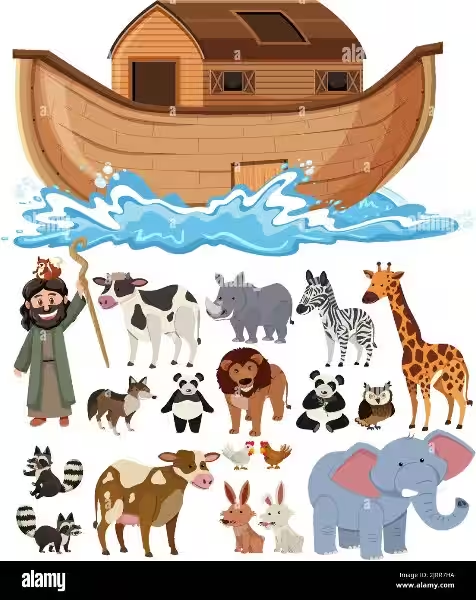
The story of Noah’s Ark, a cornerstone of religious narratives for millennia, continues to capture the human imagination. At its heart lies a seemingly impossible feat: gathering and preserving every kind of creature on Earth. The sheer scale of the task, particularly concerning the Noah’s Ark animals, invites a cascade of questions that bridge the realms of faith, science, and our fundamental understanding of the natural world. This ancient tale isn’t just about a flood; it’s a testament to divine intervention, a profound exploration of survival, and a fertile ground for contemplation about the diversity of life itself.
For believers, the account in Genesis offers a powerful message of redemption and a promise of continuity. The meticulous selection and sheltering of Noah’s Ark animals underscore a divine plan, a deliberate act to ensure the continuation of God’s creation. This narrative, passed down through generations, serves as a bedrock of faith for many, providing comfort and guidance. It’s a story that, despite its age, resonates deeply in our modern world, prompting us to consider our place within the grand tapestry of life and the responsibility we hold for the creatures we share this planet with.
Decoding the Ark: The Sheer Scale of Noah’s Ark Animals
The biblical narrative describes Noah being instructed to bring two of every kind, a male and female, onto the Ark. This phrase, “of every kind,” is where the true complexity of Noah’s Ark animals begins to unfold. What exactly constitutes a “kind”? Is it species, genus, or a broader classification? This ambiguity has fueled centuries of debate and speculation. Imagine trying to fit not just the readily recognizable animals like lions and elephants, but also the countless insects, microscopic organisms, and even plant seeds. The logistical nightmare, even with divine assistance, is staggering to contemplate.
Consider the common housefly versus a rare Amazonian beetle – both are insects, but vastly different. If “kind” referred to species, the Ark would have been impossibly small. If it referred to broader categories, like insects or mammals, the genetic diversity needed to repopulate would be a significant concern. This interpretive challenge highlights the interpretive nature of religious texts and the human desire to reconcile faith with observable reality. The vastness of biodiversity we see today, from the smallest ant to the largest whale, makes the Ark’s mission an awe-inspiring, if perplexing, proposition.
When we delve into the notion of “kind,” we enter a fascinating discussion about taxonomy and biological classification. Were the animals brought on the Ark representatives of broader ancestral groups, from which modern species later diverged through evolution? This is a common interpretation among those seeking to harmonize the biblical account with scientific understanding. For instance, perhaps Noah brought a representative pair of canids, and from those, all modern dog breeds and wolf species eventually developed. This evolutionary perspective offers a framework for understanding the diversity.
This approach suggests a much more manageable number of “kinds” than individual species. Instead of needing to house thousands upon thousands of distinct species, the Ark could have accommodated a more concentrated selection of foundational animal groups. This interpretation allows for the possibility of speciation occurring after the flood, a process where populations diverge to form new species. It’s a way to acknowledge the biblical narrative while also embracing the scientific understanding of how life diversifies over vast periods.
Beyond the Familiar: The Unseen Inhabitants of the Ark
The popular imagery of Noah’s Ark often focuses on the large, charismatic megafauna – the majestic lions, towering giraffes, and lumbering rhinos. However, the biblical text implies a much broader scope for the Noah’s Ark animals. Were the tiny, the unseen, and the less glamorous also included? We must consider the immense diversity of invertebrates, the vast array of insects, the microscopic life teeming in water and soil. The survival of these organisms is just as crucial to the continuation of ecosystems as that of larger creatures.
Think about the vital role of pollinators like bees, or decomposers like earthworms. Without them, plant and animal life would quickly collapse. The inclusion of such essential, often overlooked creatures would have been paramount for the restoration of life on Earth. This aspect of the story challenges us to think beyond our immediate, anthropocentric view of the animal kingdom and appreciate the intricate interdependencies that sustain life at all levels. The Ark, in this light, becomes a testament to the comprehensiveness of creation and divine foresight.
The Practicalities: Feeding and Managing Noah’s Ark Animals
One of the most persistent questions surrounding the Ark narrative revolves around the practical challenges of managing Noah’s Ark animals. How would Noah, his family, and a relatively small group of helpers feed and care for such a vast and diverse population for an extended period? The sheer volume of food required, along with the sanitation needs of so many creatures, presents a monumental logistical puzzle. This is where the divine intervention aspect of the story becomes central for many believers.
For those who hold to a literal interpretation, the answer often lies in the miraculous. God’s provision, the animals’ hibernation or reduced metabolic needs during the flood, or other supernatural means are invoked to explain these practicalities. Alternatively, some interpretations suggest that the Ark housed breeding pairs with dormant embryos or that the animals were somehow induced into a state of reduced activity. These explanations, while not empirically verifiable, serve to uphold the integrity of the narrative within a framework of faith, acknowledging that divine power transcends human limitations.
The Legacy of the Ark: Faith, Science, and the Enduring Questions
The story of Noah’s Ark, with its central characters being the Noah’s Ark animals, continues to be a powerful narrative that sparks discussion and contemplation. It transcends simple storytelling, inviting us to grapple with fundamental questions about our origins, the nature of life, and our relationship with the divine. The enduring appeal of the Ark lies in its ability to provoke thought, whether one approaches it from a scientific or a theological perspective.
While science offers explanations for the diversity and history of life on Earth, the Ark story provides a profound spiritual narrative about beginnings and continuity. The debates surrounding the classification of Noah’s Ark animals, the logistics of their preservation, and the very possibility of such an event highlight the ongoing dialogue between faith and reason. Ultimately, the tale of the Ark serves as a timeless reminder of humanity’s quest for understanding and our deep-seated awe for the incredible variety of life that populates our planet.
The story of Noah’s Ark, found in the Book of Genesis in the Bible, describes God’s decision to cleanse the Earth of wickedness through a great flood. God instructs Noah, a righteous man, to build an ark and take with him his family and pairs of every kind of animal to preserve them.
What does the story of Noah’s Ark mean religiously?
Religiously, the story of Noah’s Ark is often interpreted as a testament to God’s judgment, mercy, and covenant. It signifies a new beginning for humanity and the divine promise to never again destroy all life on Earth with a flood. It highlights themes of obedience, faith, and salvation.
How many animals were on Noah’s Ark?
According to the biblical account in Genesis, Noah was instructed to bring two of every kind of “unclean” animal and seven pairs of every kind of “clean” animal into the ark. The exact number of species or individuals is not specified, and interpretations vary.
Are there scientific explanations for Noah’s Ark?
From a religious perspective, the story is understood as a divine act beyond scientific explanation. Scientifically, the feasibility of such an event, including the logistics of gathering and sustaining all animal species, is not supported by conventional scientific understanding of geology, biology, or archaeology.
What are the different religious interpretations of Noah’s Ark?
While the story is central to Judaism, Christianity, and Islam, interpretations can differ. In Judaism, it emphasizes divine justice and the renewal of creation. In Christianity, it is often seen as a prefiguration of baptism and salvation through Christ. In Islam, Noah (Nuh) is considered a prophet, and the story highlights his perseverance in spreading God’s message and the divine punishment for disbelief.