The names Matthew, Mark, Luke, and John are etched deeply into the fabric of Western civilization, particularly within the realm of religion. For billions worldwide, these four individuals are more than just historical figures; they are the primary transmitters of the life, teachings, and impact of Jesus Christ. Their writings, collectively known as the Gospels, form the bedrock of Christian faith, offering intimate portraits of a figure who profoundly reshaped the spiritual landscape. But who exactly were these men, and why is their perspective so vital to understanding the Christian religion?
Exploring the identities and contributions of Matthew, Mark, Luke, and John isn’t just an academic exercise; it’s an invitation to engage with the very foundations of one of the world’s largest religions. Their unique voices, though united in their central message, offer distinct angles and emphases, painting a rich and multifaceted picture of Jesus. Understanding their backgrounds and the context in which they wrote allows us to appreciate the nuances within the Gospels and the enduring power of their narrative. This journey into their lives and works will illuminate their indispensable role in shaping religious thought and practice.
The Four Witnesses: Architects of the Gospel Narrative
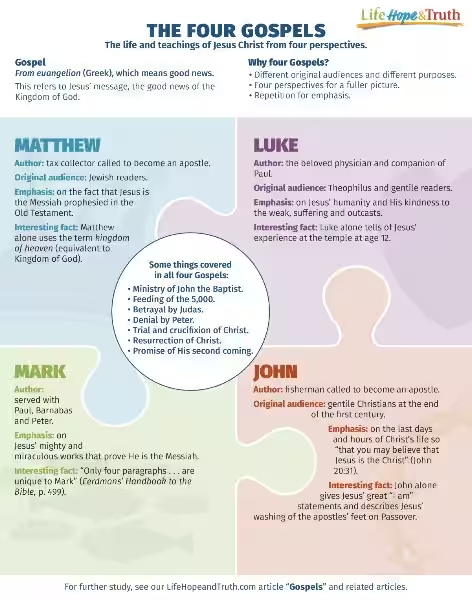
The most significant contribution of Matthew, Mark, Luke, and John to religion is the creation of the Gospels. These are not biographies in the modern sense, but rather theological documents designed to persuade readers of Jesus’ identity as the Messiah and the Son of God. Each Gospel writer approached their task with a specific audience and purpose in mind, resulting in variations in emphasis, style, and the inclusion of particular events or teachings. This diversity is not seen as a contradiction but as a testament to the richness and complexity of Jesus’ life and ministry.
Imagine trying to describe a particularly vibrant sunset to two different friends. One might focus on the fiery reds and oranges, while the other might highlight the subtle purples and the way the light plays on the clouds. Both are accurate, but they offer different perspectives on the same beautiful phenomenon. Similarly, Matthew, Mark, Luke, and John, while all recounting the same core events – Jesus’ birth, ministry, miracles, crucifixion, and resurrection – each bring their own unique lens, offering complementary rather than conflicting accounts. This is the essence of their collective impact on religious understanding.
Matthew, believed to be an apostle himself – a direct disciple of Jesus – likely wrote his Gospel primarily for a Jewish audience. His narrative is characterized by its frequent allusions to the Old Testament scriptures, meticulously demonstrating how Jesus fulfills ancient prophecies. This approach aimed to convince his readers that Jesus was indeed the long-awaited Messiah prophesied in their sacred texts. He opens with Jesus’ genealogy, tracing it back to Abraham and David, further solidifying his claim to Davidic lineage and messianic kingship.
Matthew’s Gospel often highlights Jesus’ teachings, organizing them into significant blocks, such as the Sermon on the Mount. This structure makes it easier for readers to grasp Jesus’ ethical and theological framework. For a Jewish audience grappling with whether Jesus was the prophesied redeemer, Matthew’s emphasis on fulfillment and his presentation of Jesus as the new Moses, delivering a new law from a spiritual mountain, would have been profoundly compelling. Key themes for Matthew include the Kingdom of Heaven, righteousness, and discipleship, all presented through the lens of Jewish tradition.
Mark: The Urgent Message of Action
Mark’s Gospel is the shortest and, many scholars believe, the earliest of the four. It is characterized by its fast-paced narrative and a focus on Jesus’ actions and deeds rather than extensive discourses. Mark’s style is direct and often uses the word “immediately” to convey a sense of urgency and momentum. This Gospel is thought to have been written for a Roman or Gentile audience, who might have been more impressed by power and decisive action than by theological exposition. Mark presents Jesus as a powerful servant and an active liberator.
The emphasis in Mark’s Gospel is on Jesus’ miracles and his confrontational encounters with religious authorities. He portrays Jesus as someone who is constantly on the move, performing mighty acts that reveal his divine authority. The inclusion of Jesus’ suffering and the call to take up one’s cross is a prominent theme, suggesting that following Jesus is not easy but requires sacrifice and commitment. Mark’s account serves as a powerful call to action, urging readers to recognize Jesus’ authority and to follow him with unwavering dedication.
Luke, a physician and a Gentile convert, is believed to have meticulously researched his account. His Gospel is noted for its detailed and orderly presentation, aiming to provide a comprehensive understanding of Jesus’ life and ministry. Luke’s audience appears to be broader, likely including Gentiles, and he emphasizes Jesus’ compassion for the marginalized, the poor, and outcasts. He highlights Jesus’ interactions with women, Samaritans, and other groups often overlooked in society.
Luke’s Gospel is rich with stories that showcase Jesus’ mercy and love for all people. The parables of the Prodigal Son and the Good Samaritan are classic examples of Luke’s focus on God’s boundless grace and the importance of extending kindness to everyone, regardless of their background. His introductory verses suggest he consulted eyewitnesses and documents, lending his Gospel an air of careful historical and theological inquiry. This focus on universal salvation makes Luke’s account particularly relatable and inspiring to a wide range of readers.
John: The Divine Nature and Deep Theology
John’s Gospel stands apart from the Synoptic Gospels (Matthew, Mark, and Luke) with its unique theological depth and focus on Jesus’ divine identity. Written later than the others, John’s Gospel delves into profound discussions about Jesus being the Word of God (Logos) and the Son of God in a way that is less concerned with chronological order and more with theological revelation. His audience is likely those already familiar with Jesus, seeking a deeper understanding of his divine nature.
John’s Gospel is filled with “I AM” statements, where Jesus declares his divine attributes (e.g., “I AM the bread of life,” “I AM the light of the world”). These declarations are central to understanding Jesus as God incarnate. The Gospel also features seven specific miracles, called “signs,” which are intentionally chosen to reveal Jesus’ glory and his divine power. John’s emphasis on belief, eternal life, and Jesus’ unique relationship with the Father provides a profound theological foundation for the Christian faith, inviting believers into a deeply personal connection with the divine.
The Enduring Legacy of Matthew, Mark, Luke, and John in Religion
The collective work of Matthew, Mark, Luke, and John has shaped religious thought and practice for over two millennia. Their Gospels are not merely historical records; they are living documents that continue to inspire, challenge, and guide billions. The distinct perspectives they offer allow for a multifaceted understanding of Jesus, catering to different spiritual needs and intellectual curiosities. Whether one is drawn to the fulfillment of prophecy, the power of action, the warmth of compassion, or the depth of divine truth, each Gospel provides a unique entry point into the Christian faith.
Ultimately, understanding who Matthew, Mark, Luke, and John are is crucial for anyone seeking to grasp the core tenets of Christianity. They are the essential witnesses whose accounts form the foundation of Christian belief. Their writings have been translated into countless languages, studied by theologians, and read by individuals seeking spiritual meaning. The enduring power of their narrative lies in its ability to connect humanity with the divine, offering a timeless message of hope, redemption, and love that continues to resonate across cultures and generations. Their legacy is the very essence of what it means to follow Jesus.
Frequently Asked Questions
Who are Matthew, Mark, Luke, and John?
Matthew, Mark, Luke, and John are traditionally believed to be the authors of the four Gospels in the New Testament of the Christian Bible. These Gospels are accounts of the life, teachings, death, and resurrection of Jesus Christ.
What is their religious significance?
Matthew, Mark, Luke, and John are of immense religious significance in Christianity. They are considered key figures who documented the foundational events and teachings of their faith. The Gospels attributed to them are central to Christian theology, worship, and understanding of Jesus’s message and mission. Their writings are seen as divinely inspired accounts that guide believers in their faith and practice.