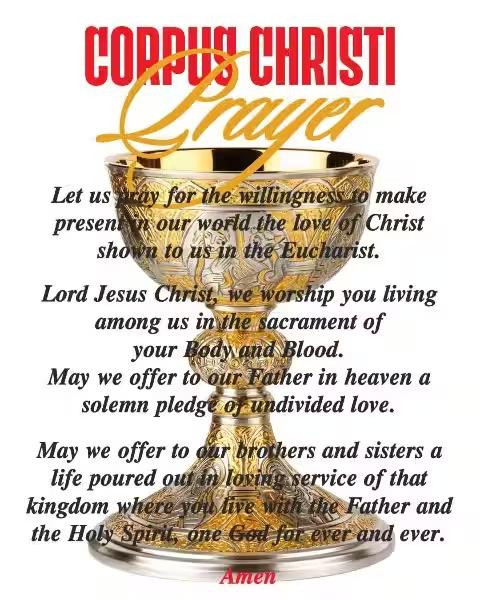
The Catholic Church calendar is rich with feasts and solemnities, each offering a unique lens through which to contemplate the mysteries of faith. Among these, Corpus Christi Sunday stands out as a particularly vibrant and deeply meaningful occasion. Celebrated on the Thursday after Trinity Sunday (or, in many countries, the following Sunday), this feast is dedicated to the real and enduring presence of Jesus Christ in the Eucharist. It’s a day that calls us to pause, reflect, and outwardly profess our belief in the sacred bread and wine, which Catholics believe become the Body and Blood of Christ through the miracle of transubstantiation.
For many, the observance of Corpus Christi Sunday is not just a liturgical event but a powerful personal encounter with the divine. It’s an invitation to re-examine our own faith and to actively participate in a communal expression of adoration. This article aims to explore the significance of this feast, offering insights into its origins, its theological underpinnings, and the ways in which it continues to resonate with believers today, making it a truly relatable and informative experience for anyone seeking a deeper understanding of this central tenet of Catholicism.
The Origins and Significance of Corpus Christi Sunday
The origins of the Feast of Corpus Christi are rooted in the Middle Ages, a period characterized by a profound devotional focus on the Eucharist. The feast was officially established in the 13th century, largely thanks to the visions of a devout Augustinian nun, Saint Juliana of Liège. She experienced mystical visions of the moon with a dark spot, which she interpreted as a sign of the Church’s need for a feast celebrating the Blessed Sacrament. Her persistent advocacy, supported by influential theologians and church leaders, eventually led Pope Urban IV to officially decree the feast in 1264.
The establishment of Corpus Christi Sunday was a significant response to theological debates and a growing desire to publicly honor the Eucharist. At a time when the understanding of transubstantiation was being further clarified, this feast provided a dedicated opportunity for the faithful to express their belief in Christ’s tangible presence. It was also a counter-balance to the more somber Lenten and Easter seasons, offering a joyous affirmation of the ongoing reality of Christ’s sacrifice and love, made present for us in every Mass. This rich history underscores the importance and enduring nature of this celebration.
Theological Pillars: Transubstantiation and Adoration
At the heart of Corpus Christi Sunday lies the profound doctrine of transubstantiation. This is the belief that during the Mass, when the priest pronounces the words of consecration, the bread and wine undergo a substantial change, becoming the actual Body and Blood of Jesus Christ, while their outward appearances (accidents) remain the same. This is not a symbolic representation but a miraculous transformation, a cornerstone of Catholic faith that distinguishes it from other Christian traditions. It means that when we receive Communion, we are truly receiving Jesus himself.
This belief naturally leads to the practice of Eucharistic adoration, a central element of Corpus Christi Sunday observances. Beyond the Mass itself, the consecrated host is often solemnly exposed for public veneration. This act of adoration is a direct response to the belief in Christ’s real presence. It’s an opportunity for individuals and communities to spend quiet time in prayer before the Blessed Sacrament, expressing their love, gratitude, and supplication. Imagine spending time with someone you deeply love and admire; Eucharistic adoration is a similar, albeit infinitely more profound, act of being in the presence of God, offering our undivided attention and devotion.
Observances and Traditions of Corpus Christi Sunday
The celebration of Corpus Christi Sunday is often marked by solemn and beautiful liturgical practices that visually underscore its central message. The most iconic of these is the Solemn Procession of the Blessed Sacrament. In many parishes, a consecrated host, encased in a monstrance (a special vessel), is carried through the streets, accompanied by prayers, hymns, and the faithful. This procession is a public declaration of faith, a visible manifestation of Christ’s reign and presence in the world, bringing his blessing to the community.
Beyond the procession, other devotional practices are common. Many churches will have special Masses with extended periods of Eucharistic adoration throughout the day or even for a full 24 hours (a “Holy Hour” or “Eucharistic Vigil”). The altar is often decorated with flowers, and the church is adorned to reflect the joyous and reverent nature of the feast. For families, Corpus Christi Sunday can be a time to engage children in understanding the Eucharist, perhaps through simple explanations of what the Blessed Sacrament is and why it is so important. These traditions help to make the abstract theological concepts tangible and relatable for the faithful of all ages.
The Meaning for Modern Believers
In our fast-paced and often secular world, Corpus Christi Sunday offers a vital opportunity to reconnect with the transcendent. It challenges us to move beyond a purely intellectual understanding of faith and to embrace the profound mystery of Christ’s presence. The feast reminds us that God is not distant or abstract, but intimately present, offering himself to us in a tangible way through the Eucharist. This is a message of immense hope and comfort, especially in times of personal struggle or societal uncertainty.
The observance of Corpus Christi Sunday invites us to consider our own participation in the life of the Church. Are we truly engaging with the Eucharist? Do we recognize its power to nourish, heal, and transform us? This feast calls us to a renewed commitment to receiving Holy Communion worthily and to fostering a deep reverence and love for the Blessed Sacrament. It encourages us to allow the transformative power of Christ’s presence to permeate our daily lives, making us more Christ-like witnesses in the world. It’s an invitation to live our faith more fully and to share its light with others.
Living the Mystery Beyond Corpus Christi Sunday
While Corpus Christi Sunday is a special day dedicated to this profound belief, the mystery it celebrates is meant to be lived out every day. The Eucharist is not merely a once-a-year observance but the spiritual nourishment that sustains Catholics throughout their lives. Attending Mass regularly, especially on Sundays, is the primary way we encounter the Body and Blood of Christ. This weekly re-affirmation of our faith is crucial for spiritual growth and for building a strong Christian community.
Furthermore, the spirit of Corpus Christi Sunday – adoration, reverence, and a profound appreciation for Christ’s presence – can be cultivated in our daily lives. Even outside of formal adoration services, we can cultivate moments of quiet prayer and reflection, recognizing that Christ is always with us. This means approaching prayer with a sense of awe and wonder, knowing that we are in the presence of the King of Kings. By internalizing the message of Corpus Christi Sunday, we can transform our everyday experiences into opportunities to live in communion with the divine, making our faith a vibrant and active force in our lives.
Frequently Asked Questions about Corpus Christi Sunday
What is Corpus Christi Sunday?
Corpus Christi Sunday is a solemnity celebrated by the Catholic Church and some other Christian denominations. It is a feast day dedicated to the Real Presence of Jesus Christ in the Eucharist – the consecrated bread and wine.
When is Corpus Christi Sunday celebrated?
Corpus Christi Sunday is celebrated on the Thursday following Trinity Sunday, which itself is the Sunday after Pentecost. In many countries, the feast is transferred to the following Sunday for liturgical convenience.
What is the theological significance of Corpus Christi Sunday?
This feast emphasizes the belief that during the Mass, the bread and wine consecrated by a priest become the actual Body and Blood of Jesus Christ through transubstantiation. It is a celebration of this profound mystery of faith.
What are the typical observances or traditions associated with Corpus Christi Sunday?
Common observances include:
A solemn Mass
A Eucharistic procession, where the consecrated Host (Body of Christ) is carried through the streets, often in a monstrance, accompanied by prayers and hymns.
Exposition of the Blessed Sacrament, where the Host is displayed for adoration.
Decorating streets and churches with flowers and banners, often in the form of an altar or canopy for the procession.
Why is a procession so important on Corpus Christi Sunday?
The procession is a public declaration and witness to the belief in Christ’s Real Presence in the Eucharist. It is seen as a way to bring Christ into the community and manifest His presence to all.
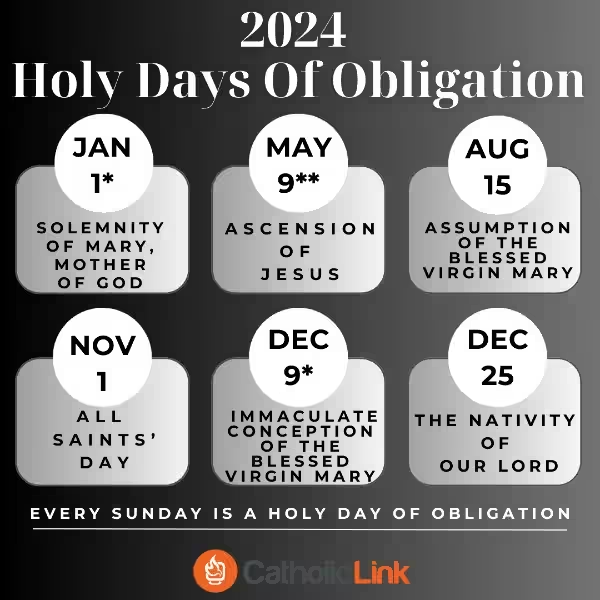
Is Corpus Christi Sunday a holy day of obligation?
In many Catholic dioceses, Corpus Christi Sunday is a holy day of obligation, meaning Catholics are required to attend Mass. However, the observance of this obligation can vary by country and local episcopal conference.
What is the origin of the feast of Corpus Christi?
The feast originated in the Middle Ages, with its establishment largely influenced by the visions of Saint Juliana of Cornillon in the 13th century, who felt a strong calling to promote the veneration of the Eucharist. It was officially instituted by Pope Urban IV in 1264.
What is the Eucharist?
The Eucharist is a central sacrament in Christianity, particularly in Catholic tradition. It is the consecrated bread and wine that believers receive, understood as the Body and Blood of Jesus Christ, in remembrance of His sacrifice.
What is a monstrance?
A monstrance is a sacred vessel, typically made of precious metal, used in the Catholic Church to display the consecrated Eucharistic Host for adoration. It is often ornate and designed to hold the Host in a way that it is visible.