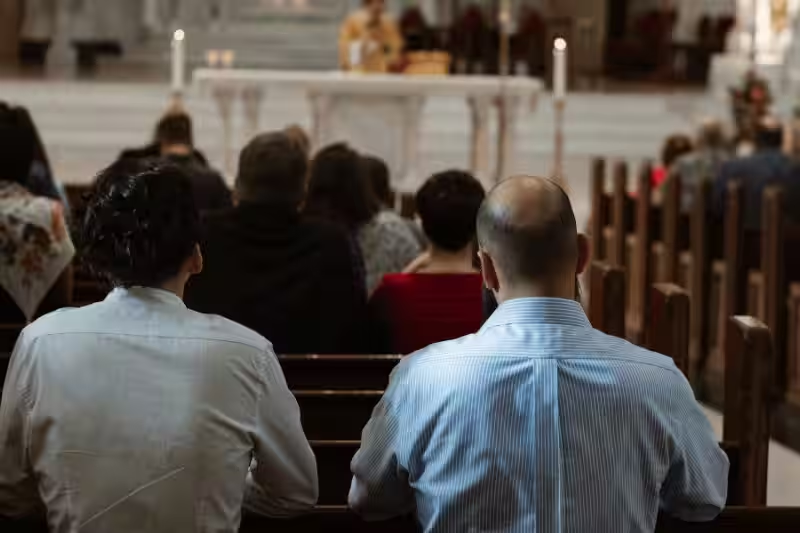
The Christian faith, a tapestry woven with centuries of devotion, intellectual inquiry, and profound experiences, rests upon a bedrock of core beliefs. These beliefs, articulated and refined over time, serve as both a compass for the faithful and a declaration of identity to the world. Two of the most significant and enduring expressions of these fundamental tenets are the Apostles’ Creed and the Nicene Creed. While sharing common ground in their affirmation of God, Jesus Christ, and the Holy Spirit, they also offer distinct nuances that reveal the historical development and theological depth of Christian thought. Understanding these creeds is not merely an academic exercise; it is an invitation to explore the very heart of what it means to be a Christian.
For many, encountering these ancient statements of faith can feel like stepping into a historical dialogue, a conversation between early believers and their understanding of the divine. They are more than just lists of doctrines; they are confessions of trust, prayers in prose, and declarations of allegiance to a God who has revealed Himself in Jesus Christ. Whether you are a lifelong adherent seeking a deeper appreciation, a curious inquirer exploring the foundations of a major world religion, or someone grappling with questions about faith, delving into the Apostles’ Creed and the Nicene Creed offers valuable insights into the enduring power and multifaceted nature of Christian belief.
The Apostles’ Creed: A Timeless Confession of Core Beliefs
The Apostles’ Creed, often recited in worship services and used in baptismal vows, is considered the oldest and most widely recognized summary of Christian doctrine. Its origins are traced back to the early Church, likely evolving from baptismal confessions used in the second century. While not directly authored by the apostles themselves, it is believed to reflect their teachings and the foundational beliefs they established. Its concise nature makes it remarkably accessible, offering a clear and powerful articulation of the essential elements of Christianity.
This creed acts as a spiritual anchor, grounding believers in the fundamental truths of their faith. It begins with a profound affirmation of God the Father, the Almighty Creator of all things, both seen and unseen. This initial statement sets the stage for the subsequent declarations, emphasizing God’s supreme power and sovereignty. From there, the creed moves to a central focus: Jesus Christ. It proclaims His unique nature as the “only Son of God, our Lord,” born of the Virgin Mary, through the power of the Holy Spirit. This declaration underscores the divinity and humanity of Jesus, a cornerstone of Christian theology.
Belief in God the Father, Creator
The opening lines of the Apostles’ Creed establish a non-negotiable foundation: the belief in one God, the Father Almighty. This is not a distant, abstract deity, but a personal and all-powerful being who is the ultimate source and sustainer of all existence. The phrase “Maker of heaven and earth” is a profound declaration of God’s creative power, suggesting that everything we see and experience, from the vastness of the cosmos to the smallest blade of grass, owes its being to Him. This belief instills a sense of awe and wonder, and also a sense of purpose, knowing that creation is not accidental but intentional.
This belief in a sovereign Creator has significant implications for how Christians understand their place in the world. It means that life has inherent value and that humanity, created in God’s image, possesses a unique dignity. It also implies that God is not indifferent to His creation but actively involved in it. This understanding of God as the Almighty Father shapes the way believers approach prayer, seeing God as a loving parent to whom they can turn with their needs and concerns. It fosters a sense of security and trust, knowing that the one who made everything is also the one who watches over and cares for them.
The heart of the Apostles’ Creed beats with the affirmation of Jesus Christ. It boldly states His unique identity as the “only Son of God, our Lord,” setting Him apart from all other figures in history. The creed then moves to one of Christianity’s most astonishing claims: the Incarnation. It declares that Jesus was “conceived by the Holy Spirit, born of the Virgin Mary.” This is not merely a historical event; it is a divine intervention, a testament to God’s profound love for humanity, choosing to enter the world in human form. This miraculous birth emphasizes the divinity of Jesus while simultaneously affirming His genuine humanity.
The creed continues by detailing Jesus’ life, suffering, crucifixion, death, and burial. These events are not presented as tragic accidents but as purposeful acts within God’s redemptive plan. His suffering demonstrates His empathy with human pain, His crucifixion is understood as a sacrifice for the sins of humanity, and His death as a victory over sin and death itself. The mention of His descent into “hell” (or “the realm of the dead”) signifies the completeness of His victory, extending His influence even beyond the grave, before His glorious resurrection and ascension into heaven.
The Holy Spirit and the Church
The Apostles’ Creed concludes with affirmations about the Holy Spirit, the holy catholic Church, the communion of saints, the forgiveness of sins, the resurrection of the body, and life everlasting. The belief in the Holy Spirit acknowledges the active presence of God in the world today, empowering believers, guiding them, and bringing them into relationship with God. This divine Spirit is not a mere force but a person of the Godhead.
The declaration of the “holy catholic Church” speaks of a universal body of believers, united in Christ across time and space. This is not a single denomination but the body of Christ in its entirety, characterized by holiness and universality. The “communion of saints” further emphasizes this interconnectedness, suggesting a fellowship that extends beyond earthly life to include those who have gone before. Finally, the creed culminates in the hope of forgiveness of sins, the resurrection of the body, and life everlasting, providing a powerful assurance of future hope and eternal life with God.
The Nicene Creed: A Deeper Theological Dive
The Nicene Creed, formally known as the Nicene-Constantinopolitan Creed, emerged from a series of pivotal ecumenical councils in the 4th century, most notably the Council of Nicaea in 325 AD and the Council of Constantinople in 381 AD. While the Apostles’ Creed provides a broad overview, the Nicene Creed was formulated as a more detailed and precise theological statement, primarily to address specific heresies and to firmly establish the divinity of Jesus Christ and the personhood of the Holy Spirit. Its richer language reflects a deeper engagement with complex theological questions.
This creed serves as a doctrinal bulwark, a more robust defense against theological deviations that threatened the core understanding of the Christian faith. It was crafted in a historical context where debates about the nature of Christ were intense. The Nicene Creed offers a profound explication of the Trinity, emphasizing the equal divinity and co-eternity of the Father, Son, and Holy Spirit. Its lengthier and more intricate phrasing allows for a more nuanced articulation of these foundational doctrines, ensuring clarity and unity among believers.
Affirming the Divinity of Jesus Christ
The Nicene Creed significantly expands upon the Apostles’ Creed in its declaration of Jesus Christ’s identity and nature. It states, “We believe in one Lord, Jesus Christ, the only-begotten Son of God, begotten of the Father before all ages.” The phrase “begotten of the Father before all ages” is crucial. It asserts that Jesus is not a created being, nor did He come into existence at a particular point in time. Instead, He is eternally begotten of the Father, implying a relationship of intrinsic divinity and co-equality within the Godhead.
The creed continues with an even stronger affirmation: “God from God, Light from Light, true God from true God, begotten, not made, consubstantial with the Father.” This dense theological statement is the heart of the Nicene formulation regarding Christ. It emphasizes that Jesus shares the very essence and being of God the Father. He is not a lesser god or a divine emanation; He is fully God. The term “consubstantial” (or “homoousios” in Greek) was a key word at Nicaea, signifying that the Son is of the same substance as the Father, a crucial point in refuting Arianism, which taught that Jesus was a created being subordinate to the Father.
The Holy Spirit as Divine and Co-Equal
The Nicene Creed also offers a more elaborate and definitive statement regarding the Holy Spirit compared to the Apostles’ Creed. It declares, “And we believe in the Holy Spirit, the Lord, the giver of life, who proceeds from the Father.” This affirms the divinity of the Holy Spirit, referring to Him as “the Lord” and associating Him with the very act of giving life. This indicates that the Spirit is not merely a force but a divine person.
The phrase “who proceeds from the Father” (and in later Western traditions, “and the Son,” often referred to as the Filioque clause) describes the relationship of the Holy Spirit within the Trinity. While the exact wording and theological implications of the Filioque have been a source of historical debate, the core assertion in the Nicene Creed is that the Holy Spirit is divine and originates from God. The creed further elaborates on the Spirit’s role, stating that the Spirit “spoke through the prophets,” highlighting His active participation in God’s revelation throughout history. This detailed affirmation solidifies the co-equality and co-eternity of the Holy Spirit with the Father and the Son, completing the Trinitarian doctrine.
Creeds as Living Declarations
Both the Apostles’ Creed and the Nicene Creed are far more than historical artifacts; they are living declarations of faith that continue to resonate with Christians today. They provide a shared language and a common understanding of fundamental beliefs, fostering a sense of unity and identity within the diverse Christian tradition. Reciting these creeds can be a profound act of worship and reaffirmation, a moment to consciously align oneself with the core tenets of Christianity.
These creeds offer clarity in a complex world, providing solid ground for navigating theological discussions and personal faith journeys. They serve as a reminder that the Christian message is built upon a foundation of divine revelation and historical continuity. Whether one finds solace in the simple elegance of the Apostles’ Creed or the theological depth of the Nicene Creed, both serve as powerful testaments to the enduring power of faith in God, who is Father, Son, and Holy Spirit – the one true God, revealed for our salvation.
Frequently Asked Questions: Apostles’ Creed and Nicene Creed
What is the Apostles’ Creed?
The Apostles’ Creed is a short, early statement of Christian belief, traditionally attributed to the apostles themselves. It summarizes core teachings about God the Father, Jesus Christ, and the Holy Spirit, as well as beliefs about the Church, forgiveness, and the resurrection.
What is the Nicene Creed?
The Nicene Creed is a longer, more detailed statement of Christian faith that was developed and formally adopted at the First Council of Nicaea (325 AD) and later expanded at the First Council of Constantinople (381 AD). It was formulated primarily to address theological disputes, particularly concerning the divinity of Jesus Christ.
What is the primary purpose of these creeds?
The primary purpose of both the Apostles’ Creed and the Nicene Creed is to articulate and preserve the fundamental doctrines of Christianity. They serve as a summary of essential beliefs, used for teaching, worship, and as a test of orthodox faith.
How do the Apostles’ Creed and Nicene Creed differ?
While both creeds share common ground, the Nicene Creed is more extensive and elaborates on specific theological points, especially concerning the relationship between God the Father and Jesus Christ (the Son). The Nicene Creed explicitly states Jesus’ divine nature and his co-equality with the Father, which was a central point of debate at the time of its formation. The Apostles’ Creed is more concise and focuses on the narrative of salvation history.
Are both creeds used by all Christians?
No, not all Christians use both creeds. Historically, the Nicene Creed is more widely used by Eastern Orthodox, Oriental Orthodox, Roman Catholic, and many Protestant denominations (e.g., Lutherans, Anglicans, Methodists). The Apostles’ Creed is often used in Western Christianity, particularly by Roman Catholics, Anglicans, Lutherans, and some other Protestant traditions, often in baptismal contexts. Some traditions may use one, the other, or both.
Why are creeds important in religion?
Creeds are important in religion as they provide a common framework for belief, foster unity among adherents, and help to safeguard against doctrinal error. They act as a concise expression of what a religious community holds to be true about God and the fundamental tenets of their faith.
Can a person be a Christian without reciting these creeds?
Belief in the core truths summarized by these creeds is generally considered essential for Christian identity. However, the specific recitation of the creeds is not the sole determinant of one’s faith. Many individuals may hold the beliefs expressed in the creeds without regularly reciting them, and faith can be expressed in diverse ways. The emphasis is on the underlying belief in Jesus Christ as Lord and Savior.