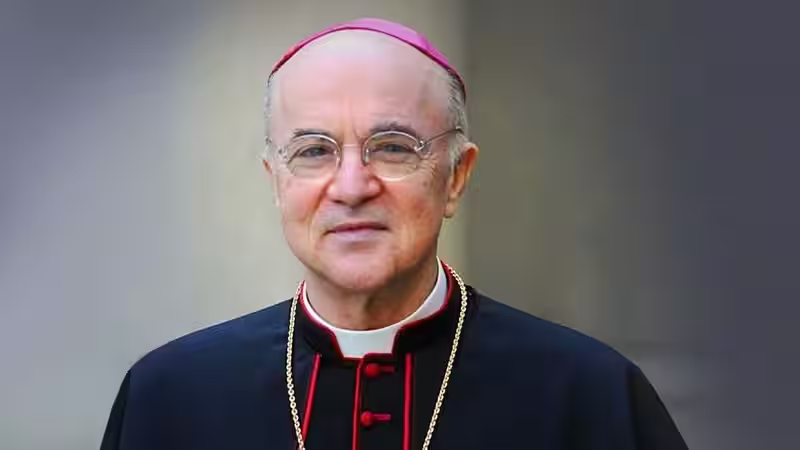
The world of religion is often a tapestry woven with threads of deep faith, rich tradition, and sometimes, significant controversy. Within this intricate weaving, certain figures emerge as focal points, their actions and pronouncements sparking widespread discussion and debate. One such individual who has garnered considerable attention is Archbishop Carlo Maria Viganò. His outspoken nature and his willingness to challenge established norms have made him a prominent, albeit divisive, voice in contemporary religious discourse. Understanding his role requires delving into the complexities of religion, ecclesiastical structures, and the challenges faced by those who feel compelled to speak truth to power, even when it comes at a personal cost.
The very title Archbishop signifies a high office within the hierarchical structure of many Christian denominations, particularly the Catholic Church. It denotes a bishop with authority over an archdiocese, often a significant metropolitan center. These individuals are expected to be shepherds of their flock, guardians of doctrine, and often, significant players in the broader social and political landscape. Archbishop Viganò, by virtue of his position, carries a weight of expectation and influence that few others possess. However, his career has been marked by a departure from the conventional path, steering him towards a more confrontational stance on issues he deems critical to the integrity of the Church and the faithful.
The Archbishop’s Rise and the Shifting Sands of Religion
The journey of Archbishop Viganò, like many in religion, began with a commitment to service and a deep engagement with theological studies. His early career saw him in diplomatic roles within the Holy See, serving in various apostolic nunciatures. These positions are akin to ambassadorships, representing the Vatican in different countries and fostering diplomatic relations. It was during this period that many observed his dedication and his earnest belief in upholding the Church’s teachings. Yet, as he ascended to higher positions, including his appointment as Apostolic Nuncio to the United States, a shift in his public persona began to become more evident.
This evolution is not uncommon in the realm of religion. Individuals, particularly those in positions of leadership, often grapple with the tension between institutional conformity and the call to prophetic witness. For Archbishop Viganò, this tension appears to have intensified, leading him to adopt a more critical and often unsparing perspective on certain developments within the Church hierarchy. His willingness to publicly criticize fellow bishops and even papal actions has set him apart, transforming him into a figure who is both admired by some for his perceived integrity and condemned by others for his disruptive tactics. His narrative offers a glimpse into the internal struggles and external pressures that can shape the trajectory of even the most senior figures in religion.
Archbishop Viganò’s Controversies and the Nature of Religious Authority
The controversies surrounding Archbishop Viganò are multifaceted and have often centered on his accusations of corruption and doctrinal deviation within the Catholic Church. Perhaps his most well-known intervention came with the publication of his testimonies regarding alleged complicity in covering up cases of clerical abuse. These testimonies, disseminated widely, cast a long shadow over prominent figures and ignited a firestorm of debate about accountability and transparency within religious institutions. His willingness to name names and present his accounts as a matter of urgent truth-telling has resonated with many who feel a profound sense of betrayal by their spiritual leaders.
The nature of religious authority is a complex and often debated topic. While hierarchies are established, the ultimate source of authority in many faiths is believed to be divine. When individuals, especially those in positions like an Archbishop, feel that this divine authority is being undermined or corrupted, their sense of duty to speak out can become overpowering. Archbishop Viganò’s interventions, therefore, can be seen by his supporters as a courageous act of defending the purity of the faith, even if it means challenging the very structures he is a part of. His actions force us to consider where ultimate loyalty lies – with the institution or with a perceived higher moral imperative, a dilemma familiar to many in any field of religion.
The Role of the Archbishop in a Changing World
In a world increasingly characterized by rapid social change and evolving moral landscapes, figures like Archbishop Viganò often find themselves at the forefront of cultural clashes within religion. His pronouncements have frequently addressed issues such as the interpretation of Scripture, the role of tradition, and the Church’s engagement with contemporary societal trends. For instance, he has been a vocal critic of what he perceives as a drift away from traditional doctrines, particularly concerning sexual morality and the broader understanding of family and gender. His perspective often appeals to those who feel that religion is being compromised by modern ideologies.
The position of an Archbishop is inherently public, and their words carry significant weight. When these words are critical of the status quo, as Archbishop Viganò’s often are, they can either galvanize a movement or create deep divisions. He has, in essence, become a lightning rod for discontent among certain segments of the faithful who feel that their traditional values are being marginalized. His continued public presence and the impact of his statements demonstrate the enduring power of an individual voice, even when that voice is in opposition to prevailing currents within their own religious community. The challenges he raises are not isolated to his person but reflect broader questions about the future direction and identity of religion in the 21st century.
Frequently Asked Questions about Archbishop Vigano, Religion, and His Statements
Who is Archbishop Vigano?
Archbishop Carlo Maria Viganò is an Italian prelate of the Catholic Church. He served as the Apostolic Nuncio to the United States from 2011 to 2016. He has gained significant public attention for his outspoken and often controversial criticisms of the hierarchy of the Catholic Church, including Pope Francis.
What are Archbishop Vigano’s main religious concerns?
Archbishop Vigano’s primary concerns revolve around what he perceives as a deviation from traditional Catholic doctrine and practice within the Church. He frequently speaks out against what he views as modernism, liberalism, and a perceived embrace of secular ideologies. He often emphasizes the importance of divine law, natural law, and the traditional teachings of the Church on matters of faith and morals.
What is Archbishop Vigano’s stance on Pope Francis?
Archbishop Vigano has been a vocal critic of Pope Francis. He has accused Pope Francis and other members of the Church hierarchy of covering up alleged abuses and of undermining traditional Catholic teachings. He has called for Pope Francis’s resignation on multiple occasions.
What are some of the controversies surrounding Archbishop Vigano?
Archbishop Vigano has been at the center of several controversies. Most notably, he released a lengthy testimony in 2018 alleging that Pope Francis knew about sexual abuse allegations against former Cardinal Theodore McCarrick and failed to act. These allegations have been widely debated and have led to significant scrutiny of the Vatican’s handling of abuse cases. His subsequent public statements and writings have continued to be a source of debate and division within the Church.
What is Archbishop Vigano’s view on the state of the Catholic Church?
Archbishop Vigano believes the Catholic Church is in a profound crisis, which he attributes to a loss of adherence to traditional doctrine and a capitulation to secular influences. He often describes this as a “reign of error” or an infiltration of modernist ideas that he believes are detrimental to the faith. He advocates for a return to what he considers the authentic teachings and practices of the Church.
Where can I find Archbishop Vigano’s statements?
Archbishop Vigano’s statements are typically published on various Catholic news websites and blogs. He has also released public letters and testimonies that can be found through online searches on reputable Catholic media outlets.