Imagine stepping back in time, not with a dusty history book, but with a tangible experience. The sprawling expanse of Rome’s Campo Marzio, or Campus Martius, offers precisely this – an immersion into a landscape where the divine and the earthly have been inextricably intertwined for over two thousand years. Once the training ground for Roman legions, a place of public games and processions, this vibrant district has quietly evolved into a living testament to Rome’s enduring religious spirit. Its ancient stones whisper tales not just of military might, but of profound spiritual devotion, pagan rituals, and the transformative power of faith.
The very name, “Field of Mars,” immediately links the area to ancient Roman religion, specifically to Mars, the god of war. Yet, the Campo Marzio‘s religious significance extends far beyond this martial deity. It was a precinct dedicated to public worship, to grand ceremonies that appeased the gods and ensured the favor of the state. As you wander through its labyrinthine streets today, you’ll find yourself treading on ground that has witnessed centuries of prayer, sacrifice, and the evolution of religious thought, making it an unparalleled site for understanding Rome’s complex spiritual heritage.
The transition of Campo Marzio from a pagan heartland to a Christian bastion is one of the most compelling narratives woven into its fabric. Initially, this vast open space was dotted with temples and altars dedicated to a multitude of gods. Think of it as an ancient religious theme park, with different zones dedicated to different divine powers. The Pantheon, of course, stands as the most prominent and awe-inspiring relic of this era, originally a temple to all gods, now a magnificent church that beautifully encapsulates this layered history. Its architectural genius, a marvel even by today’s standards, speaks volumes about the reverence and skill poured into its creation.
As Christianity gained prominence, many of these pagan structures underwent a profound metamorphosis. Temples were converted into churches, pagan deities were supplanted by Christian saints, and the spiritual pulse of the Campo Marzio shifted. This wasn’t always a violent overthrow; often, it was a gradual assimilation, a reinterpretation of sacred spaces for a new faith. Churches like Santa Maria sopra Minerva, for instance, are built directly atop the ruins of a temple to Minerva, the Roman goddess of wisdom and warfare. This layering of religious history is not just a metaphor; it’s physically present in the foundations and walls of many buildings, offering tangible proof of Rome’s spiritual evolution.
The Pantheon, a true jewel of the Campo Marzio, transcends its architectural brilliance to become a potent symbol of religious continuity. Originally commissioned by Marcus Agrippa and later rebuilt by Emperor Hadrian, its initial purpose was to honor all the gods of ancient Rome. The sheer scale of its dome, with its famous oculus open to the sky, was intended to evoke the vastness of the cosmos and the divine presence. Imagine standing beneath that immense opening, the sunlight streaming in, a direct connection to the heavens – a profoundly spiritual experience regardless of one’s beliefs.
Its transformation into a Christian church in the 7th century, Santa Maria ad Martyres, marked a pivotal moment in the religious history of the Campo Marzio. This conversion ensured its preservation, allowing us to marvel at it today. The juxtaposition of ancient Roman engineering and Christian iconography within its walls creates a unique spiritual atmosphere. It’s a place where one can contemplate the enduring human need for connection to something greater, whether through pagan worship of the celestial sphere or through the Christian veneration of saints and martyrs. The Pantheon is more than just a building; it’s a bridge between eras and faiths, a testament to the power of sacred spaces to adapt and endure.
Churches of the Campo Marzio: Living Faith
Beyond the iconic Pantheon, the Campo Marzio is a treasure trove of churches, each with its own unique history and religious significance. These churches are not mere historical relics; they are vibrant centers of faith, actively serving the Roman community. Wandering along streets like Via del Corso or Via di Ripetta, you’ll stumble upon hidden gems – small, unassuming churches that hold centuries of devotion within their walls. These are places where locals still gather for Mass, where lives are celebrated and mourned, and where the spiritual heartbeat of Rome continues to pulse.
Consider churches like San Luigi dei Francesi, famous for its stunning Caravaggio paintings that add a profound visual dimension to religious contemplation, or Sant’Agostino, home to Raphael’s fresco of the Prophet Isaiah. These artistic masterpieces are not just decorative elements; they are integral to the spiritual experience, designed to inspire awe and deepen understanding of religious narratives. Visiting these churches offers a chance to appreciate the fusion of art, architecture, and faith that has defined the Campo Marzio for so long, providing a relatable entry point into the profound spiritual journey of the area.
A Tapestry of Devotion: Notable Churches and Their Stories
The sheer density of religious sites within the Campo Marzio is astonishing. Take, for example, Santa Maria in Via Lata, a church with a history rooted in the very early days of Christianity, rumored to be built on the site where St. Paul stayed during his Roman imprisonment. Its ancient crypts whisper tales of early Christian communities and their clandestine gatherings, a stark contrast to the public grandeur of the nearby Piazza Colonna. Another gem is San Marcello al Corso, a church that has been rebuilt multiple times due to fires, yet its spiritual essence has persevered, boasting impressive Baroque frescoes and a palpable sense of history.
These churches often house relics, artistic expressions of faith, and architectural styles that span vast periods. You might find a medieval mosaic next to a Renaissance altarpiece, or a Baroque facade concealing an ancient Roman foundation. The experience of exploring these varied sacred spaces in the Campo Marzio is akin to piecing together a magnificent, intricate puzzle of religious history. It’s not just about seeing old buildings; it’s about feeling the echoes of countless prayers, witnessing the evolution of artistic and architectural expressions of faith, and understanding how these sacred sites have served as pillars of community and spiritual solace through the ages.
The Enduring Spiritual Aura of Campo Marzio
The Campo Marzio‘s religious significance isn’t confined to its magnificent structures or its ancient past. There is an intangible, yet palpable, spiritual aura that permeates the district. It’s in the hushed reverence of the churches, the ancient stones that have absorbed centuries of devotion, and the very flow of life that continues to unfold within its historic boundaries. This is a place where the sacred feels remarkably present, interwoven with the everyday rhythm of the city.
For the modern visitor, understanding the Campo Marzio through its religious lens offers a profoundly enriching experience. It allows you to see beyond the tourist crowds and the bustling piazzas, to connect with a deeper historical and spiritual narrative. It’s a journey not just through physical space, but through time and faith, offering a unique perspective on how human beings have sought meaning, solace, and connection to the divine across millennia, right here in the heart of Rome.
Frequently Asked Questions: Religion in Campo Marzio, Rome
What is the dominant religion in Campo Marzio?
The dominant religion in Campo Marzio, as in much of Rome and Italy, is Christianity, specifically Roman Catholicism.
Are there any significant religious sites in Campo Marzio?
Yes, Campo Marzio is home to several important religious sites, including churches and historical religious buildings. Many of these are within or very close to the boundaries of the ancient Campus Martius.
Can I visit churches in Campo Marzio?
Absolutely. Churches in Campo Marzio are generally open to visitors during specific hours, often for prayer and to admire their art and architecture. It’s advisable to check individual church opening times beforehand.
What denominations are represented in Campo Marzio, besides Catholic?
While Catholicism is dominant, due to Rome’s international nature, you may find other Christian denominations represented with places of worship or community centers in or near the Campo Marzio area.
Are there any non-Christian places of worship in Campo Marzio?
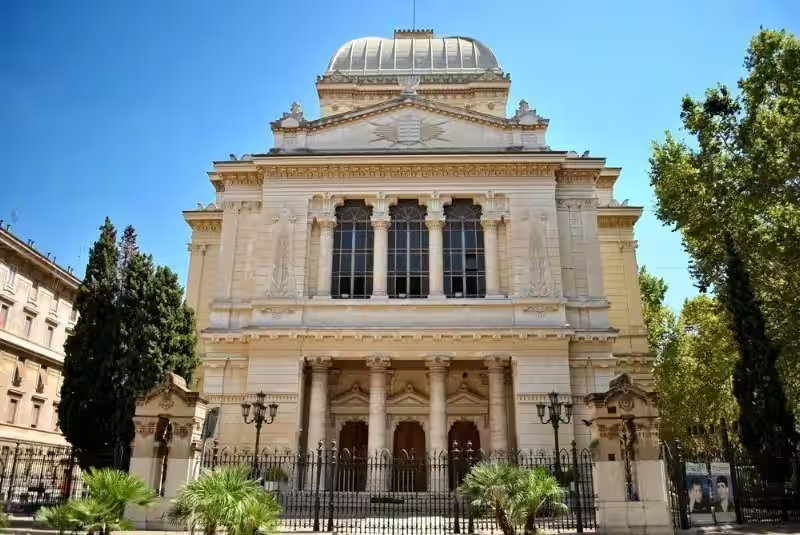
Historically and in the modern era, Rome has been a diverse city. While Catholic churches are most prevalent, depending on the specific area within Campo Marzio, there might be synagogues or other non-Christian places of worship nearby. However, the primary religious landscape is Catholic.