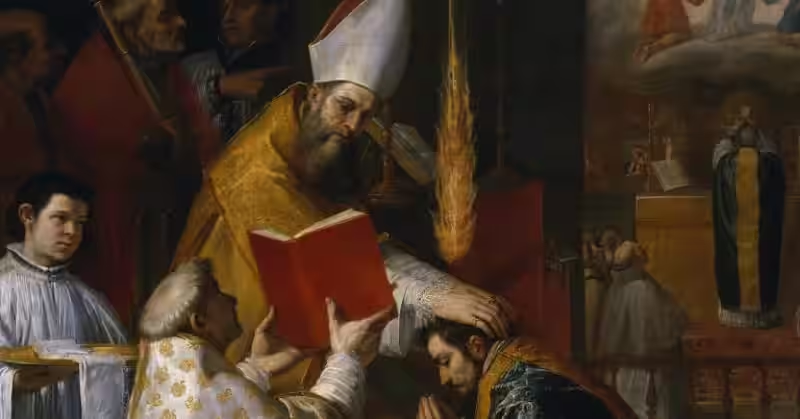
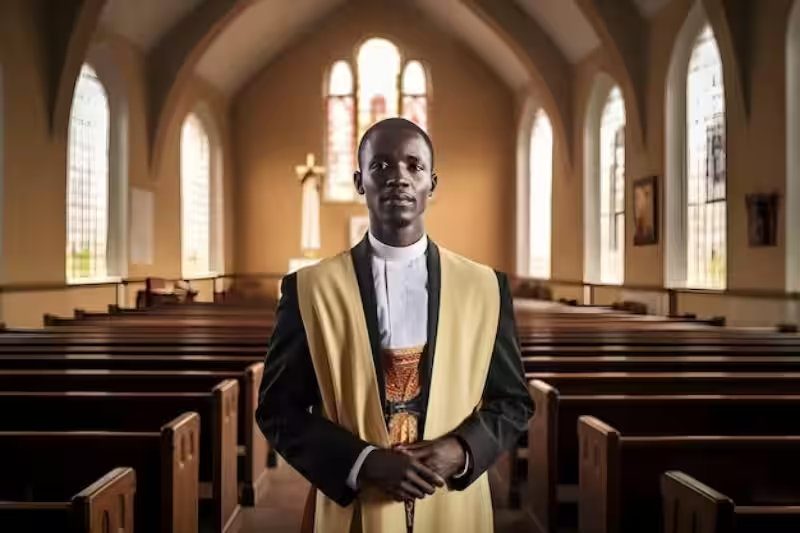
The image of the Roman Catholic priest, often depicted in his distinctive cassock, is intrinsically linked to a profound commitment: celibacy. For many outside the faith, and even for some within, the question “Why are Roman Catholic priests celibate?” lingers, sparking curiosity and a desire for understanding. This isn’t a question of arbitrary rule, but one deeply woven into the fabric of Catholic tradition, theology, and pastoral practice. It’s a choice that, while demanding, is seen as a powerful expression of dedication to God and service to His people.
Understanding priestly celibacy requires a journey back through centuries of church history and a contemplation of its theological underpinnings. It’s a practice that has evolved, been debated, and ultimately affirmed as a vital aspect of the Catholic priesthood. This article will delve into the multifaceted reasons behind this sacred vow, exploring its historical context, theological significance, practical implications, and the ongoing relevance it holds in the modern world. We will uncover how this seemingly simple abstinence from marriage serves a complex and deeply spiritual purpose.
Historical Roots: A Gradual Development, Not an Overnight Decree
The practice of clerical celibacy within the Roman Catholic Church wasn’t a sudden pronouncement but rather a gradual development that spanned several centuries. Initially, the early Christian communities did not impose mandatory celibacy on their clergy. Many early bishops and priests were married men, and their families were an accepted part of their lives, much like in other professions. However, as the Church grew in influence and its ministers became more involved in diverse societal roles, a sense of dedicated service began to emerge.
The desire for clergy to be wholly devoted to their spiritual duties, free from the temporal responsibilities of family life, started to gain traction. Early Church councils began to address the issue, often with the aim of preventing the inheritance of church property by clerical families and ensuring a more focused ministry. For instance, the Council of Elvira in the early 4th century suggested that bishops and other ministers should abstain from conjugal relations, though it wasn’t universally enforced. This period saw a growing emphasis on contemplative living and a detachment from worldly concerns, which naturally extended to the marital state.
Early Influences and the Concept of Purity
A significant influence on the increasing embrace of celibacy was the prevailing cultural and philosophical ideas about purity and spiritual dedication. Influenced partly by certain strands of Gnosticism and Neoplatonism, there was a growing appreciation for asceticism, the practice of rigorous self-discipline and abstinence from indulgence, including sexual relations. Within this context, celibacy was seen as a way to achieve a higher spiritual state, purifying oneself to be a more effective vessel for God’s work.
This concept of purity wasn’t about inherent sinfulness in marriage, but rather about a prioritization of spiritual focus. Just as an athlete might abstain from certain foods or activities to achieve peak performance, priests were encouraged to abstain from marital intimacy to dedicate their entire being – body, mind, and soul – to God and the Church. This ideal of a priest being “married” to the Church, as a spiritual father to all, began to take root and gain momentum.
Theological Significance: A Sign of the Kingdom and Total Dedication
At its core, the theological justification for priestly celibacy in the Roman Catholic Church centers on the concept of eschatological sign. Jesus himself spoke about a future state in heaven where “they neither marry nor are given in marriage” (Matthew 22:30). By choosing celibacy, priests are seen as living a foretaste of this heavenly reality, pointing towards the ultimate union of Christ with His Church, which is a spiritual, not a biological, union.
Furthermore, celibacy is understood as a profound act of total dedication and disponibilité. A married man has primary obligations to his spouse and children. While this is a beautiful and holy calling, the commitment of a priest is to serve the entire People of God. Celibacy allows him to be fully available, without the competing claims of a family, to minister to parishioners, respond to pastoral needs, and dedicate his time and energy to prayer, study, and service. This allows for a unique spiritual fatherhood, where the priest nurtures the spiritual lives of all entrusted to his care.
Emulating Christ and the Apostles
A key theological argument for celibacy draws directly from the example of Jesus Christ. Jesus himself was unmarried, and while this doesn’t mandate celibacy for all his followers, it provides a powerful model of a life lived entirely for the Kingdom of God. His focus was on his mission, his teaching, and his relationship with the Father. This Christological model is seen as the ultimate ideal for those called to represent Him in a special way as priests.
Additionally, the Apostles, particularly St. Paul, are often cited. While the exact marital status of all the Apostles is debated, Paul himself famously advocated for celibacy in 1 Corinthians 7, stating that an unmarried man is concerned about the things of the Lord, how to please the Lord. He also speaks of the “unmarried man” and “unmarried woman” being able to devote themselves to the Lord completely. This early apostolic teaching laid a significant groundwork for the Church’s understanding of how to best achieve undivided devotion to God.
Practical Implications: Ministry, Focus, and Sacrificial Love
Beyond the theological and historical, the practice of celibacy has tangible practical implications for the ministry of a Catholic priest. By freely choosing not to marry, priests are able to dedicate their lives with undivided attention to the spiritual needs of their congregations. This means being available for confessions at all hours, visiting the sick, offering counsel, preparing people for sacraments, and leading the community in prayer and worship, often without the personal demands of raising a family.
This concept of availability can be likened to a doctor or a firefighter who, when on duty, is expected to be fully present and responsive to emergencies, sometimes at the expense of personal plans. A priest, in a spiritual sense, is always “on call” for his flock. This sacrificial love that celibacy represents is seen as a powerful witness to the Gospel, demonstrating a willingness to put the needs of others before personal desires, mirroring Christ’s own self-giving love.
The celibate priest often becomes a figure of spiritual fatherhood within the parish community. He guides, teaches, and supports his parishioners, much like a father would his children, but on a spiritual plane. This role is amplified by his celibacy, as it allows him to be a father figure to everyone, regardless of their background or circumstances, without the inherent limitations or biases that might arise from his own family dynamics. He is, in essence, married to the Church and father to all its members.
This model of service through celibacy is not about denying human nature but about redeeming and redirecting its energies towards a higher purpose. It’s a conscious choice to channel the natural human desire for companionship and family into a broader, more universal love for God and humanity. This redirection allows for a profound focus on pastoral care, evangelization, and the administration of the sacraments, making the priest a dedicated servant to the spiritual well-being of his community.
Addressing Common Questions and Misconceptions
It’s important to acknowledge that the practice of priestly celibacy can sometimes lead to misunderstandings and misconceptions. One common question is whether priests are forbidden from having relationships or experiencing human affections. The answer is no. Priests are human beings who experience the full range of human emotions and relationships, but they channel these affections in a way that is consistent with their vows.
Another misconception is that celibacy is a punishment or a burden. For those who embrace it willingly and with conviction, it is seen as a gift and a calling, a path to a deeper spiritual life and a more profound union with God. While it undoubtedly involves sacrifice, it is a sacrifice undertaken with the understanding that it leads to greater spiritual fruitfulness and a more dedicated ministry. The Catholic Church also recognizes that there are exceptions, such as married men who convert from other Christian denominations and are ordained Catholic priests, demonstrating a pastoral flexibility within the overarching discipline.
The Choice and the Call: A Life of Purpose
Ultimately, the decision to become a Catholic priest is a conscious and discerning choice, a response to a divine calling. Celibacy is an integral part of that calling for the Latin Rite of the Catholic Church. It’s not a rule imposed on unwilling individuals, but a chosen path understood as essential for a particular type of ministry. This choice is made after extensive discernment, formation, and prayer, ensuring that the candidate understands the magnitude and implications of his commitment.
This commitment is not to a life of loneliness, but to a life of profound spiritual intimacy and universal love. The celibate priest finds his deepest fulfillment in his relationship with God and in his service to the Church. The question “Why are Roman Catholic priests celibate?” leads us to a rich understanding of a tradition that emphasizes total dedication, emulates Christ’s example, and offers a unique model of spiritual fatherhood, all for the greater glory of God and the service of His people.
Frequently Asked Questions: Roman Catholic Priesthood and Celibacy
Why are Roman Catholic priests celibate?
The practice of celibacy for Roman Catholic priests is rooted in a combination of theological, historical, and practical reasons. Theologically, it is seen as a way for priests to dedicate themselves fully to God and the service of the Church, mirroring the example of Jesus Christ and the apostles who, in many interpretations, remained unmarried. This undivided devotion allows them to focus entirely on their spiritual duties and the needs of their flock without the responsibilities and commitments of marriage and family life. Historically, the practice gained prominence over centuries, becoming a formalized discipline in the Western Church, particularly solidified by the Second Lateran Council in 1139 which mandated clerical celibacy. Practically, it is believed to foster a greater sense of community among clergy and to encourage a more ascetic lifestyle that can be seen as beneficial for spiritual growth.
Is celibacy a requirement in all Christian denominations?
No, celibacy is not a requirement in all Christian denominations. While the Roman Catholic Church (in its Latin Rite) and some Eastern Catholic Churches require celibacy for their priests, many other Christian denominations, including most Protestant churches and Orthodox churches, permit or even encourage their clergy to marry. In these traditions, marriage is often viewed as a blessing and a natural part of a clergyman’s life, and married clergy are common.
Has the rule of celibacy for Roman Catholic priests always existed?
No, the rule of mandatory celibacy for Roman Catholic priests has not always existed. In the early Church, married men could be ordained as priests, and many early popes and bishops were married. Over time, however, the practice of clerical celibacy gradually developed. While there were earlier pronouncements and councils addressing the issue, it was not until the Second Lateran Council in 1139 that celibacy became a universally enforced discipline for priests in the Western Church. Even today, some Eastern Catholic Churches in communion with Rome permit married priests.
Can a married man become a Roman Catholic priest?
Generally, in the Latin Rite of the Roman Catholic Church, men who are already married cannot be ordained as priests. However, there are exceptions. For instance, in some cases, married clergy from other Christian denominations who convert to Catholicism may be permitted to be ordained as Roman Catholic priests, especially if they are already ordained ministers in their former tradition. Additionally, in some Eastern Catholic Churches that are in communion with the Pope, married men are permitted to be ordained as priests, provided they are not already bishops.
What is the theological basis for priestly celibacy?
The theological basis for priestly celibacy is often linked to the concept of “consecration” and imitation of Christ. Priests are ordained to serve as alter Christus (another Christ) and to act in persona Christi Capitis (in the person of Christ the Head). Since Jesus himself was unmarried and dedicated his life entirely to his mission, it is believed that priests, by embracing celibacy, can more fully dedicate themselves to God and the Church, mirroring Christ’s sacrifice and undivided love. It is also seen as a way to embrace a spousal relationship with the Church itself, as the Church is often referred to as the Bride of Christ.