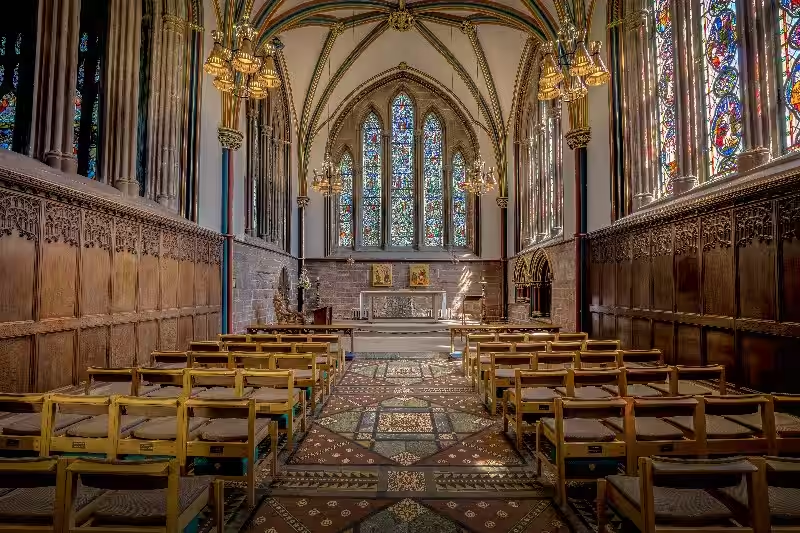
Imagine standing beneath a vast, domed ceiling, the air thick with the scent of aged incense and the echoes of countless prayers. This is the essence of a rotonda in its most profound sense, not just an architectural marvel, but a vessel of spiritual communion that has captivated humanity for millennia. The very word “rotonda” conjures images of circularity, completeness, and a space designed to draw the eye upward, often towards a divine light. This circular form, so prevalent in religious architecture, speaks to a deep-seated human need for unity, for a central point of focus that can symbolize the divine, the eternal, and the interconnectedness of all things. Whether it’s a grand cathedral or a humble shrine, the rotonda has consistently provided a stage for humanity’s most profound questions and its most fervent expressions of faith.
The influence of the rotonda on religious practice is undeniable. Its inherent design encourages a sense of shared experience, pulling individuals together into a collective embrace of belief. Unlike linear spaces that guide worshippers in a specific direction, the rotonda allows for a more holistic perception of the sacred. As you move within its embrace, the entire space seems to envelop you, fostering a feeling of being held by the divine. This architectural choice is not accidental; it’s a deliberate manifestation of theological principles, a physical representation of abstract spiritual concepts that have resonated across diverse cultures and epochs. The rotonda, in essence, is a testament to the enduring human quest for meaning and connection through religion.
From Pagan Pantheon to Christian Sanctum: The Evolution of the Sacred Rotonda
The concept of the circular sacred space predates Christianity, finding roots in ancient pagan traditions. Many early temples and burial sites utilized circular or semi-circular designs, often aligning with celestial events or embodying a reverence for the cyclical nature of life and death. Think of the Neolithic henges with their monumental stone circles, believed to be places of ritual and astronomical observation. These ancient structures, though their exact religious purposes are debated, demonstrate an early understanding of the power of circularity in connecting with the cosmos and the divine. The rotonda, in this context, was an early attempt to build a bridge between the earthly and the celestial, a physical manifestation of a yearning for something larger than oneself.
It was with the rise of Christianity that the rotonda solidified its place as a dominant form in religious architecture, particularly for baptisteries and churches. The Pantheon in Rome, with its awe-inspiring dome and oculus, served as a powerful precedent. While originally a temple to all gods, its architectural grandeur and the dramatic play of light through its central opening profoundly influenced subsequent Christian builders. The early Christians, seeking to establish their own sacred spaces, adopted and adapted this circular form. A classic example is the Baptistery of Florence, a magnificent rotonda dedicated to St. John the Baptist. Its circularity symbolized the divine perfection and eternity, mirroring the endless nature of God. The act of baptism itself, a spiritual rebirth, was perfectly encapsulated within this encompassing, sacred geometry.
Symbolism and Spirituality: What the Circular Form Evokes
The circular form of the rotonda is rich with symbolic meaning that directly informs its religious function. At its most fundamental level, a circle has no beginning and no end, a powerful metaphor for the eternal nature of God and the concept of unending salvation. This lack of directional imposition allows worshippers to engage with the sacred from any vantage point, fostering a sense of inclusivity and personal connection. The central dome, often crowned with a lantern or oculus, acts as a celestial eye, drawing attention upwards to what is perceived as the heavens or divine presence. This upward gaze is a universal gesture of supplication, adoration, and a yearning for enlightenment. The rotonda, therefore, becomes a microcosm of the universe, with the worshipper at its center, connected to everything.
Consider the experience of standing in the center of a grand rotonda. The acoustics are often designed to amplify sound, creating a resonant space where chants and prayers seem to hang in the air, fostering a profound sense of communal spirituality. The curved walls can also create a feeling of intimacy and reflection, even in a large gathering. This architectural choice encourages contemplation and introspection, allowing individuals to personalize their spiritual journey within a shared sacred environment. The rotonda doesn’t dictate a single path; it offers an open invitation for each soul to find its own connection to the divine, a truly liberating aspect of its religious design. The use of light, often strategically directed through the oculus or windows, further enhances the spiritual atmosphere, illuminating frescoes or altars, and guiding the worshipper’s focus with divine radiance.
The Rotonda in Practice: Ritual, Community, and Personal Faith
The rotonda has historically been more than just a passive structure; it has been a vibrant hub of religious activity. Its circular design is perfectly suited for certain liturgical practices. In many Christian traditions, for instance, the baptistery, often a rotonda, is where the sacrament of baptism takes place, symbolizing a new beginning within the community of believers. The pastor or priest stands at the center, surrounded by the congregation, signifying the transformative power of faith and the welcoming embrace of the church. The very act of circling, common in some rituals, is amplified and made more meaningful within the contained space of a rotonda, representing the journey of faith and its cyclical nature.
Beyond specific sacraments, the rotonda fosters a palpable sense of community and shared purpose. As individuals gather within its circular walls, their individual prayers and aspirations merge into a collective offering. This shared space encourages mutual support and solidarity among believers. Think of the feeling of unity at a major religious festival held within a domed church, where the sound of thousands of voices singing in unison reverberates through the vastness of the rotonda, creating an overwhelming sense of belonging and shared devotion. The rotonda, therefore, is not merely a place of worship; it is a stage for the living expression of faith, a physical anchor for collective spiritual experience and individual spiritual growth.
Modern Interpretations and Enduring Resonance
While the classical rotonda is deeply rooted in historical religious architecture, its principles continue to inspire contemporary sacred spaces. Architects and designers are still drawn to the symbolism of circularity and the power of the dome to create awe-inspiring and spiritually resonant environments. Modern religious buildings, even those that deviate from strict historical styles, often incorporate elements that echo the rotonda, such as central gathering spaces, soaring domes, or strategically placed skylights that mimic the effect of an oculus. These contemporary interpretations demonstrate the enduring appeal of the rotonda’s ability to evoke a sense of the sacred, the infinite, and the profound connection between humanity and the divine.
The enduring resonance of the rotonda lies in its ability to transcend specific religious doctrines and speak to a universal human experience. Whether it’s the hushed reverence of a thousand-year-old cathedral rotonda or the innovative design of a modern place of worship that draws inspiration from its form, the underlying principle remains the same: to create a space that lifts the spirit, fosters contemplation, and facilitates a deeper connection with something greater than ourselves. The rotonda, in its elegant simplicity and profound symbolism, continues to be a powerful architectural testament to our eternal search for meaning and our innate spiritual longing.
Frequently Asked Questions about the Rotunda
What is the Rotunda?
The Rotunda is a circular building, often with a dome, that is a significant architectural element found in various historical and religious contexts. It is characterized by its round shape and typically a domed roof.
What is the religious significance of the Rotunda?
Rotundas have held religious significance throughout history. Many early churches, mausoleums, and religious sites were built in a rotunda form. This design was often chosen to symbolize concepts like eternity, the cosmos, or the divine due to its continuous, enclosed, and often celestial-seeming dome. Examples include the Pantheon (originally a Roman temple, later a church) and certain baptisteries.
Are there specific religions that commonly feature Rotundas?
Historically, Roman Catholicism and Orthodox Christianity have featured rotunda architecture in significant churches and religious buildings. In ancient times, pagan temples also utilized this design. The symbolic meaning of the rotunda lent itself well to expressing spiritual concepts across different faiths.