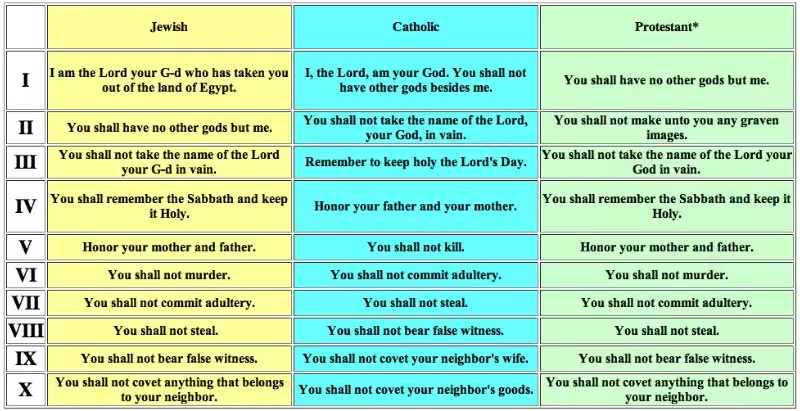
In the tapestry of religious observance, the Ten Commandments stand as foundational threads, woven into the moral and spiritual fabric of countless lives. Among these divine pronouncements, the second commandment, often overshadowed by its more widely recognized brethren, carries a profound and often underappreciated weight. This commandment, which bids us to refrain from making idols and bowing down to them, is far more than a historical prohibition; it’s a persistent whisper in the ear of faith, urging us to examine the true object of our devotion in an ever-evolving world. Understanding its nuances can unlock a deeper, more authentic relationship with the divine and with ourselves.
The allure of the tangible, the pleasing to the eye, and the comforting to the ego can easily lead us astray. In ancient times, this might have meant graven images of gods or powerful rulers. Today, however, the manifestations of this commandment’s relevance are far more subtle, yet no less potent. We are constantly bombarded with opportunities to elevate the temporal over the eternal, the material over the spiritual, and the fleeting over the enduring. This article will delve into the enduring significance of the second commandment, exploring how its principles resonate with contemporary religious practice and offer a path towards genuine spiritual fulfillment.
The concept of an “idol” might conjure images of ancient stone statues or golden calves. However, the second commandment’s prohibition extends far beyond such literal interpretations. In our contemporary society, the idols we are most susceptible to are often intangible yet incredibly powerful. These can include wealth, status, power, and even technological advancements that promise ultimate solutions and instant gratification. When we begin to prioritize these earthly pursuits above our spiritual connection, when our thoughts and actions are consumed by the acquisition of more possessions or the relentless pursuit of recognition, we are, in effect, bowing down to these modern-day idols.
Consider the individual who dedicates every waking hour to amassing a fortune, sacrificing family time, ethical considerations, and personal well-being in the relentless pursuit of financial success. While ambition can be a virtue, when wealth becomes the sole determinant of worth and the ultimate goal of existence, it has effectively usurped the place of the divine. Similarly, the relentless pursuit of social media validation, where likes and followers become the measure of our value, can be seen as a form of idolatry, replacing genuine self-worth and connection with a superficial and fleeting affirmation. The second commandment serves as a powerful reminder to critically assess what we are truly worshipping in our hearts and minds.
Perhaps the most insidious form of idolatry in the modern era is self-worship. With the rise of individualism and a culture that often champions self-expression and self-actualization, it is easy for the “self” to become the ultimate object of veneration. This doesn’t necessarily manifest as overt narcissism, but rather as an unwavering belief in one’s own infallible judgment, a refusal to acknowledge personal flaws, or an insatiable need for constant affirmation of one’s own brilliance. When our own desires and opinions become paramount, eclipsing any higher calling or the needs of others, we risk creating an altar to ourselves.
The danger here lies in the subtle erosion of humility, a cornerstone of many religious traditions. When we believe we have all the answers and are incapable of error, we shut ourselves off from the possibility of divine guidance and personal growth. This self-imposed isolation can lead to a spiritual stagnation, where our faith becomes a mere reflection of our own limited perspectives rather than an open dialogue with the infinite. The second commandment, by demanding devotion to a power greater than ourselves, implicitly calls for a disciplined humility and a recognition of our place within a larger cosmic order.
Reclaiming True Devotion: Authenticity in Faith
The core message of the second commandment is not about rejecting the beauty and utility of the created world, but about rightly ordering our affections. It’s about ensuring that our ultimate loyalty and allegiance are reserved for the divine, and that all other things are appreciated within that framework. This requires a conscious and continuous effort to disentangle our spiritual lives from the entanglements of material desires and ego-driven pursuits.
For a person of faith, this means actively cultivating practices that reinforce their commitment to the divine. This could involve:
Regular prayer and meditation to foster a deeper connection.
Studying sacred texts to learn from divine wisdom.
Engaging in acts of service and compassion to reflect divine love.
Practicing mindfulness to be aware of where our attention and devotion are directed.
These actions help to reorient our hearts away from fleeting idols and towards the enduring source of spiritual truth and strength.
Navigating the Noise: Practical Applications of the Second Commandment
In our hyper-connected world, the constant barrage of information, entertainment, and social pressures can easily distract us from our spiritual path. The second commandment offers a crucial lens through which to filter this noise. It prompts us to ask ourselves: Is this activity, this pursuit, this desire, drawing me closer to the divine, or is it pulling me away? Is it building up my spiritual life, or is it feeding my ego and my material cravings?
For example, consider the time spent consuming endless streams of content online. While some consumption can be educational or entertaining, when it becomes an all-consuming habit that displaces time for reflection, worship, or meaningful connection, it can be seen as a form of idolatry of distraction. The second commandment encourages us to be intentional about our time and energy, ensuring that we are not passively allowing ourselves to be swept away by the currents of modern life, but are actively choosing to dedicate ourselves to what truly matters. It’s about making a conscious choice to prioritize the sacred in the midst of the secular.
The Unseen Power of Spiritual Integrity
Ultimately, the second commandment is a call to spiritual integrity. It’s about aligning our outward actions with our inner beliefs, ensuring that our devotion is genuine and undivided. When we strive to live by this principle, we cultivate a sense of inner peace and purpose that is not dependent on external validation or material possessions. This integrity allows for a truer, more authentic experience of faith.
The enduring relevance of the second commandment lies in its timeless wisdom. It reminds us that while the forms of our challenges may change, the fundamental human struggle to remain devoted to the divine, to resist the allure of lesser gods, remains constant. By understanding and applying its principles, we can navigate the complexities of our modern lives with clarity and conviction, ensuring that our worship is directed towards that which is truly worthy, and that our lives are a testament to our deepest spiritual commitments.
Frequently Asked Questions about the Second Commandment
What is the Second Commandment?
The Second Commandment is a religious prohibition against the creation and worship of idols or images. It is found in the Ten Commandments, a set of biblical principles given to Moses by God.
Which religions observe the Second Commandment?
The Second Commandment is primarily observed in Judaism and Christianity, particularly within denominations that adhere to a strict interpretation of the Old Testament.
What is considered an “idol” or “image” under the Second Commandment?
In its strictest interpretation, an idol is any physical representation of a deity or anything worshipped as a god. This can extend to statues, carvings, paintings, or any object that is venerated or prayed to instead of, or alongside, God.
Does the Second Commandment prohibit all forms of religious art?
Interpretations vary significantly. Some traditions strictly prohibit any visual representations of God or holy figures. Others allow for artistic depictions for educational or inspirational purposes, as long as they are not worshipped. This is a point of historical and theological debate.
How do different Christian denominations interpret the Second Commandment today?
Protestant denominations (especially those with Reformed or Puritan roots): Tend to be more strict, often avoiding images in worship spaces and discouraging the veneration of icons.
Catholic and Orthodox traditions: Generally permit and utilize religious imagery, such as statues and icons, viewing them as aids to devotion and reminders of sacred persons and events, but not as objects of worship themselves.
Why is the Second Commandment important in these religions?
It emphasizes the transcendence and uniqueness of God, asserting that no created thing can adequately represent the divine. It aims to prevent idolatry, where worship is directed towards something other than the one true God.
Are there any modern-day applications of the Second Commandment?
Beyond religious imagery, some interpret the spirit of the Second Commandment as a caution against placing excessive value or devotion on material possessions, secular achievements, or any other worldly thing that could become a substitute for spiritual focus or worship.