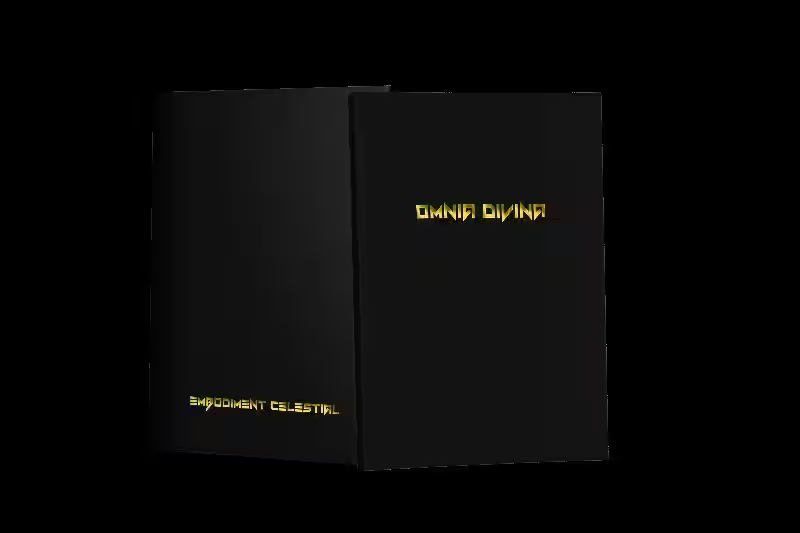
Throughout history, humanity has grappled with the profound questions of existence, purpose, and the nature of reality. In this ongoing quest, the concept of omnia divina—meaning “all things divine”—emerges as a unifying thread, weaving through the rich tapestry of religious thought and practice across cultures and eras. It speaks to the universal human inclination to seek meaning beyond the tangible, to acknowledge a power or presence that transcends our everyday experiences. Whether it’s the awe inspired by a starlit sky, the intricate beauty of a flower, or the deep bonds of human connection, we often perceive glimpses of the divine, the omnia divina, in the world around us.
This inherent desire to connect with something greater than ourselves forms the bedrock of all religions. From the earliest animistic beliefs to the complex theological systems of today, the impulse to understand and interact with the divine has shaped societies, inspired art, and guided moral frameworks. The exploration of omnia divina isn’t just an academic pursuit; it’s an invitation to examine the very essence of what it means to be human and to seek solace, guidance, and a sense of belonging in a vast and often mysterious universe. Religion, in its myriad forms, is our collective response to this profound yearning.
The Multifaceted Nature of the Divine: Beyond a Single Image
When we speak of omnia divina, it’s crucial to understand that the divine is rarely depicted as a singular, static entity. Instead, religions offer a spectrum of divine manifestations, each reflecting the cultural context and spiritual needs of its adherents. This can range from the abstract, all-encompassing monotheistic God who is the creator and sustainer of all, to the polytheistic pantheons where various deities embody different aspects of life – love, war, wisdom, nature. Even in non-theistic traditions, the concept of the divine can be understood as an ultimate reality, a fundamental principle, or a state of enlightenment that transcends ordinary consciousness. The beauty of omnia divina lies in its adaptability, resonating with diverse understandings of ultimate truth.
Consider, for instance, how different religions approach the divine. In Christianity, the concept of the Trinity presents God as Father, Son, and Holy Spirit – three persons in one divine essence. In Hinduism, there are countless gods and goddesses, each with their unique roles and attributes, yet all ultimately seen as expressions of a single, supreme Brahman. In Buddhism, while a personal God may not be central, the concept of Nirvana or enlightenment represents an ultimate, transcendent state of being. This diversity underscores the omnia divina as a concept that embraces a vast array of spiritual experiences and interpretations, demonstrating that the divine can be perceived and understood in an infinite number of ways. This inclusivity is a testament to the richness and depth of the human spiritual journey.
Manifestations of the Divine in Everyday Life
The presence of omnia divina is not confined to sacred texts or hushed temples; it often reveals itself in the most ordinary aspects of our lives. It’s in the overwhelming beauty of a sunset that ignites a sense of wonder, in the selfless act of kindness that warms the heart, or in the quiet contemplation of nature’s intricate designs. These moments, often fleeting, serve as powerful reminders of a reality that extends beyond the material world, hinting at a deeper, more profound order. Recognizing these instances allows us to cultivate a sense of the sacred in our daily routines, transforming the mundane into opportunities for spiritual connection.
For many, the divine is experienced through the profound love and connection shared with family and friends. The unconditional support, the shared laughter, and the mutual understanding can feel like a tangible manifestation of divine grace. Similarly, the creative spark that leads to art, music, or scientific discovery can be seen as a channel for the omnia divina, a way for the universe to express itself through human ingenuity. By actively seeking out and appreciating these everyday encounters with the extraordinary, we can deepen our spiritual lives and foster a greater sense of gratitude and awe. These are not just coincidences; they are often the subtle whisperings of the divine.
Religion as a Framework for Understanding Omnia Divina
Religion, in its essence, provides a structured framework for individuals and communities to explore, understand, and engage with the concept of omnia divina. It offers narratives, rituals, ethical guidelines, and communal practices that help to make the abstract tangible and the ineffable comprehensible. These frameworks act as compasses, guiding adherents on their spiritual journeys, offering solace in times of hardship, and providing a moral compass for navigating the complexities of life. Without these structures, the vastness of the divine might remain overwhelming and inaccessible to many.
Think of religious traditions as intricate maps designed to help us navigate the terrain of the spiritual. For instance, the stories of creation in Genesis, the parables of Jesus, or the tales of the Buddha’s enlightenment all serve as narratives that illuminate aspects of the divine and human existence. Rituals, such as prayer, meditation, or communal worship, are not mere ceremonies; they are active engagements with the divine, intended to foster connection, express devotion, and reinforce shared beliefs. These practices, rooted in centuries of human experience, offer a tangible way to interact with the omnia divina, making the spiritual journey a shared and communal endeavor.
The Role of Ritual and Practice
Rituals and practices are the active expressions of faith, the tangible ways in which individuals and communities connect with the omnia divina. They are the embodiment of belief, transforming abstract theological concepts into lived experiences. Whether it’s the precise movements of a prayer in Islam, the chanting in a Buddhist monastery, the communal singing of hymns in Christianity, or the mindful preparation of an altar in indigenous traditions, these actions serve to ground the spiritual in the physical, creating sacred space and time for divine encounter.
These practices are more than just symbolic gestures; they are often designed to cultivate specific states of being. Meditation, for example, aims to quiet the mind and open it to deeper insights, facilitating a connection with the inner divine. Fasting can be a way to discipline the body and focus the spirit, while acts of charity and service are seen as direct manifestations of divine love in action. The consistent engagement with these practices can lead to profound personal transformation, helping individuals to align themselves more closely with the omnia divina and its perceived will. The regularity of these actions helps to build a spiritual discipline that can profoundly impact one’s worldview.
Navigating the Spiritual Landscape: Personal and Communal Journeys
The pursuit of understanding omnia divina is a deeply personal journey for each individual, yet it is also profoundly communal. While each person’s spiritual path is unique, the shared human experience of seeking meaning often finds expression and support within religious communities. These communities provide a sense of belonging, a shared understanding of the world, and a collective space for worship and mutual encouragement. They are the crucibles where individual faith is often forged and strengthened through shared experience.
For example, a person might initially grapple with questions of suffering and loss on their own. However, finding solace and understanding within a faith community, through shared prayers, testimonials, or theological discussions, can transform that solitary struggle into a shared journey of healing and growth. The communal aspect of religion allows for the exploration of omnia divina to be a shared endeavor, where diverse perspectives and experiences can enrich the understanding for all involved. This collective exploration fosters a deeper appreciation for the multifaceted nature of the sacred.
The Search for Meaning and Purpose
At its core, the exploration of omnia divina is intrinsically linked to humanity’s innate search for meaning and purpose in life. Religions offer compelling narratives that address fundamental questions: Where did we come from? Why are we here? What happens after death? These narratives provide a cosmic context, imbuing individual lives with significance and direction. The belief in a divine plan or a higher power can offer profound comfort and a sense of belonging, assuring individuals that their existence is not accidental but part of a grander design.
This pursuit of purpose is not always about grand pronouncements. It can be as simple as dedicating one’s life to serving others, striving for personal betterment, or finding joy and gratitude in the present moment, all guided by a spiritual compass. The understanding of omnia divina, therefore, often leads individuals to discover their unique role within the universe, fostering a sense of responsibility and contribution. Whether through acts of service, creative expression, or quiet contemplation, the search for meaning is a testament to our deep-seated need for connection with something larger than ourselves.
Conclusion: Embracing the Omnia Divina in a Diverse World
The concept of omnia divina, encompassing all things divine, reminds us of the rich and varied ways humanity has sought to understand and connect with the transcendent. Religion, in its countless forms, serves as a testament to this enduring quest, offering frameworks, rituals, and communities that guide individuals on their spiritual paths. By recognizing the divine not only in grand pronouncements but also in the quiet moments of everyday life, we can cultivate a deeper appreciation for the sacred that permeates our existence.
As we navigate our diverse world, embracing the omnia divina encourages us to approach different religious traditions with respect and curiosity. It highlights the common threads of love, compassion, and the search for truth that bind us together, even amidst our differences. Ultimately, the journey of understanding the divine is a continuous process of learning, growing, and discovering the profound connections that link us to each other and to the universe itself. This journey is an ongoing testament to the enduring power of faith and the universal human spirit’s aspiration for the sacred.
Frequently Asked Questions about Omnia Divina Religion
What is Omnia Divina?
Omnia Divina is a spiritual path that emphasizes the interconnectedness of all things and the divinity inherent within creation. It draws inspiration from various religious and philosophical traditions, seeking to offer a holistic and inclusive understanding of the sacred.
What are the core beliefs of Omnia Divina?
While interpretations can vary among practitioners, core beliefs often include the reverence for nature as a manifestation of the divine, the importance of personal spiritual growth and self-discovery, the practice of mindfulness and compassion, and the recognition of a universal life force or energy that binds all existence.
Is Omnia Divina a monotheistic, polytheistic, or something else?
Omnia Divina is generally considered non-theistic or panentheistic. It does not adhere to a single, anthropomorphic deity in the way monotheism does, nor does it necessarily worship multiple distinct gods as in polytheism. Instead, it often views the divine as immanent within all of existence, a universal consciousness or energy that is both within and beyond the physical world.
Does Omnia Divina have sacred texts?
There is no single, universally accepted sacred text in Omnia Divina. Practitioners often draw wisdom from a variety of sources, including ancient scriptures, philosophical writings, poetry, nature itself, and personal spiritual experiences. The emphasis is on individual discernment and the integration of wisdom from diverse traditions.
Are there rituals or practices in Omnia Divina?
Practices in Omnia Divina are often centered around connecting with the divine and fostering personal growth. These can include meditation, contemplation in nature, artistic expression, acts of service, and personal reflection. Rituals are typically adaptable and can be created by individuals or small groups to honor significant life events or to deepen their spiritual connection.
Is Omnia Divina organized like a traditional religion?
Omnia Divina is typically more decentralized and less structured than many traditional religions. It often functions as a personal path or a collection of like-minded individuals rather than a hierarchical institution. There may be circles or communities, but adherence to strict doctrines or organizational structures is usually not a requirement.
Can someone be part of Omnia Divina and still practice another religion?
Many followers of Omnia Divina find that it complements their existing spiritual beliefs or practices. The inclusive nature of Omnia Divina often allows individuals to integrate its principles with other faiths, seeing it as a way to deepen their understanding and connection to the divine, regardless of their primary religious affiliation.
What is the role of community in Omnia Divina?
Community can be important for mutual support, shared learning, and collective practice. However, the emphasis is often on individual spiritual journey. Communities may form organically around shared interests or philosophical leanings, fostering an environment for growth and connection.
How does one “become” a follower of Omnia Divina?
There is no formal initiation or conversion process. Becoming part of Omnia Divina is generally a personal decision to embrace its principles and integrate its philosophy into one’s life. It is a path of exploration and personal discovery.