In the tapestry of Christian devotion, the figure of Mary, the Mother of Jesus, holds a place of profound significance and enduring love. For countless believers, engaging with Marian prayers is not merely a ritual but a deeply personal and transformative spiritual practice. These prayers serve as a bridge, connecting us to the heart of God through the intercession and example of His mother. Whether you are a seasoned practitioner or new to the world of Catholic and Orthodox traditions, understanding and embracing Marian prayers can enrich your faith in myriad ways.
This article will explore the beauty and power of Marian prayers, delving into their origins, their purpose, and how they can be integrated into your daily life. We will discover how these sacred utterances offer solace in times of trouble, strength in moments of weakness, and a constant reminder of God’s boundless love, all mediated through the gentle presence of Mary.
The Enduring Significance of Mary in Christian Spirituality
Mary’s role in salvation history is unique and indispensable. As the chosen vessel through whom God became man, she embodies humility, obedience, and unwavering faith. Her “yes” to the Angel Gabriel, “Behold, I am the handmaid of the Lord; let it be to me according to your word” (Luke 1:38), initiated the Incarnation and brought forth our Redeemer. This pivotal moment cemented her status not just as a mother, but as a co-redeemer in spirit, working alongside Christ for the salvation of humanity.
The Church honors Mary with a special devotion, often referred to as hyperdulia, which is a veneration superior to that given to other saints but subordinate to the worship due to God alone. This devotion is rooted in Scripture, tradition, and the shared experience of the faithful across centuries. Through Marian prayers, we acknowledge her pivotal role, seek her intercession, and strive to emulate her virtues, drawing closer to Christ through her example.
The Foundation of Marian Devotion: Scripture and Tradition
The biblical narrative provides the foundational understanding of Mary’s importance. From the Annunciation and the Visitation to the foot of the Cross and the Pentecost, Mary is consistently present, a silent but powerful witness to God’s unfolding plan. The Magnificat, Mary’s song of praise when she visited her cousin Elizabeth, is a prime example of her profound understanding of God’s mercy and her humble recognition of His greatness: “My soul magnifies the Lord, and my spirit rejoices in God my Savior” (Luke 1:46-47). This prayer, a powerful expression of faith and thanksgiving, is a cornerstone of Marian prayers and a constant inspiration.
Beyond scripture, the Church’s rich tradition has consistently affirmed Mary’s unique position. Early Church Fathers recognized her as the “New Eve,” whose obedience reversed the disobedience of the first Eve. The Council of Ephesus in 431 AD formally declared Mary as Theotokos, “God-bearer,” a title that underscores her divine motherhood. This understanding has fostered a deep and abiding love for Mary, leading to the development of numerous Marian prayers and devotional practices that have sustained believers for generations.
Exploring Popular Marian Prayers: A Gateway to Deeper Prayer Life
The landscape of Marian prayers is rich and varied, offering a multitude of ways to engage with the Mother of God. These prayers range from simple invocations to more complex and contemplative practices, each designed to foster a unique spiritual connection. Whether you are seeking comfort, guidance, or simply a moment of quiet communion, there is a Marian prayer that can resonate with your heart.
These prayers are not just a collection of words; they are expressions of love, trust, and reliance on Mary’s powerful intercession. They are a testament to the belief that, as Jesus’ mother, she is uniquely positioned to understand our struggles and to advocate for us before the throne of God. Embracing these prayers can transform your prayer life from a monologue into a dialogue of love and trust.
The Hail Mary (Ave Maria): A Beloved Classic
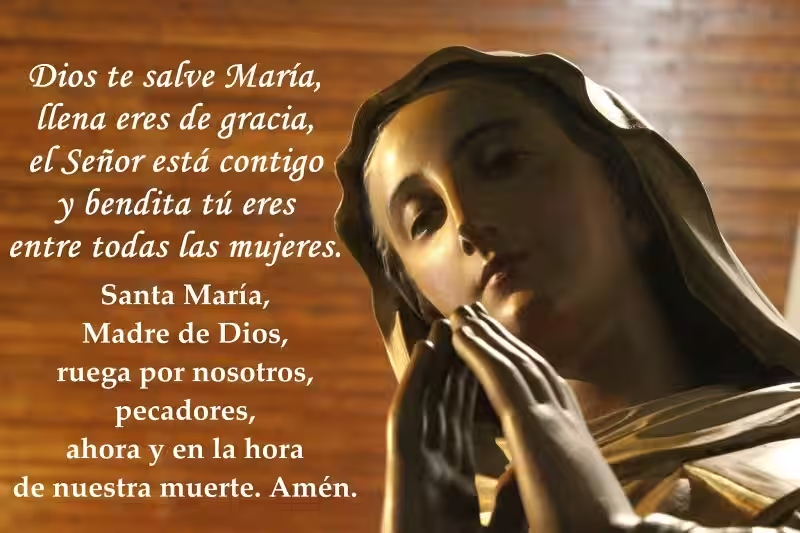
The Hail Mary is perhaps the most recognized and frequently recited Marian prayer. Its structure draws directly from Scripture: the angel Gabriel’s greeting, “Hail, full of grace, the Lord is with you!” (Luke 1:28) and Elizabeth’s exclamation, “Blessed are you among women, and blessed is the fruit of your womb!” (Luke 1:42). The second part of the prayer, “Holy Mary, Mother of God, pray for us sinners, now and at the hour of our death. Amen,” is a later addition, reflecting the Church’s growing understanding of Mary’s role and seeking her intercession.
Reciting the Hail Mary is more than just saying the words; it is an act of acknowledging Mary’s special grace and petitioning her maternal care. Each repetition can be an opportunity to meditate on her virtues – her purity, her humility, her courage. For many, the rhythmic repetition of the Hail Mary brings a sense of peace and a direct connection to the divine, especially when prayed as part of the Rosary.
The Rosary: Meditating on the Life of Christ Through Mary’s Eyes
The Holy Rosary is a cornerstone of Catholic devotion, a meditative prayer that cycles through key events in the lives of Jesus and Mary, known as the Mysteries. By praying the Hail Mary, Our Father, and Glory Be for each decade, while contemplating a specific Mystery, the Rosary invites us to walk with Mary through the most significant moments of our faith. The Mysteries are divided into four sets: the Joyful, the Luminous, the Sorrowful, and the Glorious.
For instance, when meditating on the Annunciation (a Joyful Mystery), we pray the Hail Mary while reflecting on Mary’s willing acceptance of God’s will, a profound act of faith and surrender. Similarly, during the Crucifixion (a Sorrowful Mystery), the Hail Mary takes on a deeper poignancy as we contemplate Mary’s suffering alongside her Son. The Rosary, therefore, is not just a prayer to Mary but a prayer with Mary, allowing us to see the redemptive work of Christ through her loving gaze, making Marian prayers a powerful tool for Gospel meditation.
Other Significant Marian Prayers: Expanding Your Devotional Repertoire
Beyond the Hail Mary and the Rosary, a wealth of other beautiful Marian prayers exists. The Memorare is a powerful plea for Mary’s intercession, beginning with the confident assertion: “Remember, O most gracious Virgin Mary, that never was it known that anyone who fled to your protection, implored your help, or sought your intercession was left unaided.” This prayer instills a strong sense of hope and trust in Mary’s maternal care.
The Salve Regina (Hail Holy Queen) is an ancient antiphon that addresses Mary as “Mother of mercy,” acknowledging her compassion and her role as “our life, our sweetness, and our hope.” It is often recited at the end of the Rosary and serves as a moving petition for her intercession, especially with the concluding words: “O clement, O loving, O sweet Virgin Mary.” These diverse Marian prayers offer different avenues for spiritual connection, allowing for a rich and varied devotional life.
Incorporating Marian prayers into your daily routine doesn’t require a significant time commitment, but rather a consistent intention to connect with the Mother of God. Even a few minutes dedicated to a Hail Mary or a short reflection on a Marian prayer can profoundly impact your spiritual well-being. The key is to approach these prayers with a sincere heart and a spirit of openness.
Think of it like nurturing any relationship. Just as you would send a text, make a call, or share a thought with a loved one, offering Marian prayers is your way of staying connected to Mary. It’s about bringing her into the ordinary moments of your day, asking for her guidance as you face challenges, and thanking her for her constant presence.
Finding Moments for Prayer: From Busy Schedules to Quiet Reflection
In our fast-paced world, finding time for prayer can seem daunting. However, Marian prayers are remarkably adaptable. You can recite a Hail Mary while commuting, during a coffee break, or before falling asleep. Consider setting a daily reminder on your phone to pause and pray. Even a single decade of the Rosary can be a powerful spiritual anchor in a hectic day.
For those with more time, dedicating a specific slot for prayer, perhaps in the morning or evening, can foster a deeper sense of devotion. This could involve reciting several Marian prayers, meditating on the Rosary, or simply offering a quiet moment of communion with Mary. The important aspect is the regularity and sincerity of your prayer, not the duration.
Making Marian Prayers Personal and Meaningful
To truly benefit from Marian prayers, it’s essential to move beyond rote recitation and cultivate a personal connection. Before you begin a Hail Mary, take a moment to center yourself. Think about who Mary is – the mother of Jesus, your spiritual mother, a model of faith. As you pray, consider the words and their meaning.
For example, when you say “Holy Mary, Mother of God, pray for us sinners,” reflect on your own sins and struggles, and place your trust in Mary’s powerful intercession. Imagine her embracing you with maternal love. This intentionality transforms Marian prayers from mere words into a living dialogue, a genuine encounter with grace.
The Fruits of Marian Devotion: Peace, Strength, and Hope
The consistent practice of Marian prayers yields profound spiritual benefits. Believers often report experiencing a deep sense of peace, a renewed strength to overcome difficulties, and an unwavering hope in God’s promises. Mary’s presence in our lives, fostered through prayer, acts as a constant reminder that we are never alone.
Her example of virtue, resilience, and unwavering faith serves as a powerful inspiration. By turning to her, we are not only seeking her intercession but also learning from her perfect discipleship. The practice of Marian prayers is, in essence, an invitation to walk more closely with Christ, guided by the one who knew Him most intimately.
A Source of Comfort in Times of Trial
Life inevitably presents us with storms – moments of loss, anxiety, or despair. During these times, turning to Marian prayers can be an invaluable source of comfort. The Memorare, with its promise of never being left unaided, offers a powerful reassurance. As you pray, imagine Mary holding your hand, walking with you through the darkness, and whispering words of encouragement.
Her own journey was marked by profound suffering, from the prophecy of Simeon that “a sword will pierce your own soul too” (Luke 2:35) to witnessing the crucifixion of her Son. This shared experience of sorrow allows her to empathize profoundly with our own pain. Through Marian prayers, we tap into this wellspring of maternal compassion, finding solace and the strength to persevere.
Cultivating a Deeper Relationship with Jesus
Ultimately, all Marian prayers are Christ-centered. Mary’s primary role was to bring Jesus into the world and to guide His earthly life. By honoring and praying to Mary, we are, in fact, drawing closer to her Son. She is the perfect model of how to live for Christ, and her intercession always points us towards Him.
When you pray the Rosary, you are meditating on the life of Jesus. When you recite the Hail Mary, you are acknowledging her role as the Mother of God, the Incarnate Word. Through Marian prayers, we learn to love Jesus more deeply, to follow Him more closely, and to trust in His divine plan. This journey of faith, undertaken with Mary as our guide, is a most fruitful path to holiness.
Frequently Asked Questions: Marian Prayers
What are Marian prayers?
Marian prayers are Catholic prayers that focus on Mary, the mother of Jesus. They are a way to honor her and ask for her intercession.
What are some common Marian prayers?
Some of the most common Marian prayers include the Hail Mary, the Rosary, the Magnificat, and the Memorare.
What is the Hail Mary?
The Hail Mary is a prayer that combines the greeting of the Angel Gabriel to Mary (Luke 1:28) with a petition for her intercession. It is recited multiple times in the Rosary.
What is the Rosary?
The Rosary is a devotional prayer that centers on meditating on the life of Jesus and Mary. It involves reciting the Hail Mary, Our Father, and Glory Be while contemplating specific “Mysteries” (events) from their lives.
What are the Mysteries of the Rosary?
The Mysteries of the Rosary are divided into four sets: the Joyful Mysteries, the Luminous Mysteries, the Sorrowful Mysteries, and the Glorious Mysteries. Each set focuses on different aspects of the lives of Jesus and Mary.
Why do Catholics pray to Mary?
Catholics do not worship Mary; they honor her as the Mother of God and ask her to pray for them to Jesus. They believe she can intercede with her Son on their behalf, as she did at the wedding at Cana (John 2:1-11).
Is praying to Mary biblically supported?
While there isn’t a direct command to pray to Mary in the Bible, the Scriptures highlight her unique role as the Mother of Jesus and her faith. The angel Gabriel’s greeting and Elizabeth’s exclamation (“Blessed are you among women, and blessed is the fruit of your womb!”) are seen as foundational. Catholics also interpret passages like John 2:1-11 as evidence of Mary’s ability to intercede.
Are Marian prayers exclusive to Catholicism?
While Marian devotion is a significant and central part of Catholic spirituality, other Christian denominations also hold Mary in high regard, though their forms of veneration and prayer may differ.