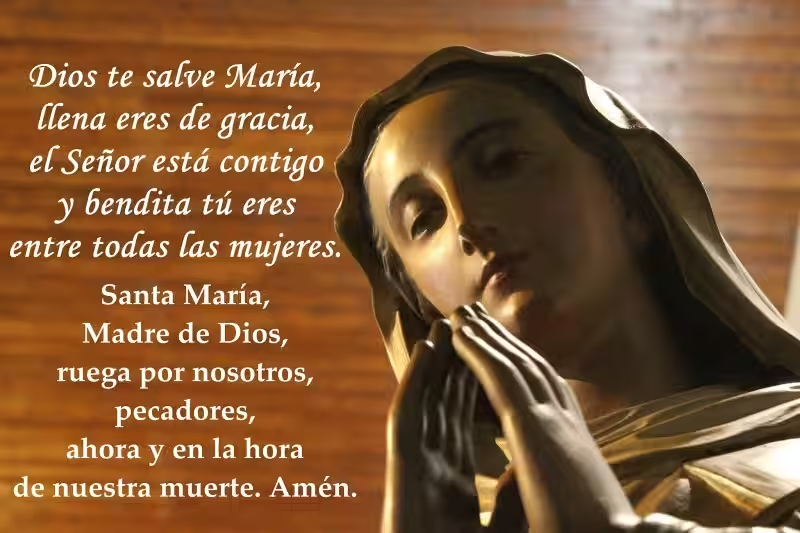
The simple invocation, “Dios te salve María,” echoes through centuries of faith, a tender prayer that has resonated with millions across the globe. More than just a few words, this Hail Mary prayer is a cornerstone of Catholic devotion, a personal whispered conversation with the Mother of God, a conduit for profound spiritual connection. It’s a phrase that evokes images of hushed chapels, rosaries clutched in hands, and the quiet comfort found in shared belief. This article will delve deep into the meaning, history, and enduring significance of “Dios te salve María,” exploring its role in the intricate tapestry of religion and its profound impact on the lives of believers.
For many, the rhythm of the Hail Mary is as familiar as their own heartbeat. It’s a prayer learned in childhood, repeated in moments of joy and sorrow, a constant companion on life’s journey. Understanding the depth behind these words requires us to explore not just the prayer itself, but the rich theological and cultural context that gives it such immense power. From its biblical roots to its place in modern spiritual practice, “Dios te salve María” offers a window into the heart of Christian faith and the enduring power of maternal intercession.
At its core, “Dios te salve María” translates directly to “Hail Mary.” This greeting, however, carries a weight of sacred significance. The first part of the prayer, “Dios te salve, María; llena eres de gracia; el Señor es contigo; bendita tú eres entre todas las mujeres, y bendito es el fruto de tu vientre, Jesús,” is a direct echo of the angelic salutation from the Gospel of Luke. When the Angel Gabriel appeared to Mary, he greeted her with words that acknowledged her unique blessedness and her pivotal role in God’s plan. This initial greeting is an act of profound recognition and reverence, acknowledging Mary’s elevated status as chosen by God.
The subsequent petition, “Santa María, Madre de Dios, ruega por nosotros, pecadores, ahora y en la hora de nuestra muerte. Amén,” is an appeal for intercession. Here, the faithful turn to Mary, recognizing her as the “Madre de Dios” (Mother of God), a title that speaks to her intimate relationship with the divine. The request, “ruega por nosotros, pecadores” (pray for us sinners), is a humble acknowledgment of human frailty and a plea for her maternal care and advocacy. This is not a prayer offered directly to Mary as a deity, but rather a request for her to pray to God on our behalf, leveraging her closeness to her son, Jesus. The inclusion of “ahora y en la hora de nuestra muerte” (now and at the hour of our death) highlights the enduring need for her intercession throughout one’s life and especially in that most critical moment.
The origins of the Hail Mary are deeply intertwined with biblical narratives. As mentioned, the initial greeting is a direct quote from the Angel Gabriel’s Annunciation to Mary in Luke 1:28. This moment marks the beginning of Jesus’ earthly life and Mary’s acceptance of her divine mission. The second part of the greeting, “bendita tú eres entre todas las mujeres, y bendito es el fruto de tu vientre, Jesús,” is also found in Luke, specifically in the greeting of Elizabeth to Mary when they meet after Mary’s conception of Jesus (Luke 1:42).
The invocation “Santa María, Madre de Dios” gained prominence and theological weight over time, particularly after the Council of Ephesus in 431 AD, which formally defined Mary as Theotokos, meaning “God-bearer” or “Mother of God.” This doctrinal clarification solidified her central role in Christian theology and devotion. The practice of reciting the Hail Mary as a structured prayer, often as part of the Rosary, developed gradually over the centuries, becoming a widespread and beloved form of Marian devotion within Catholicism. The rosary itself, a string of beads used to count prayers, provides a meditative framework, allowing individuals to contemplate the mysteries of Christ’s life while reciting the “Dios te salve María” repeatedly.
The Role of Mary in Catholic Religion
In the vast landscape of Catholic religion, Mary holds a position of unparalleled significance. She is not worshipped, but rather highly venerated as the Mother of Jesus, the Queen of Heaven, and a powerful intercessor. Her purity, her obedience to God’s will (“fiat voluntas tua” – “your will be done”), and her unwavering faith make her an exemplar for all believers. The concept of Marian devotion is not merely a cultural phenomenon; it’s an integral part of Catholic spirituality, offering a tangible and loving maternal figure to whom believers can turn.
Devotion to Mary, often expressed through the recitation of the “Dios te salve María,” provides a unique avenue for spiritual growth. It allows individuals to contemplate the life of Jesus through the eyes of his mother. The Rosary, with its sequence of prayers and meditations on the Joyful, Sorrowful, Glorious, and Luminous mysteries, invites a deeper understanding of Christ’s journey and Mary’s participation in it. This focused prayer practice can bring a sense of peace, comfort, and hope, especially during challenging times.
Marian Devotion as a Spiritual Practice
Marian devotion, at its heart, is an act of love and trust directed towards the Mother of God. It is a way to honor her unique role in salvation history and to seek her intercession in our daily lives. Reciting “Dios te salve María” with genuine devotion can be a deeply personal and transformative experience. It’s an opportunity to pause, to reflect, and to connect with a divine maternal love that transcends human understanding.
For many, the Rosary, built around repetitions of the “Dios te salve María,” serves as a form of meditation and contemplation. As one recites the prayer, focusing on the mysteries of Christ’s life, the words become more than just a rote recitation; they become a pathway to spiritual insight. This practice can cultivate a sense of humility, gratitude, and deepened faith. It’s a reminder that even in our imperfections, we are loved and cared for, and that through Mary’s intercession, we can draw closer to God.
Experiencing “Dios Te Salve María” in Daily Life
The beauty of “Dios te salve María” lies in its accessibility and its adaptability to diverse circumstances. It’s a prayer that can be whispered on a crowded bus, recited in the quiet solitude of one’s bedroom, or sung in a grand cathedral. Its simplicity allows it to resonate with people from all walks of life, regardless of their formal theological understanding. For a child learning about faith, it might be a comforting lullaby; for an adult facing hardship, it can be a source of strength and resilience.
Consider a young mother overwhelmed by the demands of raising children. The repetition of “Dios te salve María” can offer her a moment of respite, a brief sanctuary where she can entrust her worries to Mary’s care. Or think of a student facing a crucial exam; the familiar words can provide a sense of calm and focus, a reminder that she is not alone. This prayer is a testament to the enduring human need for connection and for a guiding, loving presence, a need that “Dios te salve María” so beautifully addresses.
Personal Stories and Testimonials
Countless personal stories attest to the power of “Dios te salve María.” Many individuals share how reciting this prayer has helped them through times of grief, illness, and doubt. They speak of feeling a profound sense of peace descending upon them as they utter the words, a feeling of being heard and understood. For some, it’s a way to honor their mothers or grandmothers who first taught them the prayer, keeping a cherished family tradition alive.
These narratives are not just anecdotes; they are lived experiences that highlight the tangible spiritual impact of Marian devotion. Whether it’s a feeling of protection during a dangerous journey, a sense of guidance when facing a difficult decision, or simply a moment of comfort in the face of loneliness, the prayer “Dios te salve María” has consistently served as a source of solace and strength. It’s a testament to the enduring power of faith and the profound connection believers feel to the Mother of God.
Conclusion: An Enduring Legacy of Faith
“Dios te salve María” is far more than just a prayer; it is a living tradition, a spiritual lifeline, and a testament to the enduring power of faith and devotion. Its simple yet profound words have guided, comforted, and inspired generations of believers. The religion it represents is one that embraces love, hope, and the unwavering belief in the power of intercession and maternal care.
As we continue to navigate the complexities of life, the gentle invocation of “Dios te salve María” remains a beacon of hope and a source of strength. It’s a reminder that we are never truly alone, that there is a loving presence ready to hear our pleas and to guide us on our journey. The legacy of this prayer is one of unconditional love, divine connection, and the profound comfort found in embracing one’s faith.
Frequently Asked Questions about the Hail Mary
What is the Hail Mary prayer?
The Hail Mary, also known as the Ave Maria in Latin, is a traditional Catholic prayer that invokes the Virgin Mary. It is a central devotional prayer in Catholicism.
What are the words to the Hail Mary prayer?
The prayer consists of two main parts. The first part is: “Hail Mary, full of grace, the Lord is with thee. Blessed art thou amongst women, and blessed is the fruit of thy womb, Jesus.” The second part is: “Holy Mary, Mother of God, pray for us sinners, now and at the hour of our death. Amen.”
What is the religious significance of the Hail Mary?
The Hail Mary is significant as it honors Mary, the mother of Jesus, and asks for her intercession. The first part of the prayer is derived from the words spoken by the Angel Gabriel to Mary and by Elizabeth to Mary when she visited her. The second part is a petition to Mary to pray for believers.
Is the Hail Mary prayed in other religions besides Catholicism?
While the Hail Mary is a distinctly Catholic prayer, elements of Marian devotion and prayers to her exist in other Christian denominations, such as Eastern Orthodoxy and some branches of Anglicanism and Lutheranism. However, the specific wording and the prominence of the Hail Mary are most characteristic of Catholicism.
Why is the Hail Mary recited multiple times in the Rosary?
The Rosary is a form of prayer that involves meditating on the life of Jesus and Mary while reciting the Hail Mary. The beads of the Rosary are used to keep track of the prayers. Reciting the Hail Mary multiple times is a way to focus on these mysteries and to offer continuous prayer.