From the dawn of civilization, humanity has grappled with the profound concept of justice. It’s a yearning woven into the fabric of our societies, a silent plea in the face of cruelty, and a guiding star for our laws and ethics. But long before codified legal systems, before trials and jurisprudence, our ancestors looked to a higher power for answers. They sought solace and accountability in the divine, believing that justice gods were the ultimate arbiters of right and wrong, the cosmic enforcers of cosmic order.
This intrinsic connection between our desire for fairness and our belief in the supernatural is a testament to the enduring human need for equilibrium. We instinctively recoil from injustice, from the arbitrary suffering of the innocent, and find comfort in the idea that a benevolent, or at least impartial, force oversees the universe, ensuring that debts are eventually paid and wrongs are righted. This article will explore the rich tapestry of justice gods across various religions, examining their roles, their attributes, and what their existence tells us about our own evolving understanding of justice.
The Divine Architects of Fairness: Roles and Responsibilities
Across the pantheons of the ancient world, justice gods weren’t simply passive observers; they were active participants in the cosmic drama. Their responsibilities were manifold, encompassing not only the punishment of transgressors but also the protection of the vulnerable and the upholding of sacred oaths. These deities were the bedrock of ethical frameworks, their pronouncements shaping moral codes and dictating acceptable behavior. Think of the ancient Mesopotamian god Shamash, who was not only the sun god but also the god of justice, truth, and divination. He was depicted carrying a rod and ring, symbols of authority and justice, and was invoked to witness oaths and ensure fair dealings.
The attributes assigned to these divine figures were often imbued with the very qualities we associate with true justice: impartiality, wisdom, strength, and sometimes even mercy. They were expected to hear every plea, to weigh every action without bias, and to dispense consequences that were proportionate to the offense. This idea of cosmic accountability offered a powerful deterrent against wrongdoing and a profound comfort to those who had been wronged, assuring them that no act of injustice would go unnoticed or unpunished in the grand scheme of existence.
Justice in Ancient Greece: Zeus, Themis, and Nemesis
In the vibrant mythology of ancient Greece, the concept of justice was embodied by several key deities. At the apex of Mount Olympus sat Zeus, king of the gods, whose primary role was to maintain order and justice among both gods and mortals. While he could be capricious, Zeus was ultimately the divine enforcer of oaths and the punisher of hubris, the excessive pride that Greeks believed angered the gods. His thunderbolt was a potent symbol of his power to deliver swift and decisive justice upon those who defied the cosmic order.
More directly associated with justice were Themis and Nemesis. Themis, a Titaness, was the personification of divine law and order, representing the established customs and traditions that governed society. She was often depicted blindfolded, a symbol of her impartiality, and holding scales, representing the careful weighing of evidence. Nemesis, on the other hand, was the goddess of retribution and vengeance, ensuring that prideful and arrogant individuals received their just deserts. She was the divine force that swooped in to balance the scales when human or divine transgression tipped the balance too far.
The Roman Pantheon: Iustitia and the Scales of Judgment
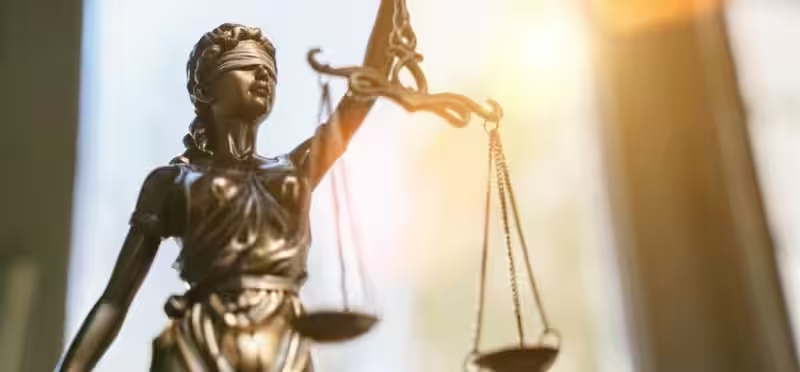
The Romans, heavily influenced by Greek culture, adopted and adapted many of their deities. The Roman goddess Iustitia is perhaps the most recognizable embodiment of justice worldwide, her imagery influencing the scales of justice that adorn courthouses today. Like her Greek counterpart, Iustitia is typically depicted blindfolded, holding a sword and a set of scales. The blindfold signifies impartiality, that justice should not be swayed by wealth, power, or appearance.
The sword represents the power of justice to enforce its will, to deliver punishment when necessary. The scales symbolize the careful and balanced consideration of evidence and arguments. The Romans believed Iustitia was a crucial virtue for the stability and prosperity of their empire, and her worship was intertwined with the functioning of their legal system. The concept of ius (law) itself was deeply respected, and the divine presence of Iustitia reinforced the idea that adherence to law was not merely a human obligation but a divinely sanctioned one.
Justice in Eastern Traditions: Dharma and Karma’s Cosmic Balance
The concept of divine justice extends far beyond the Western world, taking on unique and profound forms in Eastern religions. In Hinduism, the principle of Dharma is central to the understanding of justice. Dharma encompasses one’s duty, righteousness, and the natural order of the universe. Upholding one’s Dharma is seen as living a just life, and deviations from it lead to cosmic imbalance.
The closely related concept of Karma acts as the divine mechanism for ensuring justice. Every action, whether good or bad, creates a ripple effect, and the consequences of these actions will inevitably return to the doer, either in this life or in future reincarnations. This intricate system of cause and effect ensures that no act of injustice goes unpunished, and no act of kindness goes unrewarded, creating a profound and personal sense of cosmic accountability that transcends earthly judgment. This ensures that even when human systems fail, the universe itself maintains a form of divine justice.
Buddhism: The Law of Cause and Effect and Bodhisattvas
Buddhism, while often emphasizing compassion and enlightenment over divine judgment, also operates on a sophisticated understanding of cosmic justice through the principles of karma and rebirth. The Buddha himself taught that actions have consequences, and the cycle of suffering is perpetuated by unskillful deeds. While there aren’t justice gods in the same vein as in other religions, the natural law of cause and effect serves as the ultimate arbiter, ensuring that what goes around, comes around.
Furthermore, in Mahayana Buddhism, the concept of Bodhisattvas plays a vital role. These enlightened beings have postponed their own nirvana out of compassion for all sentient beings and work tirelessly to alleviate suffering and guide others towards enlightenment. Their actions, driven by immense benevolence and a deep understanding of karma, can be seen as a form of active, compassionate justice, intervening to help those who are caught in cycles of suffering due to past actions, offering a path to redemption and balance.
Confucianism: Harmony and the Mandate of Heaven
Confucianism, a philosophy and ethical system that has deeply influenced East Asian societies, places a strong emphasis on social harmony and righteous governance. While not a religion in the traditional sense of worshipping deities, it does incorporate the concept of Tian (Heaven), which carries a sense of cosmic order and moral authority. The Mandate of Heaven was a crucial political and spiritual doctrine, asserting that a ruler’s right to govern was granted by Heaven, and this mandate could be lost if the ruler was unjust, corrupt, or failed to care for the people’s well-being.
This concept provided a divine justification for rebellion against tyrannical rulers, as their loss of the Mandate of Heaven was seen as a cosmic sign of their failure to uphold justice. The emphasis was on virtuous leadership, ethical conduct, and the creation of a harmonious society where everyone understood their roles and responsibilities. The ideal ruler was one who embodied benevolence, righteousness, and propriety, ensuring that justice was not only a divine decree but also a lived reality for the populace.
The Enduring Human Need for Divine Justice
Across cultures and millennia, the concept of justice gods has served as a powerful anchor for human morality. Whether as active enforcers, impartial arbiters, or the embodiment of cosmic law, these divine figures reflect our deepest desires for fairness and accountability. They offered a comforting assurance that even in the face of suffering and inequity, a higher order prevailed, and that ultimately, justice would be served.
Even in secular societies, the echoes of these ancient beliefs persist. Our legal systems, our ethical frameworks, and our innate sense of right and wrong are, in many ways, secularized manifestations of that primal yearning for divine justice. The pursuit of fairness, the condemnation of injustice, and the hope for a world where wrongs are righted remain fundamental to the human experience, proving that the quest for justice, whether divinely ordained or humanly pursued, is an eternal and deeply ingrained aspect of who we are.
Frequently Asked Questions about Justice Gods, Religion, and Divinity
What is a “justice god”?
A justice god is a deity or divine entity associated with fairness, righteousness, law, and order within a religious or mythological system. They are often seen as dispensers of judgment, protectors of the innocent, and enforcers of moral codes.
Views vary greatly. Some religions have specific deities dedicated to justice (e.g., Ma’at in ancient Egyptian mythology, Themis or Dike in Greek mythology). Others integrate concepts of divine justice within a broader theological framework, where the supreme deity or a pantheon of gods collectively uphold justice or where justice is a fundamental attribute of the divine.
Are justice gods always benevolent?
Not necessarily. While many are depicted as righteous and fair, some justice deities or divine forces can also be seen as stern, unforgiving, or even wrathful when their principles are violated. Their focus is on upholding balance and cosmic order, which may involve punishment for transgressions.
How does the concept of religion relate to divine justice?
Religion often provides a framework for understanding divine justice. It establishes moral and ethical guidelines that are believed to be divinely ordained. Religious texts and traditions frequently describe how gods reward virtue and punish wrongdoing, thereby shaping believers’ understanding of justice in both the earthly and divine realms.
Can a person believe in a justice god without adhering to a formal religion?
Yes. While formal religions often codify beliefs about justice gods, individuals can hold personal beliefs in divine or cosmic justice, or in benevolent forces that ensure fairness, without being affiliated with an organized religious institution.
What is the role of faith in believing in justice gods?
Faith is central to believing in justice gods. It involves trust in the existence and power of these deities, and in their commitment to upholding justice, even when earthly events may seem unfair. This faith often provides comfort, hope, and a moral compass.
How do different mythologies represent justice gods?
Mythologies depict justice gods in diverse ways. They might be portrayed as judges in an afterlife, as guardians of oaths, as embodiments of natural laws, or as direct interveners in human affairs. Their symbols, attributes, and stories often reflect the cultural values and legal principles of the societies that created them.
What are some examples of justice gods from various cultures?
Examples include:
Ancient Greek: Themis (divine law and order), Dike (human justice), Nemesis (retribution)
Ancient Roman: Justitia (personification of justice)
Ancient Egyptian: Ma’at (truth, justice, cosmic order)
Norse: Þórr (thunder god often associated with protecting mankind and enforcing justice)
Hinduism: Yama (god of death and justice)
Buddhism: Often emphasizes karma, a principle of cause and effect that functions as a form of cosmic justice, without a specific deity personifying it in the same way.