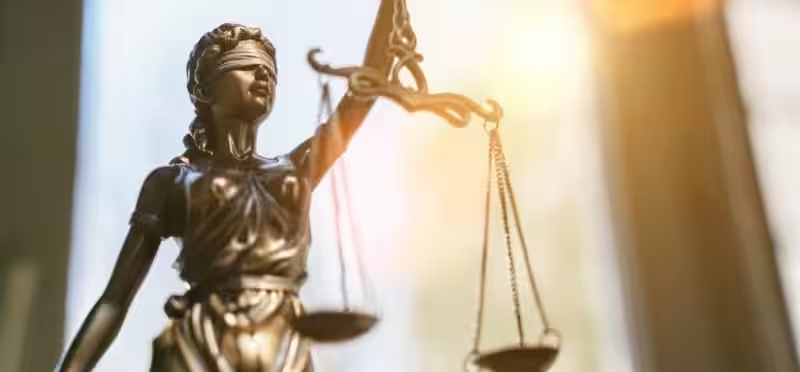
For millennia, humanity has grappled with the concept of justice. We see its absence in the everyday struggles of life – the unfairness of a child denied opportunity, the suffering of the innocent, the triumph of the wicked. Yet, woven through the tapestry of our existence is a persistent whisper, a deep-seated yearning for a reckoning, for a universal balance. This yearning often leads us to the idea of a justice god, a divine entity that embodies ultimate fairness and accountability. Religion, in its myriad forms, provides a framework for understanding this profound connection between the divine and the concept of justice.
The notion of a justice god isn’t a monolithic concept; it manifests differently across various faiths, yet the core principle remains remarkably consistent. Whether we call this entity Yahweh, Allah, Brahman, or simply the Creator, the inherent belief is that there exists a power beyond our earthly limitations that upholds moral order. This divine oversight offers solace, a sense that our actions, both good and bad, are observed and ultimately judged. It’s this belief that informs our personal ethics, encouraging us to act with integrity, knowing that a higher power witnesses our choices.
Defining Divine Justice: Beyond Human Comprehension
What does it truly mean for a god to be just? It’s a question that has sparked countless theological debates and philosophical inquiries. Human notions of justice are often flawed, influenced by personal biases, societal pressures, and limited perspectives. We seek retribution, fairness in dealings, and the righting of wrongs. A justice god, however, operates on a plane of understanding far beyond our own. Divine justice is not merely about punishment or reward; it’s about cosmic balance and the ultimate unfolding of a grander design, a plan that we may not always comprehend in our temporal existence.
Consider the parable of the farmer who sows seeds. We might see a neighboring field flourish while ours struggles, and feel it’s unjust. But the farmer understands that different soils, different weather patterns, and different growth cycles are all part of the process. Similarly, the justice god operates with a knowledge of all factors, all intentions, and all consequences, weaving a complex tapestry of cosmic accounting that transcends our immediate understanding. This doesn’t negate the reality of suffering, but it offers a perspective that our current struggles might be part of a larger, divinely ordained progression towards ultimate fairness.
The Role of Religion in Conveying Divine Justice
Religion serves as a crucial conduit, translating the abstract concept of a justice god into tangible narratives, laws, and practices for believers. Sacred texts often detail divine judgments, outlining the consequences of virtuous living and the repercussions of transgressions. These stories, from the flood narratives to the tales of prophets facing adversity, are not just ancient folklore; they are theological lessons designed to illuminate the principles of divine justice and guide human behavior.
For example, many religions emphasize the importance of charity and compassion as direct reflections of a justice god‘s will. Acts of kindness towards the less fortunate are often presented as pleasing to the divine, not just because they alleviate suffering, but because they align with the inherent fairness and empathy that are believed to be hallmarks of the divine nature. Conversely, greed, oppression, and cruelty are condemned as violations of this divine order, inviting divine displeasure and, ultimately, accountability. This religious framework provides a clear roadmap for living a life that is in harmony with God’s perceived standard of justice.
Manifestations of Justice God in Different Faith Traditions
The justice god appears in diverse guises across the world’s religious landscapes. In Judaism, the concept of Mishpat (justice) and Tzedek (righteousness) are central, emphasizing a God who is both a judge and a protector of the poor and oppressed. The Ten Commandments, a foundational text, are replete with directives aimed at establishing a just society, reflecting the divine mandate for fairness.
In Christianity, God is often portrayed as the ultimate judge, with Jesus Christ serving as both an advocate and a model of divine love and justice. The parables Jesus told, such as the Parable of the Talents, illustrate the principles of accountability and fair reward or consequence based on one’s actions. The Christian understanding of divine grace also plays a role, suggesting that while justice is absolute, there is also an avenue for mercy and redemption through faith and repentance.
Islam presents Allah as Al-Adl (The Just), emphasizing His absolute fairness and impartiality. The Quran frequently speaks of the Day of Judgment, where every soul will be accounted for their deeds, reinforcing the belief in an ultimate, divine reckoning. The pillars of Islam, including Zakat (charity), highlight the religion’s commitment to social justice and the equitable distribution of wealth, reflecting the divine emphasis on caring for the less fortunate.
Hinduism, with its vast pantheon and complex philosophical underpinnings, speaks of Karma, the law of cause and effect, which can be seen as a manifestation of divine justice. While not always personified as a singular justice god in the Abrahamic sense, the cosmic order (Rta) and the actions of deities like Yama, the god of death and justice, all contribute to the understanding of a universe where fairness ultimately prevails. The cycle of reincarnation itself can be viewed as a mechanism for experiencing the consequences of one’s actions, a form of ongoing divine justice.
Buddhism, while emphasizing non-theistic principles, still recognizes the natural law of karma. The consequences of one’s actions are seen as inherent to the universe, a form of karmic justice that unfolds regardless of belief in a divine creator. The pursuit of enlightenment is, in essence, a path towards understanding and aligning oneself with this universal order of cause and effect, a form of ultimate righteous living.
Living in Accordance with Divine Justice
The challenge for individuals is not just to believe in a justice god, but to actively integrate this belief into their daily lives. This involves more than just ritualistic observance; it requires a conscious effort to embody the qualities that are believed to be pleasing to the divine. For many, this translates to a commitment to ethical behavior, compassion, and fairness in all interactions.
Practically, this might mean:
Treating others with respect, regardless of their background or social standing.
Upholding honesty in all dealings, whether personal or professional.
Advocating for the marginalized and oppressed, speaking out against injustice wherever it is found.
Practicing forgiveness, both for oneself and for others, recognizing that human fallibility is part of the earthly experience.
Engaging in acts of service and charity, contributing to the well-being of the community.
These actions are not merely acts of good deeds; they are considered by many religions to be expressions of faith and a testament to one’s belief in a higher moral order. They are ways of aligning oneself with the perceived will of the justice god, fostering a sense of inner peace and contributing to a more just and equitable world.
The Enduring Appeal of the Justice God
The enduring appeal of the justice god lies in its promise of ultimate accountability and cosmic balance. In a world often characterized by chaos and apparent unfairness, the belief that there is a higher power overseeing and judging provides a profound sense of hope and order. It offers a framework for understanding suffering, a motivation for ethical living, and a comforting assurance that in the grand scheme of things, justice will indeed prevail.
Whether this belief is rooted in ancient scripture, personal revelation, or the quiet whisper of conscience, the concept of a justice god continues to shape human morality, inspire acts of kindness, and fuel the ongoing human quest for meaning and fairness. It is a testament to our innate desire for a universe where virtue is ultimately rewarded and wickedness is held accountable, a universe guided by an unseen, yet profoundly felt, divine hand.
Frequently Asked Questions: Justice, God, and Religion
What is divine justice?
Divine justice refers to the concept of a righteous and fair judgment by a divine being or God. It suggests that there is a moral order in the universe that will ultimately ensure that good is rewarded and evil is punished, either in this life or in an afterlife.
Is God always just?
Belief in God’s justice is a core tenet of many religions. Proponents believe that God’s actions are inherently just and aligned with a perfect moral standard. However, interpretations of what constitutes justice and how it is manifested can vary widely among different faiths and individuals.
How does religion define justice?
Religions often provide ethical frameworks and moral codes that define justice. These definitions typically involve principles of fairness, righteousness, compassion, accountability, and the importance of treating others with dignity. Many religions advocate for social justice, urging followers to advocate for the marginalized and oppressed.
Are there different concepts of God across religions?
Yes, concepts of God vary significantly across religions. Some religions are monotheistic (believing in one God), polytheistic (believing in multiple gods), or pantheistic (seeing God as identical with the universe). The attributes, nature, and roles attributed to God also differ, influencing how justice is understood within each tradition.
Can justice exist without religion?
Many secular ethical systems and philosophical traditions argue that justice can and does exist independently of religious belief. Concepts of human rights, natural law, and societal agreements provide foundations for justice that do not rely on divine authority.
How does religion influence people’s understanding of justice?
Religion can profoundly shape an individual’s understanding of justice by providing a moral compass, a framework for ethical decision-making, and a belief in ultimate accountability. Religious teachings often inspire acts of charity, compassion, and advocacy for social justice.
What is the relationship between God, justice, and suffering?
This is a complex theological question often referred to as “the problem of evil.” Religions grapple with how to reconcile the existence of suffering and injustice with the belief in an all-powerful, all-knowing, and all-good God. Explanations often involve free will, divine mystery, or the idea that suffering can have a purpose or lead to greater good.