The profound statement “I and Father are one” resonates across diverse spiritual traditions, serving as a cornerstone for understanding the intimate relationship believers seek with the divine. This isn’t merely a theological abstract; it’s a deeply personal and transformative concept that, when grasped, can revolutionize one’s faith journey. It speaks to an ultimate unity, a merging of the individual spirit with the divine essence. For many, this oneness represents the pinnacle of spiritual aspiration, a state of being where the boundaries between the self and God dissolve, leading to a profound sense of peace, purpose, and belonging.
Exploring the meaning behind “I and Father are one” involves delving into the inherent interconnectedness of all existence. Religions offer a framework for understanding this connection, providing pathways and practices to cultivate this sense of unity. It’s a journey of self-discovery that mirrors the discovery of the divine, revealing that the external search for God often leads back to the internal landscape of the soul. This exploration is not about losing one’s individuality, but rather about realizing that the truest expression of the self is found in alignment with the divine will, a harmonious resonance rather than an erasure of self.
Across the tapestry of religious thought, the concept of “I and Father are one” finds varied, yet often convergent, expressions. In Christianity, Jesus’ declaration of oneness with the Father is a central tenet, signifying not a sameness of person, but a unity of purpose, will, and divine nature. This union is often understood as a model for believers, who are called to pursue their own spiritual oneness with God through Christ. It’s about embodying divine love, truth, and compassion in our daily lives, thereby reflecting the Father’s nature. This isn’t about claiming divine status for oneself, but about participating in the divine life.
In Sufism, the mystical branch of Islam, the concept of fana (annihilation of the ego) and baqa (subsistence in God) speaks to a similar dissolution of the individual self into the divine presence. The Sufi seeker strives to shed the layers of ego and worldly attachment to experience the profound unity with Allah. This journey involves rigorous spiritual discipline, meditation, and devotion, all aimed at purifying the heart to become a mirror reflecting God’s light. The understanding is that by emptying oneself of the ‘I’ that separates, the ‘I’ that remains is truly one with the ultimate reality.
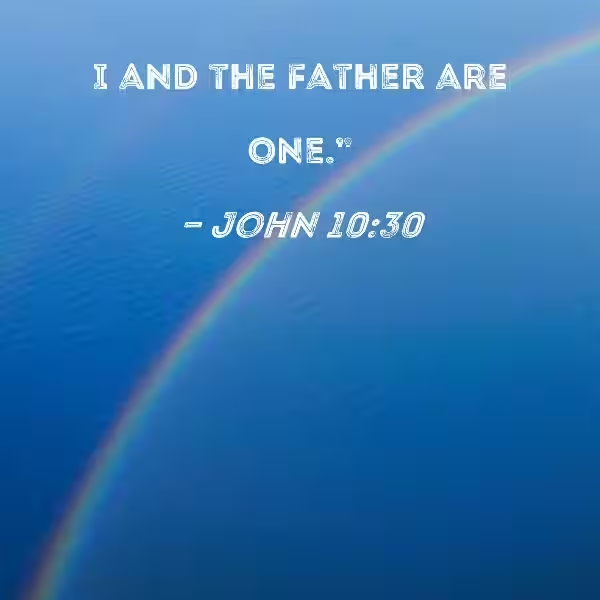
The Gospel of John famously records Jesus stating, “I and the Father are one” (John 10:30). This declaration, often met with both awe and controversy, is crucial for understanding the Christian faith. It signifies Jesus’ unique divine sonship and his perfect alignment with God’s will and being. It’s not a statement of mere agreement, but of a profound ontological unity. For Christians, this oneness is the ultimate model for human-divine relationship, inviting believers to pursue a similar unity through faith and obedience.
Other passages in the New Testament further illuminate this theme. Jesus prays in John 17:21, “that they may all be one, as you, Father, are in me, and I in you, that they also may be in us.” This prayer extends the concept of oneness beyond Jesus to his followers, highlighting that spiritual unity with God is a shared aspiration for all who believe. This unity is not about uniformity of personality or experience, but about a shared divine life, purpose, and love, making the believer an integral part of the divine family. It implies a spiritual indwelling and a shared essence.
Eastern Philosophies and the Concept of Unity
While the phrasing “I and Father are one” is particularly prominent in Abrahamic religions, the underlying concept of ultimate unity is a recurring theme in Eastern spiritual traditions. In Hinduism, the doctrine of Advaita Vedanta posits that the individual soul (Atman) is identical with the universal soul (Brahman). The famous Mahavakya, “Tat Tvam Asi” (That thou art), directly conveys this message of non-duality and inherent oneness. The realization of this truth leads to liberation (moksha) from the cycle of birth and death.
Similarly, in Buddhism, while the concept of a personal “Father” God might differ, the pursuit of enlightenment often involves transcending the illusion of a separate self. The understanding of emptiness (sunyata) suggests that phenomena, including the individual ego, lack inherent, independent existence. By realizing this interconnectedness and the impermanence of the self, one can achieve a state of liberation and union with the ultimate reality, often described as Nirvana. This isn’t about merging with a divine entity in the Abrahamic sense, but about realizing the fundamental nature of reality as a unified, interdependent whole.
The Practical Implications of “I and Father Are One”
Understanding that “I and Father are one” has profound implications for how we navigate our lives. It suggests that our true nature is divine, and that the perceived separation is often an illusion created by ego, fear, and worldly distractions. This realization can foster a profound sense of inner peace and security, knowing that we are not alone, but intrinsically connected to an infinite, loving source. It shifts our focus from external validation to internal alignment.
Furthermore, this concept encourages us to treat all beings with compassion and respect, recognizing the divine spark within them. If “I and Father are one,” then it follows that all of creation, as an extension of the divine, shares in this fundamental unity. This can lead to a more ethical and loving way of living, fostering a sense of global responsibility and interconnectedness. It calls for empathy, forgiveness, and a commitment to the well-being of others, seeing them not as separate entities, but as reflections of the same divine essence that resides within us. It’s about understanding that harming another is ultimately harming oneself.
Cultivating the Experience of Divine Oneness
The journey towards experiencing the truth of “I and Father are one” is a lifelong spiritual practice. It requires conscious effort and deliberate intention. Many traditions offer specific pathways, such as prayer, meditation, mindfulness, chanting, and acts of service. These practices are designed to quiet the incessant chatter of the ego and to open the heart to the divine presence. The key is consistency and a genuine desire for deeper connection.
One effective approach is to cultivate gratitude. By acknowledging the blessings in our lives, both big and small, we begin to recognize the divine hand at work. This fosters a sense of awe and appreciation, naturally drawing us closer to the source of all good. Another vital aspect is self-reflection. Regularly examining our thoughts, emotions, and actions allows us to identify the barriers that prevent us from experiencing this unity. It involves honestly confronting our limitations and seeking to align ourselves with divine principles like love, truth, and wisdom. The goal is to create a space within ourselves where the divine can fully express itself.
Living in Alignment with the Divine
Ultimately, the understanding that “I and Father are one” is not just an intellectual concept, but a lived reality. It means striving to live in accordance with divine principles, embodying love, compassion, and forgiveness in our daily interactions. When we act from a place of divine connection, our choices and actions become a reflection of that oneness. This is the essence of spiritual maturity.
This realization empowers us to face life’s challenges with greater resilience and faith. When we know we are intrinsically connected to an all-powerful, all-loving divine, the fears and anxieties of the world lose their grip. We learn to trust the process, understanding that even in difficult times, we are held within the divine embrace. This is the ultimate freedom, the unshakeable peace that comes from knowing, truly knowing, that “I and Father are one”.
Frequently Asked Questions: “I and Father are One” and Religion
What does it mean to say “I and Father are One”?
This statement, often found in spiritual and religious contexts, refers to a profound unity or oneness with the divine, often represented by “the Father.” It suggests an inherent connection and shared essence between the individual consciousness and the ultimate source of all being. It does not necessarily imply a literal, physical sameness, but rather a spiritual or energetic identification.
How does the concept of “I and Father are One” relate to different religions?
The expression and its underlying concept appear in various religious traditions, though the specific terminology and interpretation may differ:
Christianity: Jesus’ declaration “I and the Father are one” (John 10:30) is central to Christian theology, emphasizing his divine nature and unity with God the Father.
Mystical traditions (e.g., Sufism, Kabbalah, Advaita Vedanta): Many mystical paths across different religions explore this oneness as the ultimate spiritual realization. They speak of transcending the ego to experience the divine within or as the fundamental reality of existence.
Other religions: While not always explicitly stated in these words, many religions contain themes of divine immanence (God being present within creation) or a universal spirit that connects all beings, echoing this idea of oneness.
Is “I and Father are One” a specific religious doctrine or a broader spiritual concept?
While it is a specific and significant doctrine within Christianity, the concept of inherent oneness with the divine is a broader spiritual theme found across many belief systems and philosophical outlooks. It can be understood as a universal spiritual aspiration or a recognition of the interconnectedness of all existence.