Throughout human history, the very act of conceptualizing and depicting the divine has been inextricably linked to the idea of a sacred countenance. When we speak of face creation in a religious context, we’re not merely talking about artistic renderings; we’re delving into the profound human need to visualize the unseen, to give form to the formless, and to connect with something far greater than ourselves. From the earliest cave paintings to the most intricate altarpieces, the creation of faces has served as a powerful conduit for faith, a way to imbue abstract concepts with relatable human (or superhuman) characteristics.
This exploration of face creation within religious traditions reveals a universal fascination with what lies beyond our immediate perception. It’s about how different cultures and belief systems have grappled with the essence of divinity, often finding its most potent expression in the human face. We’ll journey through various faiths, examining how the desire to depict God, gods, prophets, and saints has shaped our understanding of both the sacred and the very nature of human representation. This isn’t just about art history; it’s about the deeply ingrained human impulse to create faces that reflect our spiritual aspirations and anxieties.
The Primordial Gaze: Early Manifestations of Divine Faces
Long before codified religions, our ancestors were already engaging in a form of face creation that hinted at the sacred. Consider the figurines and cave paintings that predate established faiths. These early representations, often stylized and abstract, frequently feature prominent eyes or face-like patterns. The sheer focus on the facial area suggests a primal recognition of its importance in conveying presence, awareness, and perhaps even a sense of being observed. These weren’t just random doodles; they were likely attempts to imbue objects or images with a spiritual essence, a way to acknowledge forces that seemed to watch over them, influencing their hunts and their lives.
The deliberate creation of faces, even in their rudimentary forms, served as a bridge between the tangible world and the intangible realm of the supernatural. Imagine early shamans or tribal elders crafting masks or carving effigies. The process of carefully shaping the wood or clay, focusing on the placement of eyes, nose, and mouth, was a ritualistic act. This act of face creation was not passive; it was an active invocation, a way to invite the spirits into a visible form, making them more accessible for communication and appeasement. These early faces were not necessarily intended to be realistic portraits of deities, but rather symbolic representations, powerful icons of spiritual connection.
Eyes as Windows to the Soul: The Power of the Gaze
Across countless religious traditions, the eyes hold a paramount position in any act of face creation. They are universally understood as the windows to the soul, the most expressive element of a face, capable of conveying profound emotion, wisdom, or even divine judgment. In religious art, the gaze of a deity or saint is rarely accidental. It is meticulously crafted to draw the viewer in, to establish a direct, often piercing, connection. Think of the serene, all-knowing eyes of Buddha statues, or the sorrowful, compassionate gaze of depictions of Mary. These eyes are designed to evoke specific spiritual responses, to inspire awe, devotion, or empathy.
The intentionality behind the creation of eyes in religious iconography is deeply significant. When an artist paints or sculpts the eyes of a divine figure, they are imbuing that representation with a sense of life and awareness. A vacant stare wouldn’t suffice; the eyes must convey presence. This is why many religious paintings feature figures with slightly upturned or wide-open eyes, suggesting a connection to a higher plane or a profound spiritual insight. The artist, through the act of face creation, is attempting to capture not just a likeness, but the very essence of divine consciousness. This deliberate focus on the gaze transforms a mere depiction into a powerful object of contemplation and prayer.
From Abstract to Anthropomorphic: Shaping the Divine Face
The evolution of face creation in religion often mirrors the development of theological understanding. In its earliest stages, divinity might be represented through abstract symbols – a pillar of fire, a roaring wind, or an unadorned stone. However, as societies matured and their philosophical frameworks deepened, there arose a desire to create faces for these abstract concepts, to make them more relatable and comprehensible to the human mind. This shift from the abstract to the anthropomorphic is a fascinating aspect of religious history, driven by the need for a more personal connection with the divine.
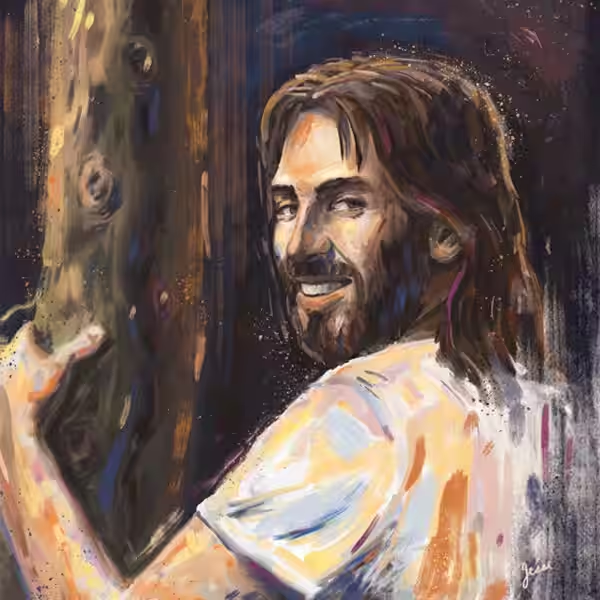
The concept of face creation as a means of anthropomorphism is particularly evident in polytheistic religions. Gods and goddesses were given distinct forms, personalities, and, crucially, faces that reflected their domains and temperaments. Zeus, with his stern, kingly visage; Aphrodite, with her captivating beauty; Ares, with his fierce, warlike expression – these are all examples of face creation that served to define and differentiate divine beings. This process allowed worshippers to form relationships with their gods, to understand their roles, and to petition them through more tangible, recognizable forms. The artist’s hand in creating these divine faces was instrumental in shaping the very narratives and mythologies of these faiths.
The Bodhisattva’s Smile: Compassion Embodied
In Buddhism, particularly in Mahayana traditions, the concept of the Bodhisattva offers a unique perspective on face creation. Bodhisattvas are enlightened beings who have chosen to delay their own nirvana to help others achieve enlightenment. Consequently, their faces are not depicted with stern judgment or abstract power, but rather with profound compassion, serenity, and gentle wisdom. The iconic smile of many Buddha and Bodhisattva statues is a deliberate artistic choice, a manifestation of their boundless benevolence and understanding.
The creation of the Bodhisattva’s face is a masterclass in conveying spiritual qualities through visual representation. The soft curves of the cheeks, the relaxed eyelids, and that unmistakable, subtle smile all contribute to an aura of peace. It’s an invitation to approach, to seek solace, and to learn. When a sculptor meticulously carves such a face, they are performing a sacred act of face creation, aiming to evoke a specific emotional and spiritual response in the viewer. This isn’t about a literal likeness, but about embodying an ideal, a divine quality of selfless love that inspires practitioners on their own spiritual paths.
Iconoclasm and the Contested Face: When Images Provoke
The very act of face creation in religion can also become a source of intense conflict. Throughout history, the depiction of divine figures has been challenged, leading to movements like iconoclasm, where religious images were destroyed. This often stemmed from a fear that worshipping the image was a form of idolatry, a deviation from the worship of the true, unseen God. For some, the creation of a physical face for the divine was an affront, an attempt to limit or misunderstand the infinite.
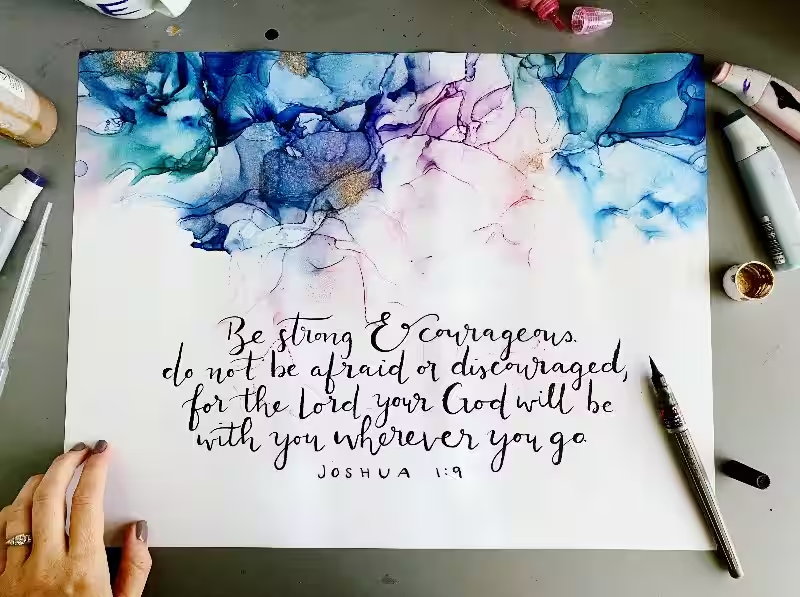
The debates surrounding face creation and religious imagery highlight the potent power these representations hold. When a particular faith prohibits the depiction of God (as in some interpretations of Judaism and Islam), the emphasis shifts to other forms of veneration, such as calligraphy or abstract patterns. Conversely, in traditions where icons are central, the creation of faces becomes a vital part of worship and spiritual connection. The controversy surrounding religious art, particularly the creation of faces that are deemed blasphemous or disrespectful by opposing factions, underscores how deeply these visual representations become intertwined with deeply held beliefs and identities.
The Human Face as a Mirror: Reflections of the Divine
Beyond the direct depiction of divine beings, many religious philosophies propose that the human face itself can be a canvas for the divine. The idea that we are created in the image of God suggests that within each human face lies a spark of the sacred. Therefore, the creation of a face – whether through birth, through artistic rendering, or even through the cultivation of one’s own character – can be seen as a continuous act of revealing or reflecting that divine essence.
This perspective shifts the focus of face creation from solely external representations to an internal, lived experience. It’s about how we present ourselves to the world, the expressions we carry, and the kindness or cruelty that emanates from our features. A face etched with compassion, illuminated by understanding, or radiating peace could be seen as a more profound manifestation of the divine than any sculpted idol. This is a continuous, ongoing face creation, where our actions, our intentions, and our spiritual growth actively shape the divine image within us, making our very existence a testament to the sacred.
Frequently Asked Questions: Face Creation and Religion
What is face creation in the context of AI or technology?
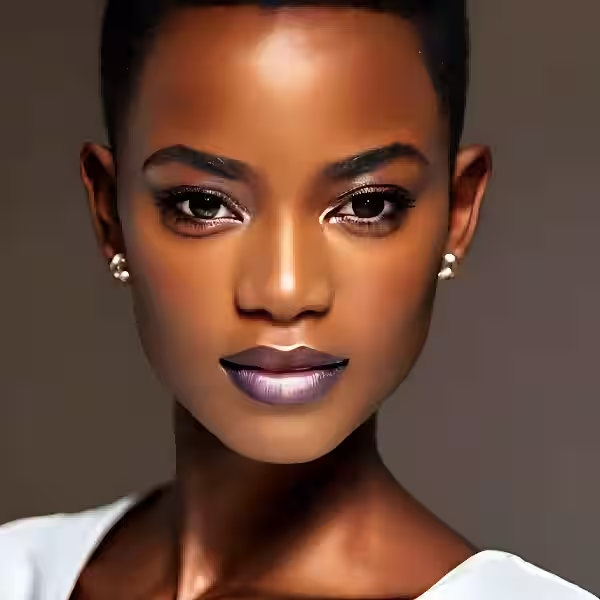
Face creation, in the context of AI and technology, refers to the process of generating or synthesizing realistic human faces using algorithms and computational models. This can involve creating entirely new, unique faces from scratch, or modifying existing images to alter features, expressions, or demographics.
Can AI create faces that look like real people?
Yes, advanced AI models, particularly those using generative adversarial networks (GANs), can create highly realistic and often indistinguishable human faces. These generated faces are not of actual individuals but are synthesized from patterns learned from vast datasets of real human faces.
Are there ethical concerns surrounding AI-generated faces?
Yes, there are significant ethical concerns. These include the potential for misuse in creating deepfakes for misinformation or harassment, the erosion of trust in visual media, issues of consent and representation when training data is used, and the potential for bias in generated faces reflecting societal prejudices.
How does religion view the creation of human beings?
Religious perspectives on the creation of human beings are diverse and vary significantly across different faiths. Generally, most religions attribute the origin of humanity to a divine creator or a supernatural force. This creation is often seen as a deliberate and purposeful act, imbued with spiritual significance.
Do religions have specific beliefs about the physical appearance of humans?
While many religions emphasize the spiritual essence and moral character of individuals over physical appearance, some traditions may have symbolic or theological interpretations related to the physical form of humanity as created by a divine being. However, these are rarely prescriptive about specific features.
Are there religious prohibitions against altering or creating faces using technology?
Religious views on the technological creation or alteration of faces are not typically addressed directly in ancient texts. Modern interpretations would likely depend on the specific religious community’s stance on technological advancement, the purpose of the alteration (e.g., medical vs. deceptive), and whether it is seen as interfering with divine creation or human dignity. Some might view the manipulation of human likeness as disrespectful to the creator’s design, while others might see technological advancements as a tool to be used responsibly.
How do religious beliefs influence a person’s perception of AI-generated faces?
Religious beliefs can influence how individuals perceive AI-generated faces by shaping their views on authenticity, the nature of reality, and the role of divine creation. Some may view AI-generated faces with skepticism or concern, seeing them as artificial or potentially deceptive. Others might approach them with curiosity, focusing on the technological innovation, while still holding their religious convictions about the origin of life.