The question of whether God exists has echoed through the corridors of human history, a persistent whisper in the grand symphony of our existence. It’s a question that has fueled countless debates, inspired profound art, and shaped the very fabric of civilizations. For many, the answer isn’t found in a laboratory experiment or a mathematical equation, but within the deeply personal and universally resonant realm of religion. This exploration delves into the multifaceted nature of “God exists proof” as understood within religious frameworks, acknowledging that for believers, the evidence is often experiential, intuitive, and woven into the tapestry of faith itself.
We are not seeking a definitive, universally accepted scientific proof here, for such a thing, by its very nature, might transcend the spiritual. Instead, we aim to understand the kinds of evidence that lead individuals to believe, the logical and philosophical arguments that have been debated for centuries, and the personal encounters that solidify faith. This journey is less about convincing the skeptical and more about illuminating the rich landscape of belief, where the concept of God’s existence is often not a matter of proof in the conventional sense, but a profound recognition of a transcendent reality.
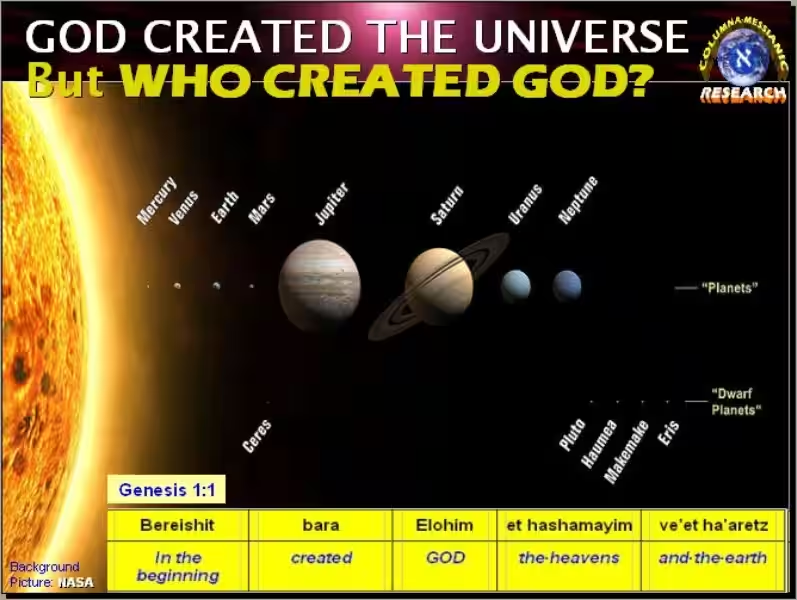
One of the most enduring avenues for contemplating “God exists proof” within religion is the argument from design, also known as the teleological argument. This perspective suggests that the sheer complexity, order, and apparent purpose we observe in the universe points towards an intelligent creator. Consider the intricate dance of a hummingbird’s wings, the precise orbital mechanics of planets, or the astonishingly complex biochemical processes that sustain life. These phenomena, proponents argue, are not simply the result of random chance but are indicative of a master designer at work.
Think of it like finding a watch on a deserted beach. If you discovered such an object, your immediate thought wouldn’t be that it spontaneously assembled itself from sand and seafoam. Instead, you’d infer the existence of a watchmaker, someone who meticulously crafted its gears and springs to serve a specific purpose. Similarly, the universe, with its laws of physics, the fine-tuning of constants, and the emergence of life, appears to be a testament to a divine intellect and intention. This perceived purposefulness is a powerful form of “God exists proof” for many, a signpost to something beyond the material realm.
The Moral Compass: Innate Sense of Right and Wrong
Another compelling area where “God exists proof” is often found is in the human experience of morality. Religions across the globe and throughout history have grappled with the concept of universal moral laws, the innate sense of justice, fairness, and compassion that seems to be hardwired into our being. Where does this inherent understanding of right and wrong originate? Is it merely a product of social evolution, or does it hint at a higher moral authority?
Consider the outrage we feel when witnessing an injustice, or the innate desire to help someone in need. These reactions often transcend cultural differences and personal upbringing. This universal moral intuition is seen by many as evidence for a divine source of morality, a God who has instilled in us a conscience and a guiding principle for ethical behavior. It suggests that our deepest moral convictions are not arbitrary but are echoes of a divine moral lawgiver, providing a profound “God exists proof” rooted in our shared humanity.
The Personal Revelation: Faith as Experiential Proof
Beyond philosophical arguments, the most potent form of “God exists proof” for religious individuals often lies in their personal experiences and faith. This is not something that can be objectively measured or demonstrated to others, but it is deeply real and transformative for the believer. These experiences can range from moments of profound spiritual insight and answered prayers to a persistent feeling of divine presence and guidance in their lives.
Many people describe a sense of peace in times of turmoil, an inexplicable feeling of being loved and supported, or a guiding intuition that leads them through difficult decisions. These are the whispers of faith, the quiet confirmations that, for them, constitute irrefutable “God exists proof.” It’s akin to falling in love; you can’t scientifically prove the existence of love to someone who has never felt it, but for those who have, it is a powerful and undeniable reality that shapes their lives.
The Miraculous and the Mystical: Signs in the Everyday
Throughout religious traditions, the concept of miracles and mystical experiences also serves as a significant form of “God exists proof.” These are events that are perceived to defy natural explanation, suggesting the intervention of a supernatural power. While often met with skepticism by those outside the faith, for believers, such occurrences can be pivotal moments that strengthen their conviction and belief.
From accounts of miraculous healing to seemingly impossible coincidences that align with one’s prayers or spiritual journey, these events are interpreted as divine affirmations. They are seen not as random anomalies but as deliberate interventions by a God who is actively engaged with the world and with humanity. This manifestation of the divine, however interpreted, provides a tangible, albeit subjective, form of “God exists proof” that resonates deeply within the hearts of believers.
The Transformative Power: Changed Lives as Evidence
Perhaps one of the most compelling, yet often overlooked, aspects of “God exists proof” within religion is the transformative power that faith can have on individuals and communities. When people embrace a religious path, many report profound shifts in their character, their outlook on life, and their behavior. They may find release from addiction, overcome deep-seated fears, or develop a newfound sense of purpose and meaning.
Consider the stories of individuals who, after finding faith, dedicate their lives to serving others, exhibiting unwavering compassion and selflessness. This radical positive change, this shedding of negative traits and the embrace of virtuous ones, is often attributed to the influence of God. This redemptive and restorative power of religion, leading to genuine human flourishing, stands as a powerful testament to the presence of a divine force for believers, offering a form of “God exists proof” that is observable in changed lives.
Ultimately, the quest for “God exists proof” within religion is a deeply personal and multifaceted one. It encompasses intellectual reasoning, intuitive understanding, and profound personal experience. For many, the evidence is not a single, conclusive piece of data, but a mosaic of interconnected insights – the order of the cosmos, the promptings of conscience, the whispers of the heart, and the undeniable transformations witnessed in lives touched by faith. These elements, woven together, form the rich tapestry of belief that has sustained humanity for millennia, offering a profound sense of connection to something greater than ourselves.
Frequently Asked Questions: God’s Existence and Religion
Does science prove or disprove God’s existence?
Science, by its nature, deals with the observable and testable physical world. The concept of God, as understood by most religions, transcends the physical and is therefore not directly subject to scientific proof or disproof. Science can explore the origins of the universe and life, but these explorations do not definitively confirm or deny the existence of a divine creator.
What are the main arguments for God’s existence?
Theistic arguments for God’s existence are diverse and have evolved over centuries. Some prominent ones include:
* Cosmological Argument: The idea that the universe must have a first cause or uncaused cause, which is identified as God.
* Teleological Argument (Argument from Design): The observation of order, complexity, and apparent purpose in the universe suggests an intelligent designer, i.e., God.
* Ontological Argument: This argument, put forth by philosophers like Anselm, attempts to prove God’s existence from the very definition of God as a perfect being, suggesting that existence is a necessary attribute of perfection.
* Moral Argument: The existence of objective morality or a universal sense of right and wrong is seen by some as evidence of a divine lawgiver.
* Argument from Religious Experience: Personal encounters with the divine or profound spiritual experiences are considered by believers to be evidence of God’s reality.
Yes, faith is often understood as belief or trust in something for which there is no empirical proof. Many religions posit that faith is a virtue and an essential aspect of a relationship with the divine. It can be a personal conviction that exists independently of scientific or logical demonstration.
What is religion and why do people practice it?
Religion is a system of beliefs, practices, and rituals that often centers on the worship of a god or gods, or on a particular set of values and ethics. People practice religion for a multitude of reasons, including:
* Seeking meaning and purpose: Religion can provide answers to fundamental questions about life, death, and existence.
* Moral guidance and community: Religions often offer ethical frameworks and foster a sense of belonging and shared identity.
* Comfort and hope: Faith can provide solace during times of suffering and offer hope for an afterlife.
* Understanding the unknown: Religion can serve as a way to comprehend phenomena that are difficult to explain through natural means.
* Spiritual fulfillment: Many seek a connection to something greater than themselves.
Are all religions the same?
While many religions share common themes such as the concepts of love, compassion, morality, and the search for transcendence, they differ significantly in their doctrines, deities, scriptures, rituals, and interpretations of the divine. The paths to spiritual understanding and the specific tenets of belief vary widely across different religious traditions.
If God is all-powerful and all-good, why is there suffering in the world?
This question, known as the “problem of evil” or “theodicy,” is one of the most challenging theological questions. Various religious and philosophical explanations exist, including:
* Free Will: Suffering arises from the choices made by humans.
* Greater Good: Suffering may be a necessary part of a larger, divine plan that is beyond human comprehension.
* Testing and Growth: Challenging experiences can lead to spiritual growth and character development.
* Mystery: Some believe that the reasons for suffering are ultimately unknowable to humans.