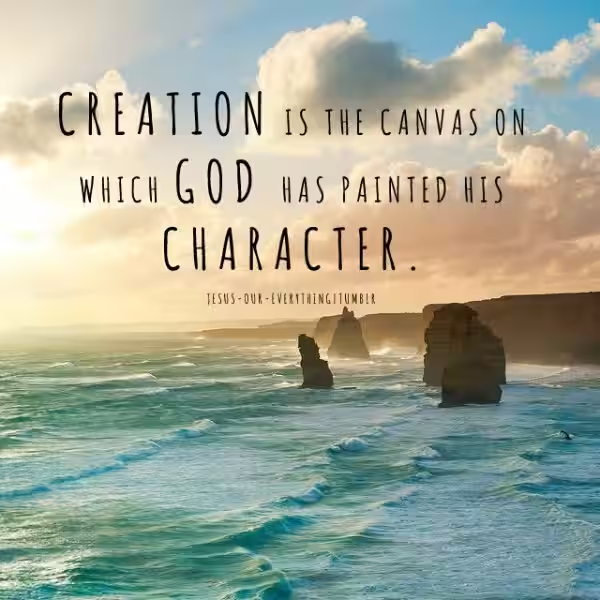
From the earliest whispers of human consciousness, we have gazed at the stars and pondered our origins. The vastness of the cosmos, the cyclical nature of life and death, the very existence of “something” from “nothing” – these fundamental questions have fueled humanity’s most profound spiritual quests. Religions, in their myriad forms, offer narratives that attempt to explain not just the creation of the universe but also the inevitable processes of destruction that seem to be woven into its very fabric. This is not a morbid preoccupation, but rather a profound engagement with the cycle of existence, a dance between what is brought into being and what is returned to the elemental.
Understanding these religious perspectives on creation and destruction is more than an academic exercise; it’s an invitation to explore our place within a grander narrative. It helps us grapple with the impermanence of our own lives, the challenges we face, and the enduring hope that even in the face of dissolution, something new can emerge. These stories, rich with symbolism and profound wisdom, offer frameworks for understanding the seemingly chaotic forces that shape our world and our souls.
The Genesis of All: Cosmic Beginnings and Divine Intent
The story of creation is often the foundational pillar of any religious tradition. It speaks of a divine architect, a supreme force, or a primordial energy that willed existence into being. These narratives are not merely tales of how stars ignited or planets formed; they are deeply symbolic accounts of order emerging from chaos, of purpose being infused into the void. They provide a sense of cosmic significance, assuring us that our existence is not random but part of a deliberate, albeit often mysterious, plan.
In many traditions, creation is an act of love, sacrifice, or even struggle. Consider the Abrahamic faiths, where God speaks the universe into existence through divine pronouncements. This highlights the power of the word and the intentionality behind the act of bringing forth life. Similarly, some Eastern philosophies speak of a cosmic egg or a primordial vibration, from which all reality unfurls. These diverse accounts emphasize the wonder and mystery inherent in the very act of becoming.
Myths of Origin: From Void to Vibrancy
The variety of creation myths across cultures is astonishing, yet a common thread often binds them: the transition from a state of nothingness or formlessness to a universe teeming with life and structure. For instance, the ancient Egyptian myth of Atum, who emerged from the primordial waters of Nun and self-created the first gods, illustrates the concept of self-generation and the emergence of a pantheon that would then continue the act of creation. This is a powerful metaphor for how even the most complex systems can arise from a single, potent source.
Another compelling example is found in the Hindu cosmogony, where Brahma, the creator god, is often depicted as emerging from a lotus that grows from the navel of Vishnu. This imagery suggests that the entire universe is supported by a divine being, and that creation is an ongoing process, sustained by a cosmic consciousness. The cyclical nature inherent in these stories, where creation is followed by periods of preservation and eventual dissolution, sets the stage for understanding the complementary force of destruction.
The Shadow of Entropy: The Inevitability of Destruction
While creation stories capture our imagination with their promise of new beginnings, the concept of destruction is equally vital in religious thought. It’s not simply an antithesis to creation, but a necessary partner in the cosmic ballet. Religions acknowledge that all things born must eventually fade, that structures crumble, and that what is built can and will be unmade. This understanding offers a profound realism, a way to face the impermanence that is an undeniable aspect of existence.
Destruction, in religious contexts, can manifest in various forms: the end of an age, the dissolution of the cosmos, or the judgement and annihilation of sin. These are not always viewed as purely negative events. Often, they are understood as purifying forces, clearing the ground for a rebirth, or as a necessary consequence of imbalance. Without destruction, there would be no room for renewal, no opportunity for a fresh start.
Cycles of Dissolution: Renewal Through Decay
Many religions incorporate the idea of cosmic cycles, where periods of creation, sustenance, and destruction are intricately linked. The Hindu concept of Yugas, vast epochs of time, exemplifies this. Each Yuga witnesses a gradual decline in righteousness, culminating in a period of dissolution (Pralaya), after which the cycle begins anew with a fresh creation. This cyclical view offers a comforting perspective: even the most catastrophic destruction is not an absolute end, but a transition.
Consider the Buddhist concept of Anicca (impermanence). This core teaching reminds us that all compounded things are subject to decay and dissolution. While this might sound bleak, it is also seen as liberating. By understanding and accepting the inevitability of destruction, we can detach ourselves from clinging to fleeting phenomena, allowing us to find peace amidst change. This acceptance of decay is, paradoxically, a pathway to a deeper, more enduring form of existence.
Divine Intervention: The Hand of God in Creation and Destruction
Across different faiths, the divine is often portrayed as the ultimate agent of both creation and destruction. Whether it’s a benevolent creator meticulously fashioning the world or a wrathful deity unleashing cataclysms, the hand of the divine is seen as guiding these fundamental processes. These portrayals reflect humanity’s innate desire to find meaning and purpose behind the often overwhelming forces that shape our reality.
The nature of the divine in these acts reveals much about a religion’s worldview. Is the divine a distant architect, or an immanent force actively involved in every moment? Is destruction a sign of anger, or a necessary part of a grander, inscrutable plan? Exploring these questions helps us understand the ethical frameworks and theological underpinnings of various religious traditions.
The Dual Nature of the Divine: Creator and Destroyer
In some traditions, a single deity embodies both creation and destruction. Shiva in Hinduism is a prime example, revered as both the destroyer of illusion and the transformer who paves the way for new beginnings. His Tandava dance, a cosmic dance of destruction, is simultaneously a force of creation, signifying that destruction is not an end but a prelude to rebirth. This duality challenges our simplistic notions of good and evil, suggesting that these forces are often intertwined and interdependent.
In Zoroastrianism, the conflict between the benevolent creator Ahura Mazda and the destructive spirit Angra Mainyu (Ahriman) highlights the cosmic battle between good and evil. While Angra Mainyu actively seeks to destroy creation and spread chaos, Ahura Mazda works to preserve and perfect it. This dualistic perspective emphasizes the ongoing struggle and the importance of human choices in aligning with the forces of creation over destruction.
Finding Meaning in the Cycle: Human Response to Cosmic Rhythms
The religious narratives of creation and destruction are not just abstract theological discussions; they offer profound guidance for how humans can navigate their own lives. By understanding the cosmic rhythm of becoming and unmaking, individuals and communities can find resilience, purpose, and hope. These stories help us contextualize our own experiences of loss, change, and renewal, reminding us that we are part of something much larger than ourselves.
The acceptance of impermanence, a recurring theme, is a powerful antidote to the fear of death and the anxiety of change. Religions provide rituals, practices, and communities that help individuals process both creation and destruction within their own lives, fostering a sense of continuity and belonging even in the face of personal endings. This is where the profound utility of these ancient narratives truly shines.
The Path of Transformation: Embracing Impermanence
Ultimately, the religious understanding of creation and destruction encourages a path of transformation. It teaches us that true growth often comes from acknowledging and embracing endings. Just as an old forest must decay to nourish new saplings, so too must we allow aspects of ourselves and our lives to dissolve so that we can recreate ourselves with greater wisdom and strength. This is the essence of spiritual maturity.
The journey of faith often involves confronting personal “destructions” – the loss of loved ones, the failure of dreams, the shattering of illusions. Religions offer frameworks for making sense of these painful experiences, reframing them not as absolute defeats but as crucial steps in a larger, ongoing process of becoming. By embracing this cosmic dance, we can move through life with greater equanimity, courage, and a profound appreciation for the ever-unfolding miracle of existence.
Frequently Asked Questions: Creation, Destruction, and Religion
What are common religious beliefs about creation?
Many religions have creation narratives that describe how the universe and life came into being. These often involve a divine being or beings as the source of creation. Examples include the Abrahamic religions (Judaism, Christianity, Islam) with their accounts of God creating the world, or Hindu cosmologies that describe cyclical creation and destruction.
How do religions address the concept of destruction?
Destruction in religious contexts can refer to several ideas, including the end of the world (apocalypse or eschatology), divine judgment leading to destruction of evil, or the natural cycle of death and rebirth. Some traditions emphasize a final judgment or a transformation of the world, while others see destruction as a necessary part of renewal or karmic consequence.
What is the relationship between religion and scientific theories of creation and destruction?
Religious beliefs about creation and destruction are often distinct from scientific theories. Science explains origins and cosmic events through natural processes and observable evidence, such as the Big Bang theory for the universe’s origin or geological and astronomical processes for destruction. While some individuals and belief systems find harmony between faith and science, others see them as separate domains or in conflict.
Are there religious perspectives on the destruction of the Earth?
Yes, many religions have prophecies or doctrines concerning the end of the world or the Earth as we know it. These can range from catastrophic events caused by divine intervention to periods of purification or transformation before a new era. The interpretation and timing of these events vary widely among different faiths.
How do religions view the purpose of creation?
The perceived purpose of creation varies significantly. Some religions teach that creation was an act of divine love or a demonstration of God’s glory. Others see it as a stage for spiritual development, a test for humanity, or a cosmic play (lila) where divine beings and souls interact and learn. The ultimate purpose is often tied to the relationship between humanity and the divine or the attainment of spiritual liberation.