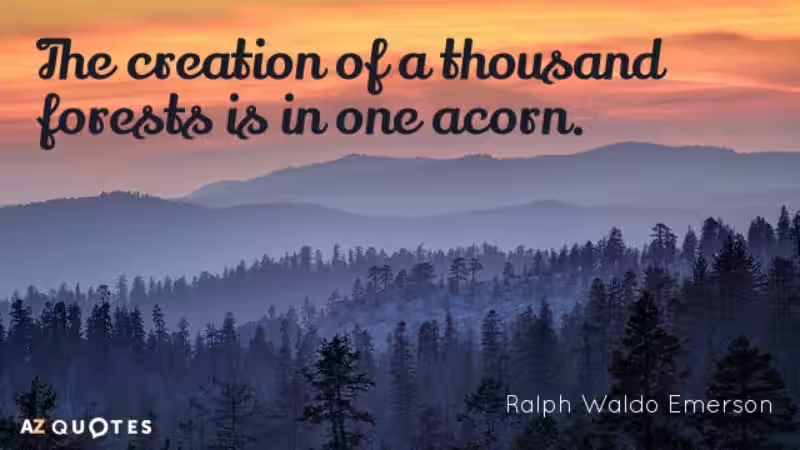
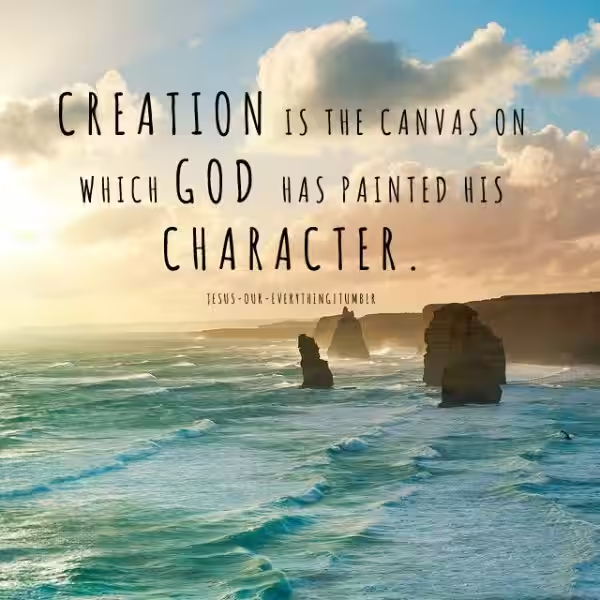
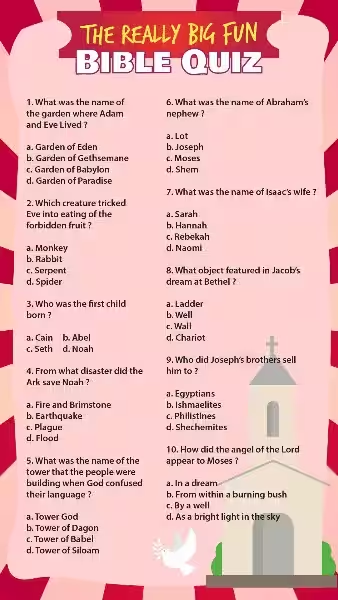
From the dawn of human consciousness, the question of our origins has been a central pillar of religious thought and philosophical inquiry. We gaze at the vastness of the cosmos, the intricate dance of nature, and the very spark of life within ourselves, and a profound sense of wonder arises. This wonder often leads us to seek understanding, to find meaning in our existence, and to connect with something larger than ourselves. Religion, in its myriad forms, offers a framework for this exploration, providing narratives, rituals, and, crucially, sacred texts filled with profound insights. These texts, often passed down through generations, are rich with quotes about creation that resonate with the human spirit, offering comfort, guidance, and a sense of purpose.
Throughout history, diverse cultures and traditions have grappled with the mystery of beginnings. Whether it’s the Genesis account of a divine architect shaping the universe from nothingness, the Buddhist concept of interconnectedness and cyclical existence, or indigenous creation stories that speak of primordial waters and ancestral beings, the underlying theme is a search for the ultimate source. These religious perspectives on creation are not merely historical curiosities; they continue to shape our understanding of the world and our place within it, offering a spiritual lens through which to view the marvels of the universe. Examining these quotes about creation allows us to delve into the heart of human faith and the enduring quest for answers to life’s most fundamental questions.
The Genesis of Existence: Divine Design and Purpose
Perhaps the most widely recognized narrative of creation comes from the Abrahamic traditions, particularly the Book of Genesis. This account paints a vivid picture of a powerful and deliberate Creator who, through divine decree, brings forth the heavens, the earth, and all living things. The emphasis is on order, intention, and a grand design. Consider the words often attributed to this divine act: “In the beginning, God created the heavens and the earth.” This simple yet powerful statement encapsulates the foundational belief that the universe did not arise by chance but by the conscious will of a higher power. This perspective instills a sense of inherent value and purpose in all of creation, suggesting that everything has a place and a reason for its existence within a divine plan.
The Genesis narrative extends beyond the mere act of bringing matter into being. It details a step-by-step process, highlighting the separation of light from darkness, land from sea, and the creation of celestial bodies, flora, fauna, and finally, humanity. This meticulous unfolding suggests a divine artist carefully crafting each element. As the text continues, we find further quotes about creation that underscore this deliberate artistry, such as the repeated refrain, “And God said, ‘Let there be…'” This phrase emphasizes the power of the divine word as the catalyst for existence. For many believers, this narrative provides not just an origin story but a foundation for morality and ethics, as humanity is often depicted as created in the “image of God,” implying a responsibility to reflect divine attributes in our own lives. It’s a cosmic blueprint that offers a sense of order in a seemingly chaotic world.
Within the framework of creation narratives, the unique position of humanity is frequently highlighted. Often, humans are presented as the pinnacle of creation, endowed with special attributes and a distinct purpose. The Genesis account, for instance, states, “Let us make humankind in our image, after our likeness; and let them have dominion over the fish of the sea, and over the birds of the air, and over the cattle, and over all the earth, and over every creeping thing that creeps upon the earth.” This depiction suggests a dual nature for humanity: a connection to the divine, implying inherent dignity and potential, and a stewardship over the natural world. This is a concept that resonates deeply, prompting reflection on our interconnectedness with all life.
This notion of dominion, however, is often interpreted not as unrestricted exploitation but as a sacred trust. Many religious scholars and theologians emphasize that true stewardship involves care, responsibility, and a recognition of the intrinsic worth of all of God’s creations. A quote often paraphrased from various religious texts might be, “The earth is the Lord’s, and all that is in it.” This sentiment underscores the idea that we are caretakers, not owners, of the planet and its resources. This understanding can foster a deep respect for nature and a commitment to environmental preservation, recognizing that our actions have consequences that extend beyond our immediate needs. It’s a powerful reminder that our existence is interwoven with the well-being of the entire ecosystem.
Beyond the Beginning: Creation in Eastern Traditions
While the Abrahamic traditions offer a linear narrative of creation, Eastern religious philosophies often present a more cyclical or emergent view of existence. Buddhism, for example, does not typically posit a singular, external creator God in the same way. Instead, its focus is on the interconnectedness of all phenomena and the concept of dependent origination, or pratītyasamutpāda. This idea suggests that all things arise in dependence upon other things, creating a vast web of cause and effect. There isn’t a moment of absolute “creation” from nothingness, but rather an eternal unfolding and transformation. As the Buddha is often quoted as saying, or at least his teachings imply, “All things are impermanent.” This applies to the universe itself, which is seen as constantly changing and evolving.
In Hinduism, the concept of creation is often depicted through elaborate cosmologies involving cycles of creation, preservation, and destruction. Deities like Brahma (the creator), Vishnu (the preserver), and Shiva (the destroyer) play crucial roles in these cosmic cycles. The Rigveda, one of the oldest scriptures, contains hymns that explore the origins of the universe, sometimes questioning its ultimate source. A famous hymn, the Nasadiya Sukta, muses, “Who truly knows, and who can declare it? Whence it arose, and whence this creation?” This reflects a profound intellectual curiosity and an acceptance of the mystery inherent in ultimate origins. These quotes about creation from Eastern traditions invite us to consider a universe that is dynamic, ever-changing, and deeply interconnected, where the distinction between creator and creation can be more fluid.
Regardless of the specific religious tradition, there is a recurring theme: the intricate beauty and complexity of the natural world are often seen as evidence of divine intelligence and artistry. The delicate structure of a snowflake, the unfurling of a fern frond, the migration patterns of birds – these marvels are frequently interpreted as manifestations of a Creator’s hand. This perspective encourages a sense of awe and reverence for the natural world. For many, observing the wonders of creation is a form of worship, a way to connect with the divine by appreciating its handiwork. A common sentiment, often expressed in various forms, might be paraphrased as, “Look at the birds of the air, they do not sow or reap, yet your heavenly Father feeds them.” This highlights the divine providence that sustains all life.
This appreciation for the detail and harmony of nature can lead to a profound sense of gratitude. It suggests that the universe is not a cold, indifferent mechanism but a rich tapestry woven with meaning and purpose. Even in the smallest of organisms, there are complex systems at play, pointing towards an intelligence that transcends human comprehension. This can foster a deep sense of humility and a recognition of our own limitations. When we marvel at the vastness of space or the intricacy of DNA, we are, in a sense, encountering the divine. These observations reinforce the idea that creation is a continuous act, a living testament to the power and creativity of the sacred.
Modern Interpretations and Enduring Questions
In our modern, scientifically-driven world, the religious understanding of creation continues to evolve and engage with new discoveries. While science explores the “how” of the universe’s formation through theories like the Big Bang and evolution, religion often continues to address the “why” – the purpose, meaning, and ultimate source behind it all. These are not necessarily conflicting perspectives but can be seen as complementary ways of understanding reality. Many theologians and scientists find ways to reconcile scientific findings with religious faith, seeing scientific laws as the very mechanisms by which the divine operates. A common paraphrased quote from religious thinkers might be, “Science explains the mechanics of the universe, while religion provides its meaning.”
The enduring power of quotes about creation and religion lies in their ability to speak to our deepest human needs: the need for connection, for belonging, and for understanding our place in the grand scheme of things. Whether we find solace in the story of a deliberate Creator, the interconnectedness of all life, or the awe-inspiring complexity of nature, these religious narratives offer a framework for navigating existence. The questions of origin are timeless, and the spiritual insights found in religious texts continue to provide comfort and inspiration to billions around the globe. The ongoing dialogue between faith and reason ensures that the exploration of creation will remain a vibrant and essential aspect of the human experience.
Frequently Asked Questions About Quotes on Creation and Religion
What are some common themes in religious quotes about creation?
Many religious quotes about creation emphasize God’s power, wisdom, and love as the source of all existence. They often highlight the orderliness and beauty of the universe as evidence of divine design. Themes of purpose, humanity’s place in creation, and stewardship are also prevalent.
Can you provide an example of a quote about creation from Christianity?
“In the beginning, God created the heavens and the earth.” – Genesis 1:1 (The Bible)
What about quotes on creation from Islam?
“He it is Who created the heavens and the earth in six days, and His Throne had been upon water, that He might test you as to which of you is best in deed.” – Quran 11:7
Are there any quotes on creation from Hinduism that touch on divine origin?
“From Him [Brahman] is born all this; in Him it dissolves; in Him it is sustained.” – Rigveda (as paraphrased in various philosophical interpretations)
How do religious quotes about creation relate to the concept of faith?
Religious quotes about creation often serve as foundational statements of faith, asserting belief in a divine creator without requiring empirical proof. They encourage believers to trust in the divine narrative and find meaning in their existence through it.
Do quotes about creation from different religions share any similarities?
Despite differing details and theological nuances, many religious quotes about creation share a common thread of a transcendent power or entity responsible for bringing the universe into being. They often express awe and reverence for this creative force.
Can quotes about creation from religion offer comfort or guidance?
Yes, these quotes can offer comfort by providing a sense of order and purpose in a vast universe. They can also offer guidance by suggesting a moral framework and a relationship with a divine creator, encouraging responsible living and belief.