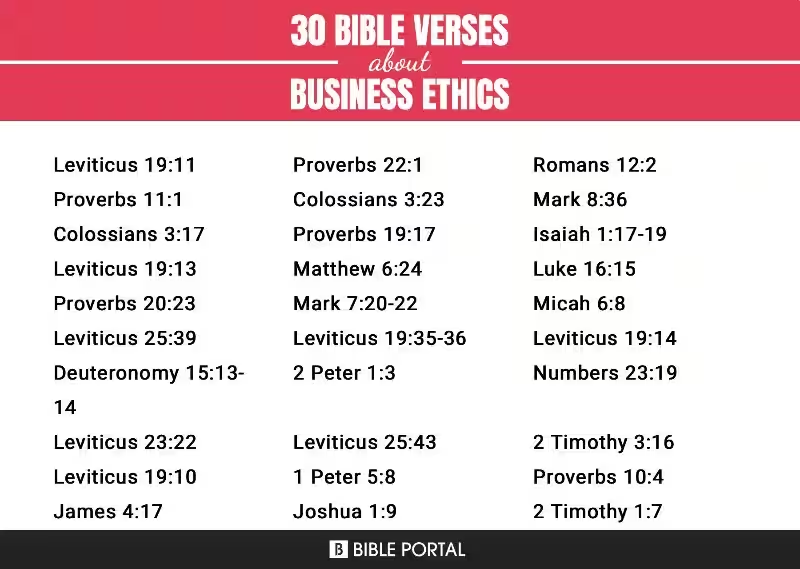
In the bustling arena of commerce, where profit margins and competitive pressures often dominate the discourse, the question of ethical conduct can sometimes feel like a secondary concern. Yet, for many, faith provides not just a spiritual anchor, but a powerful ethical framework that should permeate every aspect of life, including the workplace. The Bible, far from being a purely religious text, offers a rich tapestry of wisdom concerning integrity, fairness, and responsible stewardship, providing practical guidance for ethical business practices. Understanding and applying these ancient principles can transform not only individual businesses but also the broader economic landscape, fostering trust and sustainable success.
This exploration delves into the profound intersection of faith and commerce, illuminating how biblical teachings offer a timeless blueprint for ethical decision-making in the modern business world. We will uncover specific verses and explore their relevance to everyday business scenarios, demonstrating that a commitment to ethical principles, rooted in religious conviction, can be a significant competitive advantage and a source of deep personal fulfillment.
The Foundation of Fairness: Integrity and Honesty in Business
At the heart of biblical ethics lies a steadfast commitment to truthfulness and integrity. This principle is not merely a suggestion; it is a divine imperative that underpins all healthy relationships, including those between businesses and their customers, employees, and partners. The Bible consistently emphasizes the importance of being upright in our dealings, avoiding deception, and treating others as we would wish to be treated.
One foundational verse that resonates deeply within the business context is found in Proverbs 11:1, which states, “Honest scales are the Lord’s delight, but dishonest weights are an abomination.” This imagery of accurate weights and measures speaks directly to the need for transparency and fairness in all transactions. Imagine a shopkeeper who consistently provides exactly what is advertised, without shortchanging customers or misrepresenting the quality of their goods. This adherence to truth builds lasting trust and a sterling reputation, far more valuable than any short-term gain from deception. Similarly, in the realm of finance, avoiding hidden fees or misleading contracts aligns with this biblical mandate for honest scales.
Another powerful teaching comes from Leviticus 19:11, which commands, “Do not steal or cheat or defraud one another.” This prohibition extends beyond outright theft to encompass any form of dishonest gain at the expense of another. In business, this can manifest in various ways. For example, an employer who deliberately withholds wages earned by an employee is, in essence, stealing. Likewise, a company that engages in predatory pricing to drive competitors out of business or a salesperson who exaggerates product benefits to secure a sale could be seen as defrauding. The Bible calls for a business environment built on mutual respect and genuine value exchange, where profit is a result of honest work and fair dealings, not exploitation.
The Golden Rule in the Boardroom: Treating Others with Respect
Jesus’ profound teaching, often referred to as the Golden Rule, offers a universally applicable principle for ethical conduct: “So in everything, do to others what you would have them do to you” (Matthew 7:12). This simple yet powerful directive serves as a compass for navigating complex business decisions. It urges us to put ourselves in the shoes of others – our employees, our customers, our suppliers, and even our competitors – and to act accordingly.
Applying the Golden Rule in business means prioritizing fair treatment and empathy. For instance, when considering layoffs, a business leader guided by this principle would not only focus on financial viability but also on the impact on the livelihoods of their employees. They would strive to offer support, fair severance packages, and assistance in finding new employment, minimizing the hardship caused. Similarly, when dealing with a customer complaint, responding with understanding and a genuine desire to resolve the issue reflects the Golden Rule. It’s about recognizing the humanity in every interaction and extending the same consideration we would expect for ourselves.
This principle also extends to the fairness of compensation and working conditions. If we expect to be paid fairly for our labor and to work in a safe and respectful environment, then we are morally obligated to provide these same conditions for our employees. This means establishing competitive wages, reasonable working hours, and a workplace culture that values dignity and respect for all. Ultimately, the Golden Rule fosters a virtuous cycle of good treatment, leading to increased loyalty, productivity, and a more positive overall business environment.
Stewardship and Responsible Management: Beyond Personal Gain
The Bible presents a worldview where individuals are not owners of their resources but rather stewards entrusted with them by a higher power. This concept of stewardship fundamentally shifts the perspective from self-serving accumulation to responsible management for the benefit of others and for a greater purpose. In business, this translates to a deep responsibility to manage resources, whether financial, human, or environmental, with care and foresight.
1 Timothy 6:10 warns, “For the love of money is a root of all kinds of evil.” While financial success is not inherently wrong, the unchecked pursuit of wealth at any cost can lead to unethical compromises. This verse reminds business leaders that money should be a tool, not an ultimate goal. A steward understands that profits are not just for personal enrichment but also for reinvestment, for supporting employees, for contributing to the community, and for furthering the mission of the business in a way that aligns with ethical values. For example, a company might choose to invest in sustainable practices even if they are initially more expensive, recognizing their long-term responsibility to the environment.
Furthermore, the principle of stewardship extends to how we treat our employees and the resources we utilize. Proverbs 22:29 speaks of diligence and skill: “Do you see a man skilled in his work? He will stand before kings; he will not stand before obscure men.” This highlights the importance of competence and hard work, but also implies a responsibility to develop and utilize those skills for good. A good steward will invest in their employees’ development, providing opportunities for growth and learning. They will also manage physical resources efficiently and sustainably, minimizing waste and environmental impact. This is not just about being “green” for public relations; it’s about recognizing that all the resources we use are ultimately borrowed, and we are accountable for their responsible use.
Justice and Fairness in Dealing with Employees and Stakeholders
A cornerstone of biblical ethics in business is the pursuit of justice and fairness in all dealings, especially concerning those who contribute to the success of the enterprise. This involves ensuring that employees are treated equitably, that suppliers are paid promptly, and that customers receive genuine value.
Deuteronomy 24:14-15 provides a stark reminder: “Do not oppress a hired worker who is poor and needy, whether he is one of your own people or one of the foreigners living in your land. Pay him his wages each day before the sun sets, because he is needy and depends on it. Otherwise he may cry out to the Lord against you, and you will be guilty of sin.” This verse is a direct and powerful condemnation of exploiting vulnerable workers. It emphasizes the urgency of fair compensation and the severe consequences of delaying payments. In a modern context, this speaks to the importance of timely payroll, fair wage structures, and avoiding any practices that might exploit the financial vulnerability of employees, such as excessive overtime without commensurate pay or the imposition of unfair penalties.
Beyond wages, fairness also encompasses respectful treatment and equitable opportunities. The Bible consistently advocates for the dignity of every individual, regardless of their social standing or background. This translates to creating a workplace that is free from discrimination, harassment, and unfair favoritism. A business that promotes individuals based on merit, provides equal opportunities for advancement, and fosters a culture of mutual respect is actively living out biblical principles of justice. For example, implementing transparent promotion criteria and ensuring diverse representation in leadership positions are practical ways to embody this commitment.
The Impact of Ethical Business on Society and Reputation
Ethical business practices, guided by biblical principles, have a profound and far-reaching impact, extending beyond individual transactions to shape the broader economic and social landscape. Companies that operate with integrity and a commitment to fairness often build stronger reputations, foster greater customer loyalty, and attract and retain top talent. This is not simply a matter of good PR; it is the natural consequence of building a business on a foundation of trust and respect.
The Bible teaches that our actions have consequences, and this holds true in the marketplace. Galatians 6:7 reminds us, “Do not be deceived: God cannot be mocked. A man reaps what he sows.” This principle of sowing and reaping applies directly to business. A company that sows seeds of deception, exploitation, or unfairness will ultimately reap a harvest of distrust, declining sales, and damaged relationships. Conversely, a business that sows seeds of honesty, integrity, and genuine care will cultivate a harvest of loyal customers, dedicated employees, and a positive community standing.
Consider the example of a company that consistently prioritizes quality over shortcuts, even when it might mean slightly lower immediate profits. This commitment to excellence builds a reputation for reliability, leading to repeat business and positive word-of-mouth referrals. Such a company is sowing seeds of trust and will likely reap a long-term reward of sustained success. In contrast, a business that cuts corners or engages in deceptive marketing might see short-term gains, but the seeds of distrust will eventually undermine its foundation, leading to eventual decline. Ultimately, ethical business is not a burden, but a strategic advantage that builds a legacy of integrity and lasting value.
In conclusion, the Bible offers a compelling and practical guide for navigating the complexities of business with an unwavering ethical compass. By embracing principles of honesty, fairness, stewardship, and justice, businesses can not only achieve financial success but also contribute to a more equitable and trustworthy marketplace. These timeless teachings provide a roadmap for building businesses that are not only profitable but also principled, leaving a positive and lasting impact on the world.
Frequently Asked Questions: Bible Verses on Ethics in Business
What does the Bible say about honesty in business?
The Bible consistently emphasizes honesty and integrity in all dealings. Proverbs 11:1 states, “False scales are an abomination to the Lord, but a just weight is his delight.” This verse highlights God’s disapproval of deceitful practices. Colossians 3:23 encourages believers to “Whatever you do, work heartily, as for the Lord and not for men.” This implies that all business activities should be conducted with the same diligence and honesty as if working directly for God.
How does the Bible address fair treatment of employees?
Scripture calls for employers to treat their employees justly and with respect. Ephesians 6:9 instructs masters to “do the same to them, and stop threatening, knowing that he also has a Master in heaven. There is no partiality with him.” This emphasizes the importance of impartiality and fair treatment, recognizing that both employers and employees are accountable to a higher authority. Deuteronomy 24:14-15 also states, “You shall not oppress a hired servant who is poor and needy, whether he is one of your brothers or one of the sojourners who are in your land within your towns. You shall give him his wages on his day, before the sun sets, for he is poor and counts on it, lest he cry against you to the Lord, and you be guilty of sin.” This underscores the obligation to pay workers promptly and fairly.
What are the biblical principles regarding greed and wealth?
The Bible warns against the dangers of greed and the love of money. 1 Timothy 6:10 says, “For the love of money is a root of all kinds of evils. It is through this craving that some have wandered away from the faith and pierced themselves with many pangs.” Jesus also taught in Luke 12:15, “Take care, and be on your guard against all covetousness, for one’s life does not consist in the abundance of his possessions.” These verses highlight that true fulfillment is not found in material wealth but in a right relationship with God and others.
How does the Bible view contracts and agreements?
The Bible upholds the sanctity of agreements and promises. Proverbs 6:1-3 warns against becoming surety for a debt, stating, “My son, if you have put your hand to your neighbor’s pledge, if you have been snared by the words of your mouth, then do this, my son, escape from the hand of your neighbor: go, humble yourself, and earnestly plead with your neighbor.” This emphasizes the seriousness of commitments made. Psalm 15:4 also includes in the description of one who may dwell in God’s tent, “who swears to his own hurt and does not change.” This points to the importance of keeping one’s word, even when it becomes difficult.
What are the biblical guidelines for lending and borrowing?
The Bible offers principles for responsible financial stewardship, including caution with lending and borrowing. Proverbs 22:7 states, “The rich rules over the poor, and the borrower is the slave of the lender.” This highlights the potential burdens of debt. While not strictly prohibiting lending, the emphasis is on wisdom and avoiding unnecessary financial entanglements. Passages like Exodus 22:25 and Leviticus 25:35-37 also speak to lending with compassion and without charging interest to fellow Israelites in need, advocating for a spirit of generosity and relief.
Does the Bible address fair pricing and profit?
While the Bible doesn’t provide specific rules for pricing, it emphasizes fairness and avoiding exploitation. The principles of honesty and not taking advantage of others, as seen in the verses about fair scales and honest dealings, extend to pricing. The focus is on conducting business in a way that honors God and treats others justly, rather than solely maximizing profit at any cost.