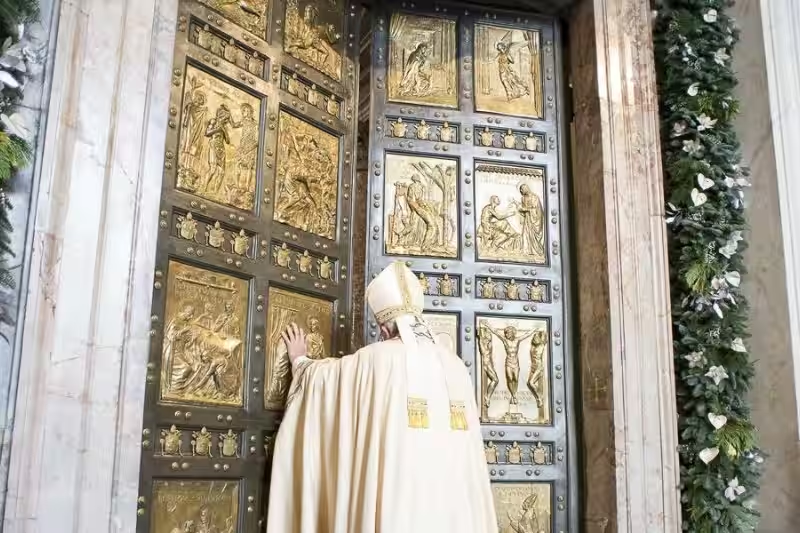
There’s a profound magic held within the first sentence of a book, a whispered invitation that can either beckon us into a new world or leave us standing at the threshold. For those of us drawn to the spiritual, the religious, and the deeply human quest for meaning, these opening lines often carry an extra weight. They are the sacred doorways, hinting at the profound journeys of faith, doubt, and revelation that lie within. The right opening can instantly connect us to themes of creation, the divine, the struggle for righteousness, or the quiet contemplation of the infinite.
Think of it like stepping into a hallowed space. A well-crafted opening line is the scent of incense, the chant of a distant choir, or the first beam of sunlight piercing the stained glass. It sets the tone, establishes the atmosphere, and promises an experience that can nourish the soul. This article will explore some of literature’s most compelling opening lines from religious and spiritually-inflected works, not just for their literary brilliance, but for their ability to immediately evoke the vast and varied landscape of human faith.
The Genesis of Meaning: Beginnings That Speak of Creation and Divine Order
The very act of creation is a cornerstone of many religious narratives, and the opening lines of certain books capture this awe-inspiring moment with breathtaking power. These beginnings often speak of a primordial state, a divine spark igniting existence, or a universe brought into being through an intentional, sacred act. They are the foundational whispers that echo through scripture and theological discourse, reminding us of our origins and the grand design that may encompass us.
Consider the stark, powerful simplicity of certain foundational texts. One might open with a declaration of absolute existence, like: “In the beginning, God created the heavens and the earth.” This single sentence, from the Book of Genesis, doesn’t just state a fact; it establishes a cosmic authority and a divine architect. It’s a statement that sets the stage for all of human history, positing a singular point of origin from which all subsequent events unfold. It’s a powerful testament to the idea that our existence is not accidental but the result of a deliberate, divine intention.
Beyond the literal creation of the physical world, other religious narratives begin by exploring the inherent spiritual order or the divine nature that underpins reality. A book might start with a philosophical assertion about the ultimate truth or the source of all being. For example, an opening line could declare: “The Absolute Reality is that which is One.” This kind of beginning immediately draws the reader into a realm of metaphysical inquiry, hinting at a singular, all-encompassing divine presence that transcends individual experiences. It’s an invitation to contemplate the unity behind diversity, the profound interconnectedness that many spiritual traditions seek to illuminate.
Echoes of the Divine: Opening Lines That Introduce the Sacred and the Profane
Many religious texts and spiritually-themed novels grapple with the complex interplay between the divine and the human, the sacred and the mundane. Their opening lines often serve as a bridge, introducing characters or situations that are on the cusp of a spiritual awakening, or are already deeply immersed in a world where the divine is an ever-present, if sometimes unseen, force. These beginnings can be introspective, dramatic, or even jarring, reflecting the diverse ways faith manifests in our lives.
A compelling opening in this vein might read: “He was a man of God, though his faith was as fragile as a moth’s wing.” This sentence immediately creates a sense of intrigue and internal conflict. It introduces a protagonist whose identity is tied to the divine, yet simultaneously hints at the vulnerability and human frailty that can accompany spiritual devotion. It’s a relatable paradox, suggesting that even those closest to God are subject to doubt, temptation, or personal struggle. The reader is invited to explore this delicate balance, to witness a journey of faith that is far from guaranteed.
Alternatively, a story might begin with an observation that elevates the ordinary to the level of the sacred: “The dew on the morning grass held the glint of a million tiny prayers.” This poetic opening transforms a simple natural phenomenon into a visual metaphor for spiritual aspiration. It suggests that the divine can be found not just in grand pronouncements or sacred rituals, but in the subtle, everyday beauty of the world around us. It’s a reminder that our spiritual lives are woven into the fabric of our daily existence, waiting to be recognized and appreciated. This kind of opening can profoundly shift a reader’s perspective, encouraging them to look for the divine in unexpected places.
The Call to Righteousness: Beginnings That Explore Morality and Spiritual Struggle
The concept of righteousness, of living a morally upright life in accordance with divine principles, is central to many faiths. Books that explore this theme often commence with opening lines that immediately establish a sense of moral imperative, a call to action, or a depiction of spiritual conflict. These beginnings can be stark warnings, hopeful proclamations, or deeply personal reflections on the struggle to live a life of integrity.
A classic example of a morally charged opening might be: “For the wages of sin is death, but the gift of God is eternal life in Christ Jesus our Lord.” This powerful excerpt from the New Testament (Romans 6:23) is not just a statement of theological consequence; it’s a profound declaration of the stakes involved in human choices. It presents a clear dichotomy, urging the reader to consider the gravity of their actions and the ultimate reward or punishment. This opening doesn’t shy away from difficult truths, instead offering a direct and unflinching portrayal of the spiritual battle between good and evil.
In a fictional context, an opening line might explore the personal journey of seeking righteousness: “She resolved, on that rain-swept Tuesday, to finally let go of the anger that had coiled in her heart like a serpent.” This sentence immediately plunges the reader into a personal narrative of redemption and self-mastery. It’s relatable because it speaks to the universal human experience of carrying emotional burdens and the conscious decision to seek a more peaceful and spiritually aligned existence. The imagery of the serpent is a potent symbol of sin or negativity, and its release signifies a step towards a purer, more righteous state of being. This opening promises a story of transformation and the difficult but rewarding path towards inner peace.
Contemplation and the Infinite: Opening Lines That Invite Spiritual Reflection
Some of the most profound religious and spiritual books don’t necessarily begin with grand pronouncements or dramatic conflicts. Instead, they might open with lines that invite deep contemplation, a quiet stillness, or a sense of wonder about the vastness of the universe and the mystery of existence. These beginnings are like a gentle hand guiding us towards introspection, encouraging us to pause, to reflect, and to connect with something larger than ourselves.
Imagine an opening that sets a tone of profound introspection: “The silence between the stars is the loudest sound I have ever known.” This evocative line immediately transports the reader to a place of cosmic awe and personal insignificance, yet also profound connection. It suggests that the true nature of reality might be found not in noise and activity, but in the quietude, in the vast, silent spaces that surround us. This opening invites us to consider the universe as a spiritual text, one that speaks through its immense scale and its profound silences. It’s a call to listen to the whispers of the infinite.
Another approach might be to begin with a question that probes the very nature of our understanding: “What if the divine did not speak in thunder, but in the rustling of leaves?” This rhetorical question challenges conventional notions of how we perceive or interact with the sacred. It suggests that spirituality can be subtle, gentle, and found in the most unassuming aspects of nature. This opening line encourages the reader to re-evaluate their assumptions about the divine and to open their minds to a more nuanced and pervasive form of spiritual presence. It’s an invitation to a more attentive and open-hearted engagement with the world.
In conclusion, the opening lines of books that delve into religion and spirituality are more than just literary devices; they are sacred invitations. They have the power to ignite curiosity, inspire contemplation, and set the stage for profound journeys of faith and understanding. Whether they speak of creation, moral struggle, or the silent wonders of the infinite, these initial words can act as powerful beacons, guiding us towards deeper meaning and a richer connection with the spiritual dimensions of life. The next time you pick up a book with a religious or spiritual theme, pay close attention to its opening. You might just find yourself stepping through a doorway to a world of profound revelation.
Frequently Asked Questions: Books with Great Opening Lines
What are some books that are famous for their opening lines?
Many books are celebrated for their memorable and impactful opening lines. Some of the most frequently cited examples include:
“Call me Ishmael.” – Moby Dick by Herman Melville
“It was the best of times, it was the worst of times…” – A Tale of Two Cities by Charles Dickens
“Happy families are all alike; every unhappy family is unhappy in its own way.” – Anna Karenina by Leo Tolstoy
“All children, except one, grow up.” – Peter Pan by J.M. Barrie
“It is a truth universally acknowledged, that a single man in possession of a good fortune, must be in want of a wife.” – Pride and Prejudice by Jane Austen
“Lolita, light of my life, fire of my loins.” – Lolita by Vladimir Nabokov
“It was a bright cold day in April, and the clocks were striking thirteen.” – Nineteen Eighty-Four by George Orwell
“It is a far, far better thing that I do, than I have ever done; it is a far, far better rest that I go to than I have ever known.” – A Tale of Two Cities by Charles Dickens (Note: While this is technically an *ending* line, it’s often discussed in the context of powerful literary statements.)
Religion is a complex and multifaceted phenomenon that generally refers to a set of beliefs, practices, rituals, and moral codes that people adhere to, often involving a supernatural or divine power, a guiding philosophy, or a commitment to a particular way of life. It can provide a framework for understanding the world, one’s place in it, and the meaning of existence.
What are some of the major world religions?
The major world religions, in terms of number of adherents, include:
Christianity
Islam
Hinduism
Buddhism
Sikhism
Judaism
There are also numerous other significant religions and spiritual traditions practiced around the globe.
What are the common elements found in many religions?
While diverse, many religions share common elements, such as:
Belief in a higher power or a transcendent reality.
Sacred texts or scriptures that convey teachings and stories.
Rituals, ceremonies, and practices that express devotion or connect with the divine.
Moral or ethical guidelines for behavior.
A sense of community and shared identity among followers.
Concepts of the afterlife or spiritual destiny.
Ways to understand suffering and to find meaning in life.
What is the difference between a religion and a spirituality?
The terms “religion” and “spirituality” are often used interchangeably but can have distinct meanings. Religion typically refers to an organized system of beliefs and practices, often with established institutions, traditions, and communal worship. Spirituality, on the other hand, can be more individual and personal, focusing on a sense of connection to something larger than oneself, a search for meaning and purpose, and inner peace, without necessarily adhering to a specific religious dogma or structure. One can be spiritual without being religious, and some find spirituality within their religious practice.
How do religions influence societies?
Religions have profoundly influenced societies throughout history and continue to do so. They can shape:
Moral and legal systems.
Cultural traditions, art, music, and architecture.
Social norms and values.
Political structures and movements.
Charitable and humanitarian efforts.
Community building and social cohesion.
However, religious differences can also sometimes be a source of conflict.