In a world often characterized by fleeting trends and superficial connections, many find themselves searching for something deeper, something enduring. For millions around the globe, this search leads to the rich tradition of Orthodox Christianity. At the heart of this ancient faith lies a profound and multifaceted guide: the Orthodox Christian catechism. It is not merely a book of rules or doctrines, but a living, breathing roadmap for navigating the complexities of life through the lens of divine love and eternal truth. This article aims to illuminate the essence of the Orthodox Christian catechism, making it accessible and relevant to anyone seeking to understand this vibrant expression of Christian religion.
The term “catechism” itself evokes a sense of foundational teaching, a process of initiation into a community of belief. In the Orthodox Church, this process is deeply personal and communal, a gradual unfolding of God’s revelation as it pertains to our lives. It’s a journey of transformation, not a mere intellectual exercise. Understanding the Orthodox Christian catechism is about embarking on a path of spiritual growth, where faith is nurtured, hope is strengthened, and love is cultivated. It’s about discovering how to live a life that is both pleasing to God and deeply fulfilling for ourselves.
What is the Orthodox Christian Catechism? A Living Foundation
At its core, an Orthodox Christian catechism is a systematic presentation of the fundamental teachings of the Orthodox Church. However, to define it solely by its systematic nature would be to miss its dynamic spirit. It’s a spiritual discipline, a structured approach to understanding our relationship with God, the Church, and our fellow human beings. Think of it like learning a complex and beautiful language; you start with the alphabet and basic grammar, but eventually, you can express profound thoughts and emotions. Similarly, the catechism provides the building blocks for a rich spiritual vocabulary and understanding.
Historically, catechism served as preparation for baptism, a rigorous and comprehensive instruction for those preparing to enter the Christian fold. While the formal rite might have evolved, the essence of this preparatory work remains. Today, the Orthodox Christian catechism serves as a vital resource for catechumens (those preparing for baptism), newly baptized members, and indeed, for all Orthodox Christians seeking to deepen their knowledge and commitment. It’s a continuous learning process, a lifelong commitment to exploring the depths of Orthodox faith and practice. It encompasses everything from the foundational beliefs about God and salvation to the practicalities of prayer, fasting, and participation in the sacraments.
The Pillars of Orthodox Christian Teaching: Beliefs and Practices
The Orthodox Christian catechism is built upon several fundamental pillars that form the bedrock of its theology and practice. These pillars are not abstract philosophical concepts but are presented as living realities that shape the believer’s experience. The first and perhaps most crucial pillar is the understanding of God. Orthodox Christianity professes belief in the Holy Trinity: one God in three co-equal persons – the Father, the Son, and the Holy Spirit. This is not a mathematical equation but a profound mystery that speaks to God’s relational nature.
Beyond the nature of God, the catechism delves into the historical events that are central to the Christian faith: the Incarnation of Jesus Christ, His life, teachings, sacrificial death, and glorious resurrection. These events are not viewed as mere historical footnotes but as redemptive acts that offer a path to reconciliation with God. The catechism also meticulously explains the role of the Church as the Body of Christ, the sacraments as channels of divine grace, and the importance of Holy Tradition – the living transmission of the faith from the Apostles. Understanding these pillars is essential for grasping the comprehensive nature of the Orthodox Christian catechism, which guides believers from initial faith to a life lived in Christ.
Key Tenets Explained: From the Creed to the Sacraments
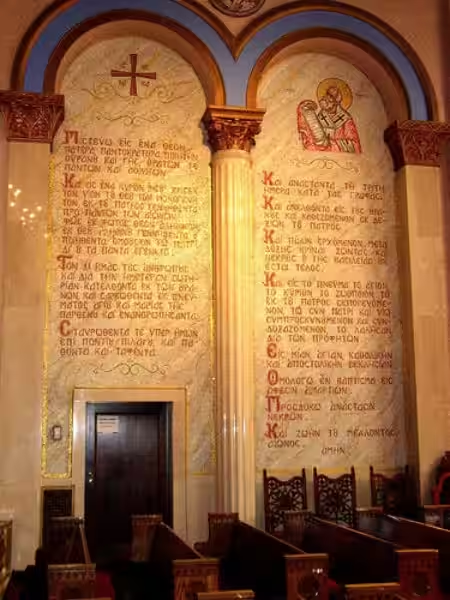
A cornerstone of any Orthodox Christian catechism is its detailed exposition of the Nicene-Constantinopolitan Creed. This ancient statement of faith, professed by Orthodox Christians worldwide, articulates core beliefs about God, Jesus Christ, the Holy Spirit, the Church, and salvation. It’s a concise yet comprehensive summary of what it means to be an Orthodox Christian, affirming belief in:
One God, the Almighty Creator.
One Lord Jesus Christ, the Son of God, who became man for our salvation.
The Holy Spirit, the Giver of Life.
One Holy, Catholic, and Apostolic Church.
One Baptism for the remission of sins.
The resurrection of the dead and the life of the world to come.
Beyond the Creed, the Orthodox Christian catechism provides in-depth explanations of the Holy Mysteries, commonly known as sacraments. These are not mere symbolic rituals but are understood as tangible means through which God’s grace is imparted. The most central of these is the Divine Liturgy, the liturgical worship of the Church, where the faithful partake in the Body and Blood of Christ through Holy Communion. Other vital sacraments include Baptism and Chrismation (often administered together, conferring the Holy Spirit), Confession (Repentance), Holy Unction (for healing), and Matrimony. Each sacrament is presented as a divine encounter, a way to experience God’s presence and love in a tangible manner and is a crucial element explored within the Orthodox Christian catechism.
The Practical Application: Living the Orthodox Faith
The teachings outlined in the Orthodox Christian catechism are not meant to remain confined to theological reflection; they are intended to be lived out in the everyday experiences of believers. This is where the religion aspect truly comes alive. The catechism guides individuals on how to integrate their faith into every facet of their lives, transforming ordinary moments into opportunities for spiritual growth. This includes the disciplines of prayer, both personal and communal, the practice of fasting as a means of spiritual self-control and focus, and the importance of almsgiving and service to others.
The Orthodox Christian catechism also emphasizes the concept of theosis, or deification, the ultimate goal of the Christian life. This is not about becoming God, but about being transformed into the likeness of God through participation in His divine energies, becoming more fully who we were created to be. It’s a process of spiritual healing and perfection, a journey of becoming more loving, more compassionate, and more Christ-like. The catechism provides the framework and encouragement for this transformative journey, illustrating how the doctrines and practices of the Church are pathways to this divine union. It makes the abstract concepts of faith tangible and actionable, guiding the reader toward a life of purpose and meaning.
In facing the inevitable challenges and complexities of life, the Orthodox Christian catechism offers a profound source of wisdom and strength. It addresses fundamental questions about suffering, temptation, death, and the meaning of life, providing answers rooted in the enduring truths of the Gospel. For instance, the understanding of suffering is not as a punishment from God, but often as a crucible for spiritual growth, an opportunity to draw closer to Christ who Himself suffered for humanity. The catechism encourages a perspective of hope and resilience, grounded in the belief in the resurrection and the ultimate triumph of good over evil.
Furthermore, the Orthodox Christian catechism equips believers with tools for spiritual warfare, guiding them in discerning and overcoming temptations that seek to pull them away from God. This involves understanding the nature of sin, the importance of repentance, and the power of prayer and the sacraments to fortify the soul. It paints a picture of a life lived in constant communion with God, where even the mundane tasks can be infused with divine purpose. The teachings provide a moral compass, guiding ethical decision-making and fostering a commitment to justice, mercy, and truth, making the Orthodox Christian catechism a practical and indispensable guide for navigating the human experience.
The Orthodox Christian Catechism as a Guide for the Modern Seeker
In our contemporary world, characterized by rapid change and often overwhelming information, the search for authentic meaning and enduring truth is more pressing than ever. The Orthodox Christian catechism offers a compelling answer to this yearning. It provides a stable anchor in a sea of shifting philosophies and transient values, offering a timeless perspective on the human condition and our place in the universe. Its teachings are not outdated pronouncements but living principles that resonate with the deepest needs of the human heart.
For anyone curious about Orthodox Christianity, or perhaps seeking a deeper understanding of their own faith, delving into an Orthodox Christian catechism is a profoundly rewarding endeavor. It’s an invitation to explore a rich spiritual heritage, to encounter the transformative power of God’s love, and to discover a path to a life of purpose, peace, and eternal joy. The journey of faith is a lifelong one, and the catechism serves as an indispensable companion, illuminating the way with the light of Christ.
Orthodox Christian Catechism – Frequently Asked Questions
What is Orthodox Christianity?
Orthodox Christianity is one of the oldest branches of Christianity, tracing its roots directly back to the teachings of Jesus Christ and the Apostles. It is characterized by its adherence to the Holy Scriptures, Holy Tradition, the Seven Ecumenical Councils, and the teachings of the Church Fathers.
A catechism is a summary of Christian doctrine, typically in the form of questions and answers, used for religious instruction. In the Orthodox Church, a catechism serves to guide individuals in understanding the core beliefs and practices of the faith.
What are the essential beliefs of Orthodox Christianity?
The essential beliefs of Orthodox Christianity include the Trinity (one God in three Persons: Father, Son, and Holy Spirit), the divinity of Jesus Christ, His Incarnation, Crucifixion, and Resurrection, the salvation of humanity through Christ, the importance of the Church as the Body of Christ, and the belief in the Holy Spirit.
What is the role of the Church in Orthodox Christianity?
The Church is understood as the Bride of Christ, the community of believers united in faith and love, and the vessel through which God’s grace is imparted. The Church is seen as the continuation of Christ’s presence in the world, guided by the Holy Spirit.
What are the Sacraments (Mysteries) in Orthodox Christianity?
The Sacraments, also known as Holy Mysteries, are divine actions through which God’s grace is given to believers. The main Sacraments include Baptism, Chrismation, Holy Communion (Eucharist), Repentance (Confession), Holy Orders, Matrimony, and Holy Unction.
What is the importance of Holy Tradition?
Holy Tradition refers to the living transmission of the Christian faith from the Apostles, encompassing Scripture, the teachings of the Church Fathers, the decisions of Ecumenical Councils, the liturgy, and the lives of the saints. It is considered an essential and authoritative source of Orthodox belief and practice.
How does one become an Orthodox Christian?
Becoming an Orthodox Christian typically involves a period of inquiry and instruction (catechesis) followed by the Sacraments of Baptism and Chrismation, if not already baptized in another Christian tradition. For those coming from other backgrounds, a formal reception into the Church may occur.
What is the significance of icons in Orthodox worship?
Icons are sacred images that serve as windows into heaven, depicting Christ, the Theotokos (Mother of God), saints, and biblical events. They are venerated, not worshipped, and are considered an integral part of Orthodox worship and theology, aiding in prayer and contemplation.
What is the Orthodox understanding of salvation?
Salvation in Orthodox Christianity is understood as a process of deification (theosis), a participation in the divine nature through grace, enabled by Christ’s sacrifice and resurrection. It is a lifelong journey of spiritual growth, repentance, and communion with God.
What is the role of prayer in Orthodox Christianity?
Prayer is central to Orthodox life, understood as a communion with God. It includes both formal liturgical prayer and private, personal prayer. The Jesus Prayer (“Lord Jesus Christ, Son of God, have mercy on me, a sinner”) is a common form of contemplative prayer.