In the tapestry of human history, few events resonate with the profound significance and enduring hope as the death and resurrection of Jesus Christ. This pivotal moment, central to the Christian faith, isn’t just a historical account; it’s a living testament to love, sacrifice, and the ultimate victory over death. For billions, these verses aren’t mere words on a page; they are the bedrock of their spiritual lives, offering solace in sorrow, strength in weakness, and an unshakeable promise of eternal future.
The narrative of Jesus’ suffering and subsequent triumph is woven through the very fabric of scripture, providing a roadmap to understanding God’s boundless love and redemptive plan. These accounts, often recounted with vivid detail, speak of a love so deep it would willingly embrace the ultimate cost, and a power so immense it would conquer the grave itself. Let’s delve into the heart of these foundational verses, exploring their meaning and their power to transform lives.
The journey to the cross was not a sudden, unexpected event. Jesus himself spoke of it, preparing his disciples for the immense suffering that lay ahead. His willingness to face this agony was not born of resignation, but of a profound sense of purpose and obedience to the Father’s will. This act of self-sacrifice is the ultimate expression of love, a divine exchange where innocence bore the weight of the world’s sin.
Consider the words from the prophet Isaiah, quoted by Jesus himself, which painted a prophetic picture of this suffering servant: “He was pierced for our transgressions, he was crushed for our iniquities; the punishment that brought us peace was on him, and by his wounds we are healed.” (Isaiah 53:5, paraphrased). This verse, echoed in the New Testament, highlights the substitutionary nature of Jesus’ death. He didn’t die because he was a sinner, but because he chose to become sin for us. His death was not a defeat, but a deliberate act of atonement, a bridge built across the chasm of our separation from God.
The Sacrifice for Humanity
The Gospels meticulously record the events leading up to and including Jesus’ crucifixion. The betrayal, the mockery, the agonizing hours on the cross – these are not presented as mere biographical details, but as crucial elements of God’s redemptive plan. As the apostle Paul eloquently explained, “For God so loved the world that he gave his one and only Son, that whoever believes in him shall not perish but have eternal life.” (John 3:16, paraphrased). This is perhaps the most well-known verse, a powerful encapsulation of God’s immense love and the central role of Jesus’ sacrifice.
The physical suffering was immense, but the spiritual burden was even greater. Jesus, the sinless Son of God, willingly took upon himself the sin of all humanity. This is what is meant by the curse of the law being broken. As it is written in Galatians 3:13: “Christ redeemed us from the curse of the law by becoming a curse for us, for it is written: ‘Cursed is everyone who is hung on a pole.'” (paraphrased). This monumental act of love and justice paved the way for reconciliation, offering forgiveness and a renewed relationship with God to all who accept it. It’s a profound reminder that our sin, no matter how grievous, was met by a love and sacrifice that far surpasses it.
Jesus’ death was the culmination of centuries of prophecy, fulfilling ancient scriptures and demonstrating the divine orchestration of history. He himself foretold his death, not as a tragic accident, but as a necessary step. In Matthew 16:21, Jesus began to explain to his disciples, “The Son of Man must suffer many things and be rejected by the elders, the chief priests and the teachers of the law, and he must be killed and on the third day be raised to life.” (paraphrased). This foreknowledge underscores the deliberate nature of his sacrifice, dispelling any notion of it being a random tragedy.
The purpose behind this death was multifaceted: to atone for sins, to demonstrate God’s love, and to overcome the power of death. It was a purposeful act of redemption, a cosmic transaction that offered freedom from the bondage of sin and its eternal consequences. Think of it like a debt that we could never repay; Jesus stepped in and paid it in full, freeing us from its oppressive weight. This sacrifice, therefore, is not just an event of the past, but a living reality that continues to offer forgiveness and healing to all who turn to him.
The Dawn of a New Era: Verses on Jesus’ Resurrection
The crucifixion, though devastating, was not the end of the story. The resurrection of Jesus Christ is the cornerstone of Christian belief, the glorious triumph that validates his claims and offers an unparalleled hope for the future. This event is not a myth or a legend; it is presented as a historical reality, witnessed by numerous individuals and confirmed by the empty tomb.
The apostle Paul, in his letter to the Corinthians, emphasizes the critical nature of the resurrection: “And if Christ has not been raised, your faith is futile; you are still in your sins.” (1 Corinthians 15:17, paraphrased). This declaration is incredibly powerful. It means that without the resurrection, the sacrifice of Jesus would have been in vain. It is the resurrection that proves his victory over death and sin, and it is this victory that offers us the assurance of our own future resurrection and eternal life.
The Empty Tomb: Proof of Victory
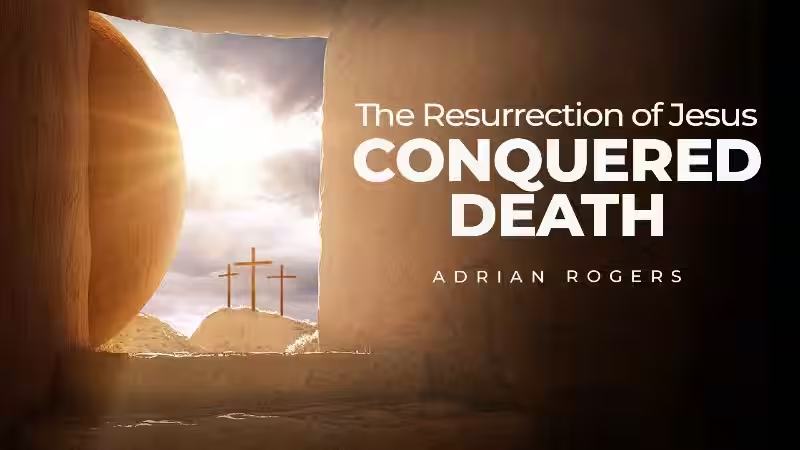
The accounts of the resurrection are filled with vivid descriptions of the events following Jesus’ burial. The women who went to the tomb to anoint his body found it empty. An angel proclaimed, “He is not here; he has risen, just as he said.” (Matthew 28:6, paraphrased). This declaration from the angelic messenger, coupled with the testimony of multiple witnesses, forms the irrefutable evidence of Jesus’ resurrection. The empty tomb is the most potent symbol of his victory over death. It declares that death has no lasting power over those who are in Christ. Imagine a king who has been imprisoned by his enemies, but then bursts forth from his prison, not just alive, but victorious. That is the image the empty tomb presents.
The resurrected Christ appeared to his disciples on numerous occasions, proving that he was not a ghost or a spirit, but truly alive. He even ate with them, demonstrating the tangible reality of his new, glorified body. This physical manifestation was crucial for solidifying their faith and empowering them to spread the message of the Gospel. The resurrection is not just a spiritual concept; it has tangible, historical proof that transformed a group of disheartened followers into a movement that would change the world.
The Promise of New Life and Eternal Hope
The resurrection of Jesus is intrinsically linked to the promise of new life for believers. It signifies that through faith in him, we too can experience a spiritual resurrection, a transformation from spiritual death to spiritual life. As Romans 6:4 states, “We were therefore buried with him through baptism into death in order that, just as Christ was raised from the dead through the glory of the Father, we too may live a new life.” (paraphrased). This “new life” is not a mere improvement on our old one; it’s a complete rebirth, a radical change in our identity and purpose.
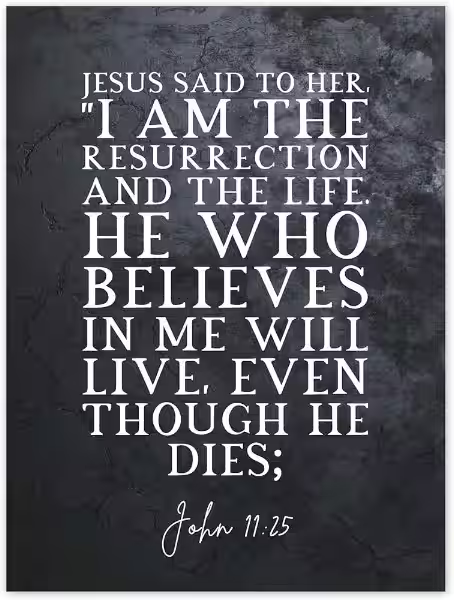
Furthermore, the resurrection is the ultimate guarantee of our own future resurrection and eternal life. Jesus’ triumph over death assures us that death is not the end, but a transition to an eternal dwelling with God. He declared, “I am the resurrection and the life. The one who believes in me will live, even though they die; and whoever lives by believing in me will never die.” (John 11:25-26, paraphrased). This is the profound hope that sustains Christians through trials, losses, and the inevitable reality of mortality. It is the promise of a future where sorrow and pain will be no more, and where we will be in the presence of God forever, a testament to the enduring power of his love and victory.
The Enduring Impact: Faith Built on These Verses
The verses surrounding Jesus’ death and resurrection are more than just historical accounts; they are the very foundation upon which the Christian faith is built and sustained. They offer a compelling narrative of divine love, ultimate sacrifice, and unfathomable victory. This bedrock of belief provides a unique perspective on suffering and a profound source of hope for believers navigating the complexities of life.
For individuals seeking meaning, purpose, or solace, these verses offer a powerful and relatable message. They speak to the universal human experience of facing hardship and loss, while simultaneously presenting a transformative solution and an enduring promise. The willingness of Jesus to face the cross for humanity’s sins, and his subsequent triumph over death, is a testament to a love that is both unconditional and all-powerful, a message that continues to resonate and transform lives across cultures and generations.
Frequently Asked Questions: Verses About Jesus’ Death and Resurrection
What are some key Bible verses about Jesus’ death?
Several New Testament passages describe Jesus’ sacrificial death. Key verses include:
Isaiah 53:5: “But he was pierced for our transgressions, he was crushed for our iniquities; the punishment that brought us peace was on him, and by his wounds we are healed.” (This is a prophecy often interpreted as referring to Jesus.)
Romans 5:8: “But God demonstrates his own love for us in this: While we were still sinners, Christ died for us.”
1 Corinthians 15:3: “For what I received I passed on to you as of first importance: that Christ died for our sins according to the Scriptures.”
John 3:16: “For God so loved the world that he gave his one and only Son, that whoever believes in him shall not perish but have eternal life.”
What are some important Bible verses about Jesus’ resurrection?
The resurrection of Jesus is a central tenet of Christianity. Key verses include:
1 Corinthians 15:4: “that he was buried, that he was raised to life on the third day according to the Scriptures.”
Romans 1:4: “and who through the Spirit of holiness was declared with power to be the Son of God by his resurrection from the dead: Jesus Christ our Lord.”
Matthew 28:6: “He is not here; he has risen, just as he said. Come and see the place where he lay.”
Acts 2:24: “But God raised him from the dead, freeing him from the agony of death, because it was impossible for death to keep its hold on him.”
What is the theological significance of Jesus’ death and resurrection in Christianity?
In Christian theology, Jesus’ death is seen as an atoning sacrifice for the sins of humanity, reconciling believers with God. His resurrection is the ultimate proof of his divine nature, the victory over sin and death, and the assurance of eternal life for those who believe in him. It forms the foundation of the Christian faith.
Are there other religions that have narratives similar to Jesus’ death and resurrection?
While the specific narrative of Jesus’ death and resurrection is unique to Christianity, other religions have figures or stories that involve themes of sacrifice, death, and rebirth, or a divine being overcoming a great adversary. These may include:
Dionysus (Greek Mythology): Stories of his death and rebirth, often associated with the fertility of nature.
Osiris (Ancient Egyptian Religion): A god who was murdered and dismembered, then reassembled and resurrected to rule the underworld.
Attis (Phrygian Religion): A god whose myths involve his death and subsequent revival.
Some Buddhist concepts: While not a direct parallel, Buddhist teachings on enlightenment and liberation from suffering can be seen as a form of overcoming death and achieving a transformed existence.
It is important to note that these are comparisons of thematic elements and not theological equivalents to the Christian understanding of Jesus’ death and resurrection.