The vast and influential Roman Empire, a civilization synonymous with legions, law, and unparalleled organization, left an indelible mark on nearly every facet of Western civilization. While we often associate their legacy with roads, aqueducts, and architectural marvels, the Romans’ order also profoundly influenced the development and spread of religion. Their approach to governance, their tolerance (and sometimes, their intolerance), and their very infrastructure created a fertile ground, or at times a crucible, for a multitude of faiths, most notably Christianity, which would eventually become the dominant religion of the empire and, subsequently, the Western world.
Understanding the Romans’ order is key to grasping how diverse religious practices not only survived but thrived within their sprawling dominion. It wasn’t a monolithic, top-down imposition of a single creed, but rather a complex interplay of practicality, power, and a surprisingly adaptable worldview. This article will delve into the intricate relationship between the Romans’ order and the evolution of religion, exploring how their societal structures and imperial policies inadvertently, and sometimes deliberately, shaped the spiritual trajectories of millions.
The Roman Approach to Religious Pluralism: Order Through Pragmatism
At its heart, the Romans’ order was built on a foundation of pragmatism and a keen understanding of social stability. They were not inherently dogmatic in their religious beliefs, at least not in the way we might understand doctrinal purity today. Instead, their focus was on maintaining peace and ensuring the well-being of the state. This meant that for much of their history, the Romans exhibited a remarkable degree of religious tolerance. As long as a new cult or deity did not threaten civic order or the worship of the Roman gods (considered essential for the empire’s prosperity), it was generally permitted to exist.
This tolerance wasn’t born out of a deep respect for individual religious freedom in the modern sense. Rather, it was a strategic decision to incorporate conquered peoples and their beliefs into the Roman fold. Imagine a vast marketplace, teeming with vendors selling all sorts of goods. The Romans, in this analogy, were the market organizers. They wanted to ensure the market ran smoothly, that no vendor disrupted the peace, and that everyone paid their dues (in the form of taxes and loyalty). This meant allowing various religious “stalls” to operate, as long as they didn’t try to burn down the other stalls or overthrow the market master. Foreign gods were often welcomed and assimilated, sometimes even syncretized with existing Roman deities, a process known as interpretatio romana. For example, the Celtic god Lugus might be identified with the Roman Mercury, making him more familiar and less threatening to Roman sensibilities.
The State and the Gods: A Symbiotic Relationship
The Romans’ order inextricably linked the state and religion. The worship of the Roman pantheon, particularly Jupiter, was not merely a private affair; it was a civic duty, essential for the ongoing success and protection of Rome. Public festivals, sacrifices, and the maintenance of temples were integral to the functioning of the empire. Religious observance was a demonstration of loyalty and a way to ensure divine favor for imperial endeavors. When the legions marched, prayers and sacrifices were offered for victory. When a new emperor ascended, religious ceremonies affirmed his legitimacy. This established a clear hierarchy, with the state’s needs and the Roman gods at the apex of the religious landscape.
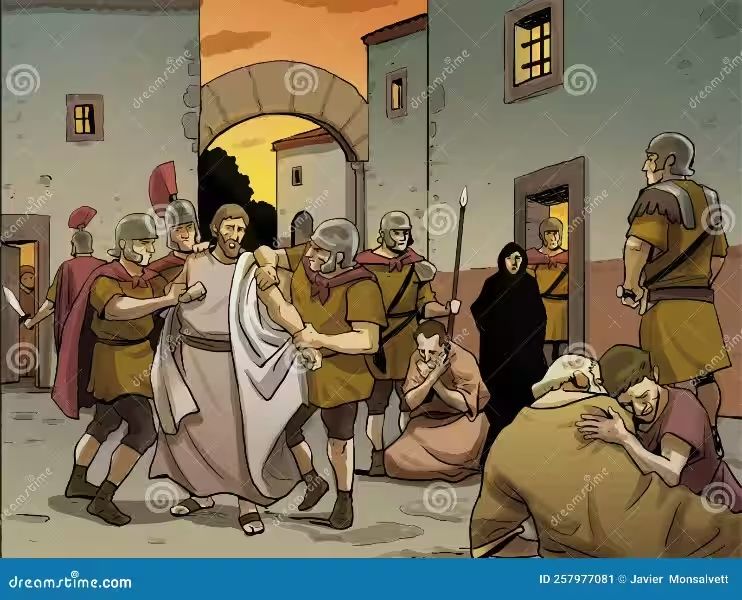
This symbiotic relationship meant that religious innovation was often viewed with suspicion if it challenged the established order. While individual worship of foreign gods was generally tolerated, any movement that seemed to undermine the authority of the state or the traditional Roman cults could face severe repercussions. This was particularly true for religions that encouraged exclusive devotion, demanding that their followers forsake all other gods. Such exclusivity was seen as a direct threat to the carefully constructed Romans’ order, which relied on a degree of religious inclusivity to maintain peace and prevent internal strife. The persecution of early Christians, for instance, stemmed not primarily from their beliefs about Jesus, but from their refusal to participate in Roman civic cults, which was interpreted as disloyalty and atheism.
The Infrastructure of Empire: Facilitating Religious Diffusion
The Romans’ order was not just about laws and governance; it was also about physical infrastructure. Their legendary network of roads, meticulously constructed and maintained, was a marvel of engineering that served military and administrative purposes. However, this same network became an incredibly efficient conduit for the spread of ideas, including religious ones. Missionaries, traders, and pilgrims traveled these paved highways, carrying their beliefs and practices to every corner of the empire.
Consider the humble traveler undertaking a journey across the vast Roman Empire. They could rely on the Romans’ order to provide safe passage and reliable routes. These roads, designed for swift troop movements and efficient trade, inadvertently opened up channels for the dissemination of new faiths. A devout follower of a mystery cult originating in the East could travel from Antioch to Rome, sharing their rituals and teachings along the way. Likewise, the establishment of Roman cities, with their public spaces, forums, and baths, created hubs for social interaction where religious ideas could be exchanged and debated. The very process of Romanization, which brought Roman law, language, and culture to diverse regions, also created a shared cultural space where religious ideas could find common ground and spread more easily.
Urban Centers: Melting Pots of Faith
Roman cities were dynamic, cosmopolitan centers, the beating heart of the Romans’ order in practice. These urban environments, characterized by a diverse populace drawn from across the empire, became natural melting pots for religious thought. In cities like Alexandria, Antioch, or even Rome itself, one could find temples dedicated to Egyptian gods, Persian deities, Greek philosophies, and a myriad of local cults, all existing, for the most part, side-by-side. This exposure to different beliefs fostered a climate of religious exchange and syncretism.
Within these bustling metropolises, the Romans’ order provided a framework for public life that included religious observance. Temples were built, festivals were celebrated, and religious discourse was a part of daily conversation. This created a fertile ground for the growth of new religious movements. Early Christianity, for example, found fertile ground in these urban centers. The existing infrastructure of synagogues in Jewish communities provided initial points of contact, and the vibrant intellectual and social life of Roman cities offered opportunities for evangelism and the establishment of communities. The relative ease of communication and travel, facilitated by the Romans’ order, allowed these nascent Christian communities to connect and grow, forming a network that transcended geographical boundaries.
The Rise of Christianity: An Unforeseen Consequence of Roman Order
Ironically, the Romans’ order, with its emphasis on structure and its initial attempts to suppress Christianity, ultimately played a crucial role in its eventual triumph. The empire’s administrative efficiency, its legal framework, and its vast communication networks, all hallmarks of the Romans’ order, proved to be surprisingly conducive to the spread of the Christian message.
When Christianity began to gain traction, it was met with varying degrees of suspicion and outright persecution. However, the very mechanisms of the Romans’ order that were meant to contain it often inadvertently facilitated its expansion. The legal system, while capable of prosecuting Christians, also provided a degree of predictability. The common language (Latin and Greek) facilitated communication, and the Pax Romana, the period of relative peace and stability enforced by Roman rule, allowed for safer travel and the establishment of communities. The eventual adoption of Christianity by Emperor Constantine, and its subsequent establishment as the state religion under Theodosius I, was a monumental shift, demonstrating how the Romans’ order, in its later stages, could be co-opted to serve the very faith it had once sought to suppress.
From Persecution to Patronage: The Shifting Sands of Roman Religious Policy
The journey of Christianity within the Roman Empire was a dramatic narrative of transformation, intrinsically linked to the evolving Romans’ order. Initially, Christians were seen as a peculiar sect, a deviation from the norm, and their refusal to participate in Roman civic cults was viewed as a dangerous form of separatism. This led to periods of intense persecution, where individuals were arrested, tortured, and executed simply for their faith. This was a clear demonstration of the Romans’ order asserting its authority and attempting to stamp out perceived threats to its stability.
However, the resilience of the Christian faith, coupled with its appeal to a wide range of people, proved to be its strength. The martyrs, instead of deterring converts, often inspired further devotion. The willingness of Christians to care for the poor and sick, a practice that stood in contrast to some aspects of Roman society, further attracted followers. The pivotal moment arrived with Emperor Constantine’s conversion. This act, a dramatic shift in Roman religious policy, signaled a new era. The Romans’ order began to actively support and patronize Christianity. Churches were built, clergy were granted privileges, and the faith that had once been driven underground was now ascendant, becoming a cornerstone of the empire’s identity and a defining element of the future of religion in the West.
Conclusion: The Enduring Legacy of Roman Order on Religion
The Romans’ order, with its pragmatic approach to governance, its vast infrastructure, and its complex relationship with religious diversity, created a unique environment that profoundly shaped the trajectory of religion in the Western world. While their initial intentions may have been focused on maintaining imperial stability and the worship of their own gods, the unintended consequences of their organizational prowess and their flexible approach to foreign cults paved the way for the widespread dissemination and eventual dominance of new faiths, most notably Christianity.
From the meticulously planned roads that carried spiritual ideas across continents to the urban centers that acted as vibrant hubs of religious exchange, the Romans’ order provided the very scaffolding upon which future religious landscapes were built. The enduring legacy of their organizational genius can still be seen today, not just in the ruins of their empire, but in the very fabric of our spiritual heritage. Understanding the Romans’ order is thus not just an academic exercise; it is a crucial step in comprehending the deep and lasting connections between power, society, and the enduring human quest for meaning and faith.
Frequently Asked Questions about Roman Catholicism
What is Roman Catholicism?
Roman Catholicism is the largest branch of Christianity, with over 1.3 billion members worldwide. It is characterized by its hierarchical structure with the Pope as its head, its sacramental theology, and its rich tradition of spiritual practices and teachings.
What are the core beliefs of Roman Catholicism?
Core Catholic beliefs include the Trinity (one God in three persons: Father, Son, and Holy Spirit), the divinity of Jesus Christ, his death and resurrection for the salvation of humanity, the importance of the Church as the Body of Christ, and the belief in the seven sacraments as channels of God’s grace.
Who is the Pope?
The Pope is the Bishop of Rome and the spiritual leader of the Roman Catholic Church. He is considered the successor of Saint Peter, whom Jesus appointed as the first Pope. The Pope holds supreme authority in the Church and is guided by the Holy Spirit.
What are the Sacraments in Catholicism?
There are seven Sacraments in the Catholic Church: Baptism, Confirmation, Eucharist, Penance (Reconciliation), Anointing of the Sick, Holy Orders, and Matrimony. These are understood as outward signs instituted by Christ to give grace.
What is the role of Mary in Catholicism?
Catholics hold a special reverence for Mary, the mother of Jesus. They believe she was immaculately conceived, remained a perpetual virgin, and was assumed into heaven. Mary is honored as the Mother of God and is invoked as an intercessor for believers.
What is the significance of the Bible and Tradition in Catholicism?
Catholics believe that God’s revelation is contained in both Sacred Scripture (the Bible) and Sacred Tradition, which is the living transmission of the Gospel message through the teachings and life of the Church. These two sources are considered inseparable and are interpreted by the Magisterium (the teaching authority of the Church).
What is the Mass?
The Mass is the central act of worship in the Catholic Church, a re-presentation of the sacrifice of Jesus Christ on the cross. It includes readings from Scripture, a homily, and the celebration of the Eucharist (Holy Communion), where Catholics believe Jesus is truly present in the consecrated bread and wine.
What is the Catholic view on salvation?
Catholics believe that salvation is a gift from God’s grace, received through faith and good works. It is initiated by Baptism and nurtured through participation in the Sacraments and living a life in accordance with Christ’s teachings and the Church’s guidance.
What is the structure of the Catholic Church?
The Catholic Church is a hierarchical structure with the Pope at its head, followed by cardinals, archbishops, bishops, priests, and deacons. This structure is seen as a continuation of the apostolic ministry established by Jesus.
What is the Catholic understanding of Purgatory?
Purgatory is understood as a state of purification after death for those who die in God’s grace but are not yet perfectly purified. It is a temporary state where souls are cleansed of the temporal punishment due to sin before entering heaven.