When you picture Rome, what comes to mind? Perhaps it’s the grandeur of the Colosseum, the whispering fountains of the Trevi, or the vibrant hues of a sunset painting the ancient ruins. But if you look a little closer, beneath the veneer of imperial might and artistic mastery, lies a city woven from threads of profound religious significance. The very air in Rome seems to hum with centuries of devotion, prayer, and the echoes of pivotal faith-based events. This is a city where every cobblestone, every piazza, and every magnificent dome tells a story, not just of history, but of the enduring power and evolution of belief. Understanding Rome, truly understanding its soul, requires delving into its religious picture.
From its mythical founding by Romulus and Remus to its status as the spiritual heart of Roman Catholicism, religion has been an unwavering constant in Rome’s narrative. It has shaped its architecture, its laws, its culture, and the very identity of its people. To explore Rome is to embark on a pilgrimage, whether you are a devout follower or simply a curious observer, seeking to comprehend the forces that have shaped so much of Western civilization. Let this journey into the religious picture of Rome be your guide.
The Roots of Reverence: Pagan Rome and its Pantheon
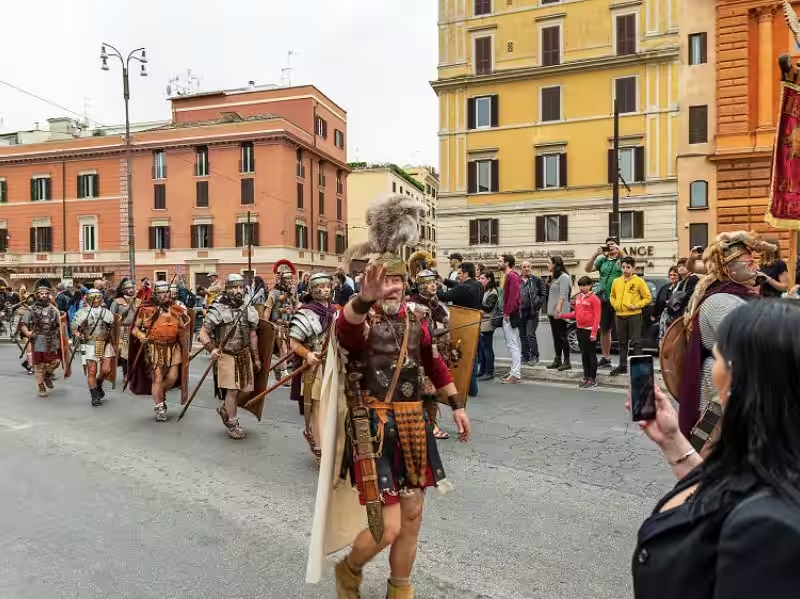
Before Christianity ascended to become the dominant faith, Rome was a vibrant tapestry of pagan beliefs. The city was dotted with temples dedicated to a vast pantheon of gods and goddesses, each with their own domains and rituals. Imagine the bustling Forum, not just a center of political power, but a spiritual nexus where Romans offered sacrifices, sought divine favor, and celebrated festivals honoring deities like Jupiter, the king of the gods, Mars, the god of war, and Venus, the goddess of love and beauty. The pantheon of Roman gods was deeply intertwined with the daily lives and civic duties of its citizens, reflecting a worldview where the divine was ever-present.
One of the most enduring testaments to this era is the Pantheon, a architectural marvel that has stood for nearly two millennia. Originally a temple to all gods, its oculus, a perfectly circular opening in the dome, acts as a celestial eye, connecting the earthly realm to the heavens. Standing beneath its vast, unreinforced concrete dome, you can almost feel the weight of history and the reverence that these ancient structures commanded. The Pantheon is a powerful reminder that Rome’s religious picture is not a singular narrative, but a layered one, with pagan foundations supporting later spiritual structures.
Temples, Sacrifices, and the Everyday Divine
The practice of religion in pagan Rome was often a communal and public affair. Grand temples, like the Temple of Saturn or the Temple of Vesta (home to the sacred eternal flame), served as focal points for worship and civic ceremony. Priestly colleges, such as the Vestal Virgins, played crucial roles in maintaining religious traditions and ensuring the favor of the gods. The concept of pax deorum, or the “peace of the gods,” was paramount, and Romans believed that their prosperity and safety depended on maintaining a harmonious relationship with the divine through consistent offerings and adherence to sacred rites.
Even the humblest Roman household had its own shrine, the lararium, where small statues of household gods, or lares, were kept. Families would offer daily prayers and small sacrifices, demonstrating that the divine was not solely confined to grand temples but was an intimate part of domestic life. This pervasive sense of the sacred, this daily engagement with the spiritual, is a crucial element in understanding the deep-seated religious sensibility that would later define Rome, regardless of the specific deity being invoked.
The Dawn of a New Era: Christianity’s Rise and Rome’s Transformation
The emergence of Christianity in the Roman Empire marked a seismic shift in the city’s religious landscape. What began as a persecuted sect, centered around the teachings of Jesus of Nazareth, gradually gained traction, appealing to a diverse population with its message of hope, salvation, and equality. The early Christian communities met in secret, often in catacombs beneath the city, creating a clandestine religious picture that contrasted sharply with the public displays of pagan worship. These underground sanctuaries, adorned with simple frescoes depicting biblical scenes, offer a poignant glimpse into the resilience and burgeoning faith of these early followers.
The conversion of Emperor Constantine in the early 4th century proved to be a turning point. Christianity was no longer an outlawed faith; it was on the path to becoming the state religion. This era witnessed the construction of magnificent basilicas, built on a grand scale and often over the tombs of martyrs. The constantinian basilicas, like the original St. Peter’s Basilica and the Archbasilica of Saint John Lateran, signaled Christianity’s newfound power and permanence. Rome, the former heart of an empire built on pagan gods, was rapidly transforming into the spiritual capital of a Christian world, a transformation vividly captured in the evolving religious picture of the city.
From Persecution to Patronage: The Church’s Ascendancy
The transition from a persecuted minority to the dominant faith was a complex process, marked by periods of intense theological debate, internal reform, and external challenges. However, the growing influence of the Church was undeniable. Bishops of Rome, who would eventually become known as Popes, began to consolidate their authority, laying the groundwork for the papacy as we know it today. The Church became a powerful institution, not only spiritually but also politically and socially, wielding significant influence over the lives of Romans and beyond.
This ascendancy is reflected in the opulent churches and chapels that began to adorn Rome. The richness of the art and architecture within these sacred spaces, from glittering mosaics to intricate sculptures, was designed to inspire awe and devotion, to communicate the grandeur of God and the narratives of salvation. Imagine stepping into Santa Maria Maggiore, with its breathtaking 5th-century mosaics still intact, a testament to the early Christian commitment to visual storytelling in faith. This period cemented Rome’s role as the undisputed center of Western Christianity, solidifying its religious picture for centuries to come.
The Vatican City: A State Within a State, A Spiritual Epicenter
No exploration of Rome’s religious picture would be complete without a deep dive into Vatican City. This sovereign city-state, nestled within Rome, is the smallest independent nation in the world and the spiritual and administrative headquarters of the Roman Catholic Church. Home to the Pope, the spiritual leader for over a billion Catholics worldwide, the Vatican is a place of pilgrimage, prayer, and immense historical and artistic significance. Its very existence is a testament to the enduring power and global reach of the Catholic faith, a power that has profoundly shaped Rome’s identity.
The St. Peter’s Basilica stands as the crowning glory of Vatican City, a masterpiece of Renaissance architecture and a symbol of Catholic Christendom. Its immense dome, designed in part by Michelangelo, dominates the Roman skyline, a constant reminder of the spiritual authority emanating from this sacred enclave. Inside, the sheer scale and beauty are overwhelming, from Bernini’s baldachin over the papal altar to Michelangelo’s poignant Pietà. The basilica is more than just a building; it’s a sacred space where millions come to worship, to reflect, and to feel connected to a universal spiritual tradition, a core element of Rome’s religious picture.
St. Peter’s Square and the Embrace of the Faithful
Designed by Gian Lorenzo Bernini, St. Peter’s Square is an architectural marvel in itself. Its elliptical shape, framed by grand colonnades, is designed to symbolically embrace the faithful, drawing them towards the basilica. Imagine standing in the center of this vast piazza, surrounded by towering obelisks and statues of apostles, and witnessing the Pope addressing a multitude during a special occasion. The sense of unity and shared purpose that permeates the square during these events is palpable, a powerful manifestation of collective faith.
The square serves as a public forum for faith, a place where pilgrims from every corner of the globe converge. It’s a space where the global Catholic community comes alive, united by their devotion. Whether it’s for a papal audience, a canonization ceremony, or simply to soak in the atmosphere, St. Peter’s Square offers a unique opportunity to witness the living, breathing heart of the Catholic Church. It’s a vital component of Rome’s religious picture, showcasing the faith not just in its historical grandeur, but in its vibrant, contemporary expression.
Beyond the Vatican: Churches, Shrines, and the Sacred Fabric of Rome
While Vatican City rightfully commands much attention, Rome’s religious tapestry extends far beyond its walls. The city is home to over 900 churches, each with its own history, artistic treasures, and unique spiritual significance. From ancient basilicas that have witnessed centuries of change, to Baroque masterpieces filled with dramatic art, and humble parish churches that serve local communities, these sacred spaces are integrated into the everyday life of Rome. Walking through the city, you will stumble upon magnificent churches at nearly every turn, each offering a quiet sanctuary and a glimpse into Rome’s rich religious heritage.
Consider the Basilica di San Clemente, with its layers of history, dating back to the 12th century and built atop a 4th-century church, which in turn sits above a 1st-century Roman house and a Mithraic temple. This site offers a fascinating, tangible representation of Rome’s evolving religious picture, allowing visitors to descend through time and witness the different layers of faith that have occupied the same sacred ground. It’s a powerful reminder that Rome’s religious identity is not static but a continuously developing narrative.
Art as Devotion: Masterpieces in Sacred Spaces
Rome’s churches are not merely places of worship; they are immense repositories of art and history. Many of the world’s most renowned artists, from Caravaggio and Raphael to Bernini and Borromini, have left their indelible mark on these sacred structures. Imagine standing before Caravaggio’s “The Calling of Saint Matthew” in the Church of San Luigi dei Francesi, the dramatic chiaroscuro illuminating a pivotal moment of spiritual awakening. Or marveling at Raphael’s frescoes in the Vatican’s Stanze di Raffaello, depicting theological and philosophical themes that have inspired generations.
These masterpieces serve a dual purpose: they are objects of artistic genius, and they are tools of devotion. The art aims to inspire awe, to communicate theological concepts, and to draw the viewer closer to the divine. The visual narrative of faith, woven through paintings, sculptures, and architectural design, is a fundamental aspect of Rome’s religious experience. It transforms sacred spaces into living galleries, where art and devotion are inextricably linked, enriching the visitor’s understanding of Rome’s profound religious picture.
Pilgrimage and Modern Faith: Rome’s Enduring Spiritual Appeal
Even in the 21st century, Rome remains a potent destination for spiritual journeys and pilgrimages. Millions of people from around the world travel to the Eternal City each year, seeking solace, inspiration, or a deeper connection to their faith. Whether it’s walking in the footsteps of saints, participating in Holy Year celebrations, or simply experiencing the profound spiritual atmosphere of its sacred sites, Rome continues to draw those seeking a transcendent experience.
The tradition of pilgrimage in Rome is ancient, dating back to the early Christians who flocked to visit the tombs of apostles and martyrs. Today, this tradition continues, with individuals and groups undertaking journeys to sites like the Scala Santa (Holy Stairs), believed to be the very stairs Jesus ascended in Pontius Pilate’s palace, or to the many churches housing relics of saints. This continuous flow of pilgrims underscores the enduring power of Rome’s religious picture, a testament to its ability to inspire faith and devotion across generations and cultures. It’s a city where the past and present of faith converge, offering a unique and profound experience for all who visit.
Frequently Asked Questions About Religion in Rome
What is the dominant religion in Rome?
The dominant religion in Rome is Christianity, specifically Roman Catholicism. The Vatican City, the headquarters of the Catholic Church, is an independent state located within Rome.
Is Rome a religious city?
Yes, Rome is considered one of the most religious cities in the world due to its historical and contemporary significance to Christianity. It houses numerous churches, basilicas, and religious sites.
Are there other religions practiced in Rome?
While Catholicism is dominant, Rome is also home to communities of other faiths, including Judaism (with a long-standing Jewish presence), Islam, and various Protestant denominations.
Can I visit religious sites in Rome?
Absolutely. Rome is renowned for its religious landmarks, such as St. Peter’s Basilica, the Vatican Museums, the Pantheon, and many other historic churches, which are open to visitors.
Do religious holidays affect travel in Rome?
Yes, major Catholic holidays like Easter and Christmas are significant in Rome, and while they offer unique cultural experiences, they can also mean larger crowds and some closures.