The Book of Revelation. Just the name conjures images of cosmic battles, mysterious prophecies, and a climactic end. For many, it’s a text shrouded in enigmatic symbolism, often leading to more confusion than clarity. Yet, within its pages lies a profound message of hope, perseverance, and ultimate divine victory. This article invites you on a verse-by-verse exploration, not as a dry academic exercise, but as a personal pilgrimage through one of the most fascinating and impactful books in religious literature. We will unpack its message, making it relatable and informative, revealing how its ancient words speak to our modern lives.
Imagine standing on a precipice, gazing into a landscape of both unprecedented challenge and unimaginable triumph. This is the vista Revelation offers. It’s a divine unveiling, a apocalypsis in Greek, of God’s sovereign plan for history, culminating in the establishment of His eternal kingdom. Our journey will be guided by its powerful imagery and unwavering pronouncements, seeking to understand the heart of its message for believers across the ages. We’ll find that the seemingly complex visions are, at their core, about God’s faithfulness and His ultimate control over all things.
The book begins with a powerful vision granted to the Apostle John on the island of Patmos. Revelation 1:1 states, “The revelation from Jesus Christ, which God gave him to show his servants what must soon take place.” This opening immediately establishes the divine origin of the book. It’s not human speculation, but a direct impartation from Christ Himself. This is crucial because it lends immense authority to the subsequent visions and messages. Think of it like receiving a top-secret directive from the highest authority – its importance cannot be overstated.
Following this foundational verse, Revelation 1:4-8 introduces us to the seven churches of Asia Minor. These are not just historical entities; they represent different facets of the church throughout history, facing various struggles and triumphs. John sends greetings: “Grace and peace to you from him who is, and who was, and who is to come, and from the seven spirits before his throne, and from Jesus Christ, who is the faithful witness, the firstborn from the dead, and the ruler of the kings of the earth.” This Trinitarian greeting sets a solemn and reverent tone, reminding us of the holiness and power of the God we serve. The mention of Jesus as the “faithful witness,” the “firstborn from the dead,” and the “ruler of the kings of the earth” are powerful affirmations of His authority and victory over death and earthly powers, a theme that will resonate throughout the entire book.
The Vision of the Exalted Christ
The heart of the opening chapter is the awe-inspiring vision of the glorified Christ in Revelation 1:10-18. John describes Him with imagery that is both familiar and overwhelmingly divine: “I was in the Spirit on the Lord’s Day, and I heard behind me a loud voice like a trumpet, saying, ‘Write on a scroll what you see and send it to the seven churches: to Ephesus, Smyrna, Pergamum, Thyatira, Sardis, Philadelphia, and Laodicea.'” The trumpet-like voice signifies divine proclamation, demanding attention. The description of Christ is paramount: “I turned to look at the one who was speaking to me. When I turned, I saw seven golden lampstands, and among the lampstands was someone like the Son of Man, dressed in a robe reaching his feet and with a golden sash around his waist. His head and hair were white like wool, as white as snow, and his eyes were like blazing fire. His feet were like bronze glowing in a furnace, and his voice was like the sound of rushing waters. In his right hand he held seven stars, and from his mouth came a sharp double-edged sword. His face was like the sun shining in all its brilliance.”
This vivid portrayal is not merely aesthetic; each element carries profound symbolic meaning. The seven golden lampstands, as explained in Revelation 1:20, represent the seven churches. This signifies that Christ walks among His people, His presence illuminating and guiding them. His white hair symbolizes eternal wisdom and purity. His eyes like blazing fire speak of His all-seeing nature, penetrating every deception and hidden motive. The bronze feet suggest endurance and judgment, as bronze is often associated with strength and purification. The voice like rushing waters conveys His immense power and authority. The seven stars in His hand, also explained in Revelation 1:20, represent the angels or messengers of the seven churches, indicating His complete control and care over them. Finally, the sharp double-edged sword from His mouth symbolizes the power of His word, which is penetrating, life-giving, and judgmental. This vision serves as a powerful reminder to the churches, and to us, of the majesty and authority of Jesus Christ.
To each of the seven churches, Christ delivers a specific message, recorded in Revelation chapters 2 and 3. These messages are a blend of commendation and correction, offering encouragement for faithfulness and stern warnings against compromise. For example, to the church in Ephesus (Revelation 2:1-7), Christ acknowledges their “hard work and your perseverance, and that you cannot tolerate wicked people.” However, He also rebukes them: “Yet I hold this against you: You have forsaken the love you had at first.” This is a relatable admonition for any believer or community: passion for God must not wane.
Consider the church in Smyrna (Revelation 2:8-11), which faced severe persecution and poverty. Christ commends their endurance and warns them of future suffering, promising: “Be faithful, even to the point of death, and I will give you the crown of life.” This is a timeless assurance for those facing hardship for their faith. In contrast, the church in Laodicea (Revelation 3:14-22) is met with a scathing rebuke for their lukewarmness: “I know your deeds, that you are neither cold nor hot. I wish you were either one or the other! So, because you are lukewarm—neither hot nor cold—I am about to spit you out of my mouth.” This highlights the danger of spiritual apathy and the importance of a wholehearted commitment to Christ. These messages are not just historical curiosities; they are divine diagnostics for the church today, calling us to examine our hearts and practices.
The Heavenly Throne Room: A Glimpse of God’s Sovereignty
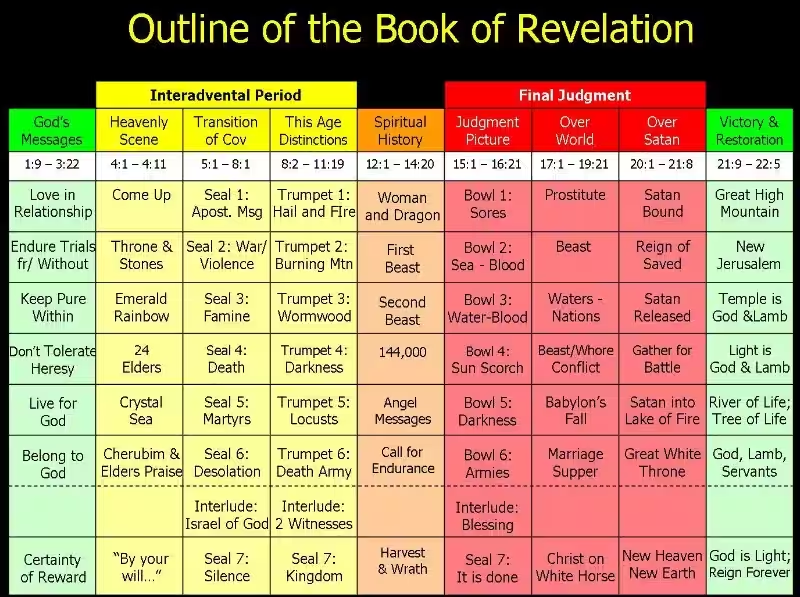
Moving beyond the earthly churches, Revelation transports us to the celestial realm. Revelation 4:1 begins, “After this I looked, and there before me was an open door in heaven. And the first voice I heard was like a trumpet speaking to me, saying, ‘Come up here, and I will show you what must take place after this.'” This is an invitation into the very presence of God, a divine unveiling of His ultimate authority and plan. The open door signifies access to God’s throne, a privilege granted to John and, by extension, to all believers through Christ.
The scene that unfolds is one of unparalleled majesty and worship. Revelation 4:2-11 describes a throne in heaven, with God seated upon it. Around the throne are twenty-four elders and four living creatures, all engaged in ceaseless worship. The elders, often interpreted as representing the believing community from both Old and New Testaments, cast their crowns before the throne, declaring: “You are worthy, our Lord and God, to receive glory and honor and power, for you created all things, and by your will they were created and have their being.” This is a profound declaration of God’s absolute sovereignty and creative power. The four living creatures, each with different features, are depicted as constantly exclaiming, “Holy, holy, holy is the Lord God Almighty, who was, and is, and is to come.” This is the Trisagion, a profound expression of God’s transcendent holiness, a holiness that is eternal and unchanging.
The Scroll and the Lamb: The Mystery of Redemption Unveiled
A pivotal moment occurs with the introduction of a scroll sealed with seven seals in Revelation 5:1. An angel proclaims, “Who is worthy to open the scroll and break its seals?” The weight of this question hangs heavy, for the scroll contains the divine decree of history and judgment. John weeps because “no one in heaven or on earth or under the earth could be found worthy” to open it. This highlights our human inability to orchestrate or comprehend God’s unfolding plan. It’s a stark reminder of our reliance on divine intervention.
Then, a new figure emerges: the Lamb, standing as if it had been slain (Revelation 5:6). This is Jesus Christ, identified by His sacrifice. The Lamb alone is found worthy to take the scroll and open its seals. The reaction is overwhelming praise: “Worthy are you to take the scroll and to open its seals, because you were slain, and with your blood you purchased for God persons from every tribe and language and people and nation.” This is the heart of Christian theology: redemption through Christ’s atoning sacrifice. The seven seals represent the unfolding of God’s plan of salvation and judgment, a plan that only the slain Lamb is qualified to execute. The breakdown of the seals in the subsequent chapters unleashes a series of judgments and events that progressively reveal God’s sovereign hand in history.
The Unleashing of the Seals: A Progression of Events
As the Lamb opens the seals, a series of powerful visions unfold, beginning with Revelation 6:1-8, the Four Horsemen of the Apocalypse. The first horseman, on a white horse, symbolizes conquest, often interpreted as the spread of the gospel or, more ominously, deceptive power. The second, on a red horse, represents war. The third, on a black horse, signifies famine. The fourth, on a pale horse, brings death and Hades following behind. These are not necessarily chronological events but rather manifestations of the fallen world’s brokenness, intensified as God’s judgment begins to unfold.
The opening of the fifth seal (Revelation 6:9-11) reveals the souls of martyrs under the altar, crying out, “How long, Sovereign Lord, holy and true, until you judge the inhabitants of the earth and avenge our blood?” They are given white robes and told to wait a little longer for the completion of their number. This is a message of comfort and vindication for those who have suffered for their faith, assuring them that God sees their suffering and will ultimately bring justice. The sixth seal (Revelation 6:12-17) describes a great earthquake, the sun turning black, the moon like blood, and stars falling from the sky – cosmic disturbances signaling the intensity of God’s judgment and the fear of His wrath by those who have opposed Him. These events, while dramatic, underscore the inevitability of God’s justice and the ultimate consequences of rebellion.
The Great Tribulation and the Triumph of God’s People
The trumpet judgments (Revelation 8-11) and the bowl judgments (Revelation 16) represent further stages of God’s increasingly severe judgments upon a rebellious world. These are not presented as random calamities but as divine interventions designed to bring about repentance and to separate the righteous from the wicked. The imagery is often graphic, depicting plagues, environmental devastation, and supernatural phenomena, all serving to underscore the gravity of sin and the power of God’s righteous anger.
Amidst this tumultuous period, a crucial vision is presented in Revelation 7:1-17. John sees 144,000 from all the tribes of Israel who are sealed as servants of God, signifying divine protection. Immediately following this, he sees a vast multitude from every nation, tribe, people, and language, standing before the throne, wearing white robes and holding palm branches. These are the redeemed, cleansed by the blood of the Lamb. Their cry is one of eternal praise: “Salvation belongs to our God, who sits on the throne, and to the Lamb!” This vision is a powerful antidote to despair. It assures us that even in the midst of tribulation and judgment, God’s ultimate purpose is salvation for a redeemed people, a diverse and victorious community united in worship.
The Conflict with Evil: Babylon and the Beast
Revelation vividly portrays the cosmic conflict between God and Satan, often personified in the figures of Babylon the Great and the Beast. Babylon, described in Revelation 17-18, represents a worldly system of power, wealth, and idolatry that stands in direct opposition to God. It is depicted as a harlot adorned in luxury, drunken with the blood of the saints. Its eventual downfall is prophesied with great detail, serving as a stark warning against the allure of materialism and worldly corruption.
The Beast, also known as Antichrist, is a powerful political and religious entity that deceives the nations and persecutes God’s people. The number of the beast, 666, remains a subject of much discussion, but it clearly symbolizes human imperfection and rebellion against God’s perfect number, seven. The worship of the Beast and the mark of the Beast represent a total allegiance to the forces of evil. Understanding these symbols helps us to identify the spiritual and ideological forces that seek to draw us away from Christ, urging us to remain steadfast and discern true allegiance.
The Ultimate Victory: The New Jerusalem
The climax of Revelation is not one of destruction, but of consummate victory and restoration. Revelation 19 describes the return of Christ in glory, accompanied by the armies of heaven, to defeat His enemies. This is followed by the binding of Satan for a thousand years, during which Christ will reign (Revelation 20).
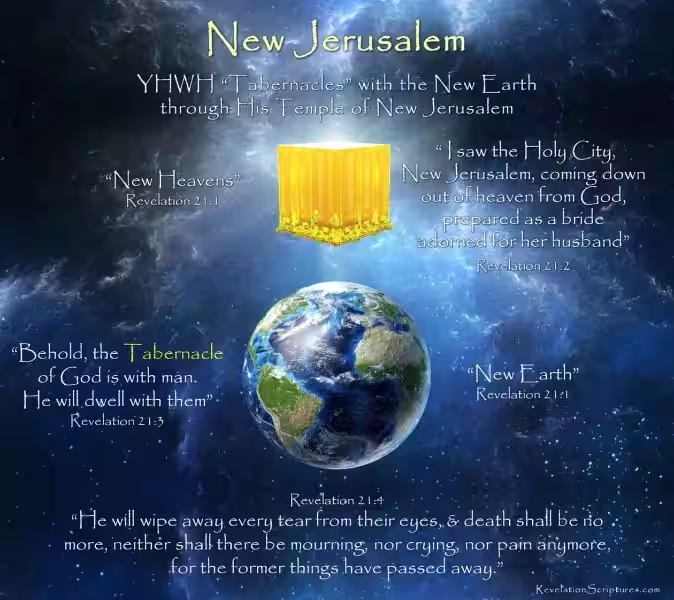
The ultimate culmination is the vision of the New Jerusalem in Revelation 21-22. This is not merely a rebuilt city but a divine dwelling place, a perfect communion between God and His redeemed people. John describes it with unparalleled beauty: a city of pure gold, with foundations of precious jewels, and a river of the water of life, clear as crystal, flowing from the throne of God and the Lamb. The gates are never closed, and there is no more death, mourning, crying, or pain, for the former things have passed away. This is the ultimate hope of the Christian faith: a restored creation, free from sin and suffering, where God dwells with His people forevermore. It is a promise that transcends our present realities, offering profound comfort and an inspiring vision for the future.
This verse-by-verse journey through Revelation, though brief, unveils a rich tapestry of divine revelation. It reminds us of God’s sovereignty, the sufficiency of Christ’s sacrifice, the reality of spiritual conflict, and the certainty of ultimate victory. May this exploration inspire you to delve deeper into this profound book, finding hope, encouragement, and a clearer understanding of God’s magnificent plan for all of creation. The message of Revelation is not one of fear, but of steadfast faith and unwavering hope in the One who is, and who was, and who is to come.
Frequently Asked Questions: Revelation Verse by Verse Commentary
What is a verse-by-verse commentary of Revelation?
A verse-by-verse commentary of Revelation is an in-depth explanation of the Book of Revelation in the Bible, analyzing each verse or small group of verses to understand its meaning, historical context, theological implications, and prophetic significance.
What are the different approaches to interpreting Revelation?
The primary approaches include the Preterist (events fulfilled in the past), Historicist (events throughout church history), Futurist (events in the future), and Idealist/Spiritual (symbolic truths for all ages). Many commentaries blend these approaches.
Is Revelation meant to be interpreted literally?
Revelation is a highly symbolic book, using visions, metaphors, and imagery. While some elements may have literal fulfillment, a purely literal interpretation often struggles with the symbolic language. Understanding the symbolic nature is key.
What is the historical context of the Book of Revelation?
Written by the Apostle John, Revelation was likely composed during a time of persecution for Christians in the Roman Empire, around the late first century AD. Understanding this context helps interpret its messages of endurance and judgment.
Why is Revelation considered a difficult book to understand?
Its symbolic language, complex imagery, diverse interpretations, and prophetic nature contribute to its difficulty. Different theological viewpoints also lead to varied understandings of its meaning.
What are the main themes found in Revelation?
Key themes include the sovereignty of God, the victory of Christ over evil, judgment on sin and ungodliness, the perseverance of believers, the ultimate establishment of God’s kingdom, and the hope of a new heaven and new earth.
How does Revelation relate to other books in the Bible?
Revelation is the culmination of biblical prophecy, drawing heavily on Old Testament imagery and themes. It connects to the teachings of Jesus and the early church, offering a final vision of God’s plan for humanity and creation.
What is the role of religious tradition in understanding Revelation?
Religious traditions, such as denominational interpretations or the writings of early church fathers, can offer valuable insights and historical perspectives on understanding Revelation, though they should be weighed against the text itself.
What is the primary religious message of Revelation?
The core religious message is one of hope and assurance for believers facing adversity. It emphasizes God’s ultimate control, the triumph of good over evil through Christ, and the eternal reward for faithfulness.
How can understanding Revelation impact one’s faith today?
Studying Revelation can strengthen faith by revealing God’s power and ultimate plan, encourage perseverance in difficult times, foster a deeper appreciation for salvation, and motivate a commitment to righteous living in anticipation of Christ’s return.