The concept of revelation is a cornerstone of many religious traditions, acting as the very conduit through which humanity receives divine insight. It’s not merely about ancient texts, but about a dynamic, ongoing process of unveiling the sacred, offering guidance, truth, and a glimpse into the ultimate reality. However, interpreting revelation is rarely a straightforward affair. It’s a journey fraught with nuance, requiring careful consideration, historical context, and a deep engagement with the spiritual life. This article will delve into the multifaceted nature of interpreting revelation within the realm of religion, aiming to provide a useful, relatable, and informative perspective for anyone seeking to understand this profound aspect of faith.
Revelation in its most fundamental sense is the act of God, or the divine, making itself known to humanity. This can manifest in a myriad of ways, from direct communication to subtle nudges in the heart and mind. Understanding the diverse forms of revelation is the first step in grasping how we approach its interpretation. It’s not a single, monolithic event, but a spectrum of divine disclosure that has shaped religious thought and practice for millennia.
Think of it like a skilled artist revealing their masterpiece, not all at once, but through a series of carefully placed brushstrokes. Each stroke adds depth, color, and meaning. Similarly, revelation can come through:
Prophetic utterances: Direct messages delivered by chosen individuals, often with a sense of urgency and divine authority.
Sacred texts: Written accounts believed to be divinely inspired, preserving teachings, histories, and ethical frameworks.
Mystical experiences: Profound, personal encounters with the divine that transcend ordinary understanding.
Natural phenomena: The order and beauty of the universe, seen by many as a testament to a creator’s power and wisdom.
Conscience and inner intuition: A moral compass and a sense of right and wrong, often attributed to divine indwelling.
Each of these avenues requires a different lens through which to be understood, and it is within this diversity that the challenge and beauty of interpreting revelation truly lie.
The Art and Science of Interpreting Revelation
To interpret revelation is to engage in a process that is both an art and a science. It requires the sensitivity of an artist to feel the nuances and emotional weight of the divine message, while also employing the rigor of a scientist to analyze, contextualize, and draw logical conclusions. This is where the real work of understanding religious texts and experiences begins, and it’s a task that has occupied theologians, scholars, and devout individuals throughout history.
The goal of interpreting revelation is not simply to decipher words on a page or to rationalize a fleeting experience. It is to access the divine truth that lies at its core, to allow it to transform our lives, and to better understand our place in the grand cosmic narrative. This requires a commitment to humility, a willingness to learn, and an openness to the possibility that our initial understanding might be incomplete or even mistaken.
Historical and Cultural Context: The Foundation of Understanding
No religious text or prophetic utterance exists in a vacuum. To truly interpret revelation, we must first understand the historical and cultural soil from which it sprang. This means delving into the world of the prophets, the ancient societies that received these messages, and the prevailing social, political, and religious norms of their time. Without this crucial context, we risk misinterpreting the meaning, applying it anachronistically, or missing its intended impact.
Consider, for example, the dietary laws found in some ancient religious scriptures. If interpreted literally today without understanding their original purpose – perhaps related to hygiene, social distinction, or symbolic purity in a specific historical setting – they can seem arbitrary. However, when viewed through their historical and cultural lens, their significance becomes clearer. Interpreting revelation demands that we ask: “What did this mean to the people who first heard or read it?” This question acts as a vital key to unlocking deeper meaning.
Linguistic Nuances and Literary Devices: The Color and Depth of Divine Language
The language of revelation is rarely plain and simple. Divine communication often employs vivid imagery, metaphors, parables, and poetic structures to convey truths that transcend ordinary prose. Understanding these linguistic nuances is paramount to accurate interpretation. It’s like trying to understand a song by only reading the lyrics without hearing the melody; you miss a significant part of the message.
For instance, when a scripture speaks of God’s ‘hand’ or ‘face,’ it’s not a literal anatomical description but a symbolic representation of divine action, presence, or judgment. Similarly, parables, like Jesus’s story of the Sower, use everyday scenarios to illustrate profound spiritual principles. Interpreting revelation involves recognizing these literary devices and appreciating the layers of meaning they are designed to convey, allowing the text to speak in its own unique, often beautiful, language.
The Role of Tradition and Authority: Guiding the Interpretation
For many religious adherents, interpreting revelation is not a solitary endeavor. Religious traditions and established authorities play a significant role in shaping how divine messages are understood. These traditions often represent centuries of reflection, debate, and consensus-building among learned individuals and communities. They provide a framework, a set of hermeneutical tools, and a collective wisdom that can guide individuals in their pursuit of understanding.
Think of a legal system. While laws are written, their application and meaning are often clarified through case law and judicial precedent. Similarly, religious traditions offer a body of interpretive wisdom that has been tested and refined over time. While it’s important to engage with revelation personally, acknowledging and learning from the established interpretive frameworks can prevent eisegesis (reading your own meaning into the text) and promote a more accurate understanding of the divine unveiling.
Navigating Personal and Communal Understanding
Ultimately, interpreting revelation is a journey that unfolds on both personal and communal levels. While individual reflection and spiritual experience are vital, so too is the shared exploration and discernment within a believing community. This balance is what allows for both an authentic personal connection with the divine and a robust, well-grounded understanding of religious truths.
The beauty of interpreting revelation lies in its capacity to speak differently to each individual while simultaneously fostering a sense of shared faith and purpose. It’s a testament to the boundless nature of the divine, which can be accessed and understood in ways that resonate with the unique journey of every soul.
The Inner Voice: Personal Discernment and Spiritual Experience
Every believer is called to engage with revelation personally. This involves an active process of listening to the inner voice, of allowing the divine message to resonate within one’s own heart and mind. This personal discernment is not about imposing one’s will on the divine, but about cultivating a receptive spirit, open to the subtle promptings and illuminations that come from beyond the self.
Mystical experiences, moments of profound insight, or even a persistent feeling of conviction about a particular teaching are all forms of personal revelation. Interpreting revelation in this personal sphere requires introspection, prayer, and a willingness to be guided by a sense of inner truth. It’s a deeply intimate dialogue between the individual soul and the divine.
The Collective Wisdom: Community and Shared Interpretation
While the personal encounter with revelation is crucial, religious communities offer an invaluable space for shared interpretation. When individuals come together with diverse perspectives, experiences, and intellectual capacities, a richer and more nuanced understanding of divine unfolding can emerge. This collective wisdom helps to safeguard against individual biases and provides a sounding board for testing and refining interpretations.
Imagine a group of people trying to assemble a complex puzzle. Each person might see a few pieces clearly, but it’s only when they pool their observations and discuss their findings that the complete picture begins to emerge. In religious groups, discussions, sermons, and communal study all contribute to a collective interpretation of revelation, strengthening the faith of the entire community through shared understanding.
The Enduring Relevance of Interpreting Revelation
The process of interpreting revelation is not a static academic exercise; it is a living, breathing aspect of religious life. As humanity evolves, as new challenges arise, and as our understanding of the world deepens, the need to re-examine and re-interpret divine unveilings becomes ever more pressing. The enduring relevance of interpreting revelation lies in its capacity to provide timeless truths that can guide us through the complexities of contemporary existence.
By engaging thoughtfully and humbly with the diverse forms of revelation, and by acknowledging both the personal and communal dimensions of interpretation, we can unlock profound spiritual insights. This journey of interpreting revelation is a lifelong endeavor, promising not only a deeper understanding of religion but also a richer, more meaningful life. It is through this ongoing unveiling that we can continue to connect with the divine and find our purpose within the grand tapestry of existence.
The Book of Revelation is the final book of the New Testament and is considered a prophetic and apocalyptic text. It describes visions and prophecies given to the Apostle John, primarily concerning the end times, the cosmic struggle between good and evil, the return of Jesus Christ, and the establishment of God’s eternal kingdom. It uses symbolic language, imagery, and visions to convey its message.
What are the main approaches to interpreting Revelation?
There are several major approaches to interpreting Revelation, including:
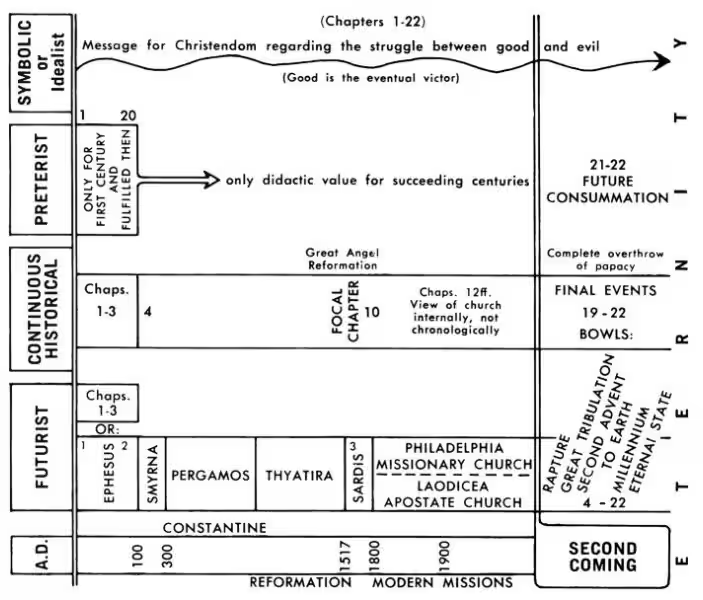
Preterist: Views most of the prophecies as having already been fulfilled in the past, particularly during the first century AD.
Historicist: Sees Revelation as a symbolic representation of the entire sweep of church history from the time of John to the second coming of Christ.
Futurist: Interprets most of Revelation’s prophecies as yet to be fulfilled, primarily in a future tribulation period before Christ’s return.
Idealist/Symbolist: Understands Revelation’s imagery and events as symbolic representations of timeless spiritual truths and the ongoing conflict between good and evil, without necessarily assigning them to specific historical periods.
Many interpreters combine elements of these approaches.
What does the symbolism in Revelation mean?
Revelation is rich in symbolism, drawing heavily from Old Testament imagery, Jewish apocalyptic literature, and Roman cultural contexts. For example:
Numbers: Seven often represents completeness or perfection (e.g., seven churches, seven seals).
Colors: White can symbolize purity or victory, red can signify bloodshed or war, and black can represent famine or death.
Animals: Beasts often represent powerful, oppressive empires or forces hostile to God (e.g., the dragon, the beast from the sea).
Individuals: Figures like the Lamb (Jesus Christ) and the Woman (God’s people) carry significant theological meaning.
Understanding the historical and literary context is crucial for deciphering these symbols.
Is Revelation meant to be taken literally?
While some elements of Revelation may refer to literal events, the book is predominantly written in symbolic and visionary language. Taking everything literally can lead to misinterpretations. The goal is to understand the meaning behind the symbols, which often represent spiritual realities, principles, and ultimate outcomes rather than precise, literal historical predictions.
When will the events described in Revelation happen?
This is a central point of debate among interpreters.
* Preterists believe most events have already occurred.
* Futurists believe they will happen in a future period of tribulation.
* Historicists see them unfolding throughout history.
* Idealists view them as ongoing spiritual realities.
The book itself suggests that the events are near and that God’s judgment and salvation are certain.
What is the “Mark of the Beast”?
The “Mark of the Beast” (Revelation 13:16-18) is depicted as a mark required for economic transactions, imposed by the beast. Its meaning is widely debated. Some see it as literal, others as symbolic of allegiance to oppressive powers or a rejection of God. Historically, it has been interpreted in various ways related to political and economic systems perceived as anti-Christian. The primary message is about loyalty to God versus allegiance to worldly powers.
What is the “New Jerusalem”?
The New Jerusalem (Revelation 21-22) is a vision of the ultimate dwelling place of God with His redeemed people. It symbolizes perfect fellowship, purity, and the eradication of suffering, death, and sin. It represents the culmination of God’s redemptive plan, where heaven and earth are united in a renewed creation.
How should I approach reading Revelation?
When approaching Revelation, consider these points:
Pray for wisdom: Seek divine guidance and understanding.
Understand its genre: Recognize it as apocalyptic literature, characterized by symbolism and visions.
Context is key: Study the historical, cultural, and biblical context from which it emerged.
Focus on the main themes: Pay attention to the consistent messages of God’s sovereignty, Christ’s victory, judgment, salvation, and the hope of eternal life.
Avoid speculation: Be cautious of sensationalistic interpretations or trying to pinpoint exact dates or identities that are not clearly revealed.
Remember its purpose: Revelation offers encouragement to believers facing persecution and assures them of God’s ultimate triumph.