Introduction: A Tapestry of Faith Woven by Four Voices
In the vast tapestry of human spirituality, few narratives resonate as profoundly as the life and teachings of Jesus of Nazareth. For billions across the globe, these accounts form the bedrock of their faith, offering solace, guidance, and a path towards understanding the divine. At the heart of this profound influence lie the four Gospels: the books attributed to Mathew, Mark, Luke, and John. While they all tell the same overarching story, each Gospel offers a unique perspective, a distinct voice, and an individual emphasis that enriches our understanding and deepens our connection to the foundational figure of Christianity. Exploring these four accounts isn’t just an academic exercise; it’s an invitation to engage with a powerful narrative that has shaped history and continues to touch countless lives today.
These ancient texts, penned by distinct individuals with their own experiences and intended audiences, are more than just historical documents. They are living testimonies, designed to persuade, inform, and inspire. Think of them like four different photographers capturing the same breathtaking sunset. One might focus on the fiery reds and oranges, another on the soft, diffused light, a third on the silhouetted landscape, and the fourth on the subtle shifts in color as evening descends. Each captures a truth, a facet of the beauty, but together, they offer a more complete and nuanced appreciation of the phenomenon. Similarly, Mathew, Mark, Luke, and John present the life of Jesus through different lenses, each contributing essential pieces to the puzzle of who he was and what his message meant.
Mathew: The Messiah for a Jewish Audience
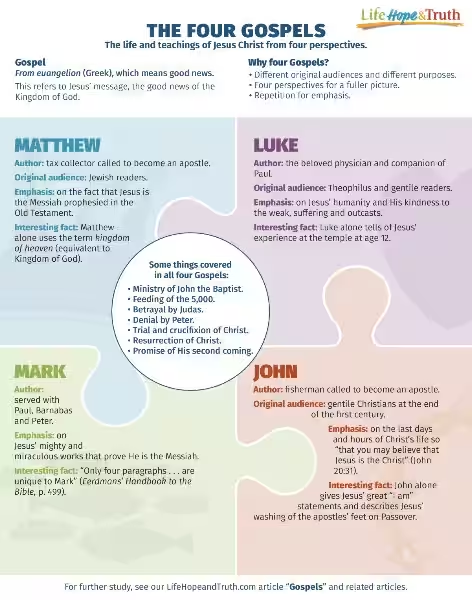
The Gospel of Mathew is often seen as presenting Jesus as the long-awaited Messiah promised in the Old Testament scriptures. Written primarily for a Jewish audience, Mathew meticulously draws connections between Jesus’ life and actions and the prophecies of ancient Israel. He frequently quotes scripture, demonstrating how Jesus fulfills these ancient predictions, thereby aiming to convince his readers that Jesus is indeed the King they have been waiting for. This focus on lineage and fulfillment makes Mathew’s Gospel particularly appealing to those familiar with Jewish tradition.
One of the key characteristics of Mathew’s Gospel is its structured presentation of Jesus’ teachings. Think of the five great discourses – lengthy blocks of Jesus’ words, such as the Sermon on the Mount. This organization suggests an intention to present Jesus as a master teacher, a new Moses, delivering divine law and wisdom. For instance, in the Sermon on the Mount, Mathew records Jesus not just reiterating the law but profoundly deepening its meaning, teaching about inner motivations and the spirit of the commandments, not just the letter. This emphasis on Jesus as the authoritative interpreter of God’s will is a hallmark of Mathew’s unique contribution.
The Gospel of Mark is the shortest and often considered the earliest of the four Gospels. It’s characterized by its fast pace, vivid descriptions, and a strong emphasis on Jesus’ actions and miracles. Mark presents Jesus as a powerful servant, constantly on the move, demonstrating his divine authority through numerous deeds of healing, exorcism, and compassion. This energetic narrative style makes Mark’s Gospel incredibly engaging and accessible, drawing the reader into the dynamic ministry of Jesus.
Mark’s Gospel often highlights the urgency and immediacy of Jesus’ mission. We see Jesus frequently telling people to keep his identity a secret, a concept known as the “messianic secret.” This creates a sense of mystery and anticipation, inviting the reader to discover Jesus’ true nature alongside the disciples. For example, after Jesus heals a deaf man and makes him speak, he “ordered them not to tell anyone.” This isn’t about hiding his power, but perhaps about allowing people to grasp his identity through his deeds and teachings before the full revelation of his suffering and resurrection. The focus is on Jesus’ unwavering commitment to his divine purpose, even in the face of misunderstanding and opposition.
Luke: The Compassionate Savior for All Nations
The Gospel of Luke is known for its thoroughness, historical detail, and a particular emphasis on Jesus’ compassion for the marginalized and the outcast. Luke, a physician and a historian, meticulously researched his account, aiming to provide an orderly and comprehensive narrative for his readers, particularly for a Gentile (non-Jewish) audience. He highlights Jesus’ universal love and concern, extending his message of salvation to women, Samaritans, the poor, and tax collectors – groups often overlooked or despised by society.
Luke’s Gospel is rich with parables that illustrate God’s mercy and grace. Consider the parables of the Lost Sheep, the Lost Coin, and the Prodigal Son. These stories, found primarily in Luke, powerfully convey the message that God actively seeks out the lost and rejoices in their return. Luke’s detailed accounts of Jesus’ interactions with these individuals demonstrate a profound empathy and a commitment to showing that Jesus’ ministry was for everyone, regardless of their social standing or past mistakes. His narrative invites us to see Jesus as a Savior who breaks down barriers and embraces all who seek him.
The Gospel of John stands apart from the other three, often referred to as the synoptic Gospels (Mathew, Mark, and Luke, so named because they share a similar outlook). John’s Gospel offers a more theological and philosophical exploration of Jesus’ identity, presenting him as the divine Son of God, the eternal Word who became flesh. His narrative is characterized by profound discourses and the “I Am” sayings of Jesus, boldly declaring his divine nature.
John’s Gospel emphasizes belief and eternal life. Jesus’ miracles in John are presented not just as acts of power, but as signs (“semeia”) that point to his divine identity and offer a glimpse of God’s glory. For instance, the miracle of turning water into wine at Cana is described as Jesus revealing his “glory, and his disciples believed in him.” This focus on recognition and faith is central to John’s message. He wants his readers to understand that believing in Jesus is to believe in God, and that through this belief, they can have eternal life. John’s Gospel invites a deep contemplation of Jesus’ relationship with the Father and his ultimate purpose.
Conclusion: A Harmonious Symphony of Faith
While Mathew, Mark, Luke, and John each offer a unique perspective, their narratives are not contradictory but rather complementary. Together, they paint a richer, more vibrant, and profoundly comprehensive portrait of Jesus Christ. Mathew presents him as the Messiah fulfilling prophecy, Mark as the powerful servant in action, Luke as the compassionate Savior for all, and John as the divine Son revealing God’s truth. Understanding these distinct voices allows us to appreciate the multifaceted nature of Jesus’ life and ministry, and the enduring power of his message for religion and humanity.
Engaging with these four Gospels is an ongoing journey of discovery. Each reading can yield new insights, deepen our understanding, and strengthen our faith. Whether we are drawn to the authoritative teachings in Mathew, the compelling actions in Mark, the tender compassion in Luke, or the profound theological truths in John, we find in these accounts a timeless invitation to encounter Jesus and to embrace the transformative power of his love and sacrifice. They are not simply ancient stories; they are living testimonies that continue to shape lives and inspire hope across the world.
What are the Gospels of Matthew, Mark, Luke, and John?
The Gospels of Matthew, Mark, Luke, and John are the first four books of the New Testament in the Christian Bible. They are accounts of the life, ministry, teachings, death, and resurrection of Jesus Christ.
Who wrote the Gospels?
Traditionally, the Gospels are attributed to the apostles Matthew and John, and to Mark and Luke, who were companions of the apostles Peter and Paul, respectively. Modern biblical scholarship sometimes debates the exact authorship and dating of these texts, but the traditional attributions are widely recognized within Christian traditions.
What is the main focus of each Gospel?
Matthew: Emphasizes Jesus as the Messiah fulfilling Old Testament prophecies, presenting him as the King of Israel. It is often seen as written for a Jewish audience.
Mark: Presents Jesus as the dynamic and active Son of God, focusing on his deeds and the urgency of his message. It is generally considered the shortest and oldest of the Gospels.
Luke: Highlights Jesus’ compassion for the marginalized, the poor, and women, portraying him as the Savior of all humanity. It is known for its detailed narrative and orderly account.
John: Offers a more theological and reflective perspective, focusing on Jesus’ divine identity and his relationship with God the Father. It emphasizes Jesus’ words and his role as the Word of God.
Are the Gospels historically accurate?
The Gospels are considered by Christians to be divinely inspired and historically reliable accounts of Jesus’ life and teachings. While historical and archaeological evidence can sometimes corroborate details within the Gospels, their primary purpose is theological and devotional, aiming to proclaim Jesus as the Christ and Savior.
How do the Gospels relate to each other?
Matthew, Mark, and Luke are known as the “Synoptic Gospels” because they share a similar perspective and much of the same material, often presented in the same order. John’s Gospel is significantly different in its content, style, and theological emphasis, offering a complementary yet distinct witness to Jesus.
What is the theological significance of the Gospels?
The Gospels are central to Christian faith. They provide the foundational narrative for understanding who Jesus is, his salvific mission, and the core tenets of Christianity, including salvation through faith in him. They are read, preached, and studied by Christians worldwide as the primary source of their beliefs and practice.