10 Differences Between Islam and Christianity: A Comparative Exploration
In our interconnected world, understanding different faiths is more crucial than ever. While Islam and Christianity share common roots as Abrahamic religions, stemming from a lineage tracing back to the prophet Abraham, they have evolved into distinct spiritual traditions with unique doctrines, practices, and historical trajectories. This exploration delves into ten key differences that set these two major world religions apart, offering insights that are both informative and relatable for anyone seeking to grasp the nuances of their beliefs.
These differences aren’t about declaring one faith superior to another, but rather appreciating the rich tapestry of human spirituality. By examining their core tenets, we can foster a deeper respect and understanding for the diverse ways people connect with the divine. So, let’s embark on this journey of comparative discovery, illuminating the distinct paths of Islam and Christianity.
Perhaps the most significant and foundational difference between Islam and Christianity lies in their conception of God. In Islam, the absolute oneness of God, known as Tawhid, is paramount. Muslims believe there is only one God, Allah, and associating any partners with Him is the gravest sin. This concept is so central that it forms the very first pillar of Islam: the declaration of faith, “There is no god but Allah, and Muhammad is his messenger.”
This absolute monotheism means that Muslims do not believe in the Christian concept of the Trinity. They see the divine as indivisible, a singular entity without any equals or partners. This is akin to a solitary, unyielding beam of pure light, incapable of being split into different components. The Quran consistently emphasizes Allah’s uniqueness and sovereignty, urging believers to worship Him alone. Therefore, any notion of God having a son, or being comprised of multiple persons, is considered polytheistic and unacceptable.
The Trinity in Christianity
Christianity, on the other hand, adheres to the doctrine of the Trinity. This belief states that God is one God, but exists in three co-equal and co-eternal persons: God the Father, God the Son (Jesus Christ), and God the Holy Spirit. While distinct, these three persons are considered to be one God, sharing the same divine essence. Understanding the Trinity can be complex, often described using analogies such as water, which can exist as solid ice, liquid water, and gaseous steam, yet remains H2O – one substance in different forms.
This doctrine is central to Christian theology and forms the basis for their understanding of salvation and the role of Jesus Christ. Christians believe that Jesus, as the Son of God, is divine and was sent to Earth to redeem humanity. The Holy Spirit is seen as the active presence of God in the world and within believers. This concept of God existing as a unified yet multifaceted being is a profound departure from the strict monotheism of Islam, presenting a core theological difference between Islam and Christianity.
2. The Role and Nature of Jesus Christ
Jesus as a Prophet in Islam
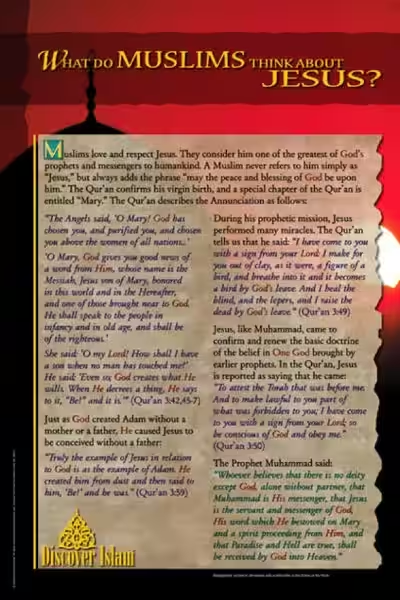
In Islam, Jesus, known as Isa, is highly revered. He is considered one of the most important prophets of God, a messenger who performed miracles and brought divine guidance. Muslims believe he was born of the Virgin Mary (Maryam) through a miraculous conception, a testament to God’s power. However, they do not believe Jesus is the Son of God in a literal, divine sense, nor do they believe he was crucified. The Quran states that Jesus was not killed or crucified, but rather “it was made to appear so to them.”
Muslims see Jesus as a human prophet, albeit one with a special status, who preceded Muhammad. His message, like that of other prophets, was to call people to worship Allah. They believe he will return again before the Day of Judgment, but his role will be to affirm the truth of Islam and follow the teachings of Muhammad. This fundamental understanding of Jesus’s nature and his ultimate role is a significant difference between Islam and Christianity.
Jesus as the Divine Son of God in Christianity
For Christians, Jesus Christ is the central figure and the divine Son of God. They believe he is God incarnate, the second person of the Trinity, who willingly took on human form. His crucifixion is seen as a sacrificial atonement for the sins of humanity, and his resurrection is the cornerstone of Christian faith, signifying victory over death and offering hope for eternal life. Christians believe that through faith in Jesus, individuals can be reconciled with God.
The divinity of Jesus is a non-negotiable tenet of Christianity. He is not merely a prophet but the Savior, the Messiah, whose life, death, and resurrection have transformative power. This belief in Jesus’s divine nature and his redemptive mission is a profound difference between Islam and Christianity, shaping the entire theological framework of the latter.
Muslims believe the Quran is the literal and final word of God, revealed to the Prophet Muhammad through the Angel Gabriel over a period of 23 years. It is considered the ultimate and uncorrupted scripture, a guiding light for all of humanity. The Arabic text of the Quran is believed to be divinely preserved and untranslatable in its essence, meaning that while translations exist, the true Quran is only in its original Arabic.
The Quran is seen as the culmination of previous divine revelations, including the Torah and the Gospels, which Muslims believe were either misinterpreted or altered over time. For Muslims, the Quran is a complete and perfect guide for all aspects of life, from personal conduct to societal governance. Its comprehensive nature and claims of divine preservation represent a significant difference between Islam and Christianity in terms of their primary holy books.
The Bible: Inspired by God, Compiled Over Time
Christians revere the Bible as the inspired word of God, a collection of books written by various authors over many centuries. It comprises the Old Testament (shared with Judaism) and the New Testament, which focuses on the life and teachings of Jesus Christ and the early Christian church. While Christians believe the Bible is divinely inspired and authoritative, they generally understand it as being conveyed through human authors, reflecting their historical and cultural contexts.
The understanding is that God guided the writers, but the text itself is not always considered the direct dictation of God in the same way the Quran is understood in Islam. The diversity of authorship and the historical development of the biblical canon are aspects that differentiate it from the singular, direct revelation of the Quran. This difference in the perception of the origin and nature of their sacred texts is a crucial difference between Islam and Christianity.
4. The Prophet Muhammad: The Final Messenger
Muhammad: The Seal of the Prophets
Muslims believe Muhammad is the final prophet in a long line of messengers sent by God, including Adam, Noah, Abraham, Moses, and Jesus. He is considered the “Seal of the Prophets,” meaning no prophet will come after him. His role was to deliver God’s final and complete message to humanity, the Quran, and to establish the religion of Islam. His life and teachings, known as the Sunnah, serve as a model for Muslims.
Muhammad is revered not as divine, but as a perfect human being, chosen by God to convey His ultimate message. His obedience to Allah and his dedication to spreading Islam are exemplary. This unique position as the final prophet is a core tenet of Islam. The absence of such a concept in Christianity highlights a significant difference between Islam and Christianity.
No Equivalent “Final Prophet” in Christianity
Christianity does not recognize any prophet after Jesus Christ. Jesus is considered the ultimate revelation of God, and his teachings and the subsequent writings in the New Testament are seen as the final and complete divine message. While Christians believe in ongoing guidance from the Holy Spirit, they do not anticipate a new prophet to deliver a new divine law or scripture.
The focus in Christianity is on the person of Jesus himself as the mediator between God and humanity. The idea of a “final prophet” in the Islamic sense is absent from Christian theology. This distinct perspective on prophetic succession is a key difference between Islam and Christianity.
5. The Concept of Sin and Salvation
Personal Responsibility for Sin and Direct Atonement in Islam
In Islam, sin is seen as an act of disobedience to God’s commands. Every individual is responsible for their own actions and will be judged accordingly. While God is merciful, there is no concept of original sin passed down from Adam and Eve. Muslims believe that through sincere repentance, seeking forgiveness from God, and striving to live a righteous life according to Islamic principles, one can attain salvation.
The path to salvation is through submission to God’s will (Islam), performing good deeds, and adhering to the pillars of Islam: faith, prayer, charity, fasting, and pilgrimage. There is no intermediary required for forgiveness; individuals can directly ask Allah for mercy. This direct accountability is a fundamental difference between Islam and Christianity.
Original Sin and Salvation Through Faith in Christ in Christianity
Christianity teaches the doctrine of original sin, inherited from Adam and Eve, which taints all humanity. As a result, humans are seen as inherently sinful and incapable of saving themselves. Salvation is achieved through faith in Jesus Christ, his atoning sacrifice on the cross, and his resurrection. This is often referred to as salvation by grace through faith.
Christians believe that Jesus’s death paid the penalty for humanity’s sins, and by accepting him as their Lord and Savior, individuals are cleansed of sin and reconciled with God, gaining the promise of eternal life. The role of Jesus as the unique mediator and savior is a pivotal difference between Islam and Christianity.
6. Religious Practices and Rituals
The Five Pillars of Islam: A Framework for Devotion
Islam is structured around five core practices known as the Five Pillars. These are: the declaration of faith (Shahada), daily prayers (Salat) performed five times a day facing the Kaaba in Mecca, charitable giving (Zakat), fasting during the month of Ramadan (Sawm), and pilgrimage to Mecca (Hajj) for those who are able. These pillars provide a comprehensive framework for a Muslim’s spiritual and communal life.
These rituals are not merely symbolic; they are considered acts of worship and submission to God, designed to foster discipline, community, and a constant awareness of Allah. The specific timings, methods, and communal aspects of these pillars are distinct and form a significant part of Muslim identity. This structured approach to worship is a notable difference between Islam and Christianity.
Christian Practices: Sacraments and Worship
Christian practices vary widely among denominations but often center around sacraments such as Baptism and Communion (the Eucharist). Baptism symbolizes spiritual cleansing and initiation into the Christian community, while Communion commemorates Jesus’s Last Supper and his sacrifice. Worship services typically involve prayer, singing hymns, scripture readings, and sermons, often held on Sundays.
While prayer and scripture are central to both faiths, the specific rituals, their theological meanings, and their frequency differ. For instance, the communal prayer structure and the specific devotional acts in Islam are distinct from the varied liturgical practices found in Christianity. This variation in ritualistic expression is a key difference between Islam and Christianity.
7. Dietary Laws and Lifestyle
Halal and Haram in Islam: A Comprehensive Code
Islam has established dietary laws, categorizing foods as either Halal (permissible) or Haram (forbidden). The most well-known forbidden item is pork, along with alcohol, blood, and animals not slaughtered in the prescribed manner. These laws extend beyond food to encompass lifestyle choices, encouraging modesty, honesty, and abstaining from gambling and usury.
These guidelines are seen as a way to maintain purity and discipline, reflecting obedience to God’s commands. The emphasis is on a holistic lifestyle that is pleasing to Allah. This detailed and prescriptive code for daily living is a distinct characteristic of Islam. The presence of such a codified system is a clear difference between Islam and Christianity.
Christianity: Emphasis on Freedom and Conscience
While Christianity has historical dietary laws mentioned in the Old Testament, the New Testament generally emphasizes freedom of conscience regarding food. Jesus declared all foods clean, and while many Christians choose to abstain from alcohol for personal or societal reasons, there are no universally binding dietary prohibitions like those in Islam. The focus is more on the internal disposition of the heart and the purity of intention.
Instead of strict dietary codes, Christianity often emphasizes spiritual virtues like love, forgiveness, and compassion. While some Christian traditions may have ascetic practices or lifestyle recommendations, they are generally not as universally codified as the Halal and Haram distinctions in Islam. This difference in emphasis on external regulation versus internal disposition is a notable difference between Islam and Christianity.
8. The Concept of the Afterlife
Jannah and Jahannam: Gardens of Paradise and Hellfire
Islam describes the afterlife with vivid detail, outlining Jannah (Paradise) as a place of eternal bliss and reward for the righteous, characterized by lush gardens, flowing rivers, and divine pleasure. Conversely, Jahannam (Hell) is a place of punishment for wrongdoers, described as a fiery abyss. The outcome is determined by one’s deeds, faith, and God’s mercy.
The Quran provides detailed descriptions to motivate believers towards righteousness and deter them from sin. The concept of accountability for every action, leading to either eternal reward or punishment, is a powerful motivator. This specific imagery and framework for the afterlife are a significant difference between Islam and Christianity.
Heaven and Hell: Eternal Destinations
Christianity also believes in an afterlife with Heaven as the eternal dwelling place for believers, a realm of eternal joy and communion with God, and Hell as a place of eternal separation from God and suffering for the unrepentant. The path to Heaven is generally understood through faith in Jesus Christ and his redemptive work.
While both religions share the concepts of eternal reward and punishment, the specific theological pathways and the detailed descriptions often differ. The emphasis on Jesus as the sole mediator for entry into Heaven is a core Christian belief. This nuanced yet significant difference between Islam and Christianity in their eschatological views is important to note.
9. Religious Law and Governance
Sharia: Islamic Law Guiding Life
In Islam, Sharia is the divine law derived from the Quran and Sunnah, intended to guide all aspects of a Muslim’s life, including personal conduct, family matters, and societal governance. While the interpretation and application of Sharia can vary, its underlying principles are considered divinely ordained. Many Muslim-majority countries incorporate elements of Sharia into their legal systems.
Sharia aims to establish justice, morality, and order. It provides a comprehensive framework for a just and ethical society, encompassing criminal law, family law, and commercial law. The aspiration for religious law to inform civil governance is a distinct feature. This integration of religious and legal frameworks is a key difference between Islam and Christianity in their historical and contemporary applications.
Separation of Church and State in Christianity
Historically, Christianity has seen various models of church-state relationships. However, in modern Western contexts, there is often a strong emphasis on the separation of church and state, meaning religious institutions are distinct from governmental ones, and laws are primarily based on secular principles. While Christian ethics may influence societal values, religious law does not typically form the basis of civil governance.
The focus in many Christian societies is on the individual’s relationship with God and the church’s role in spiritual guidance, rather than direct governance. This separation allows for pluralistic societies where different religious beliefs can coexist. The differing approaches to religious law and governance represent a significant difference between Islam and Christianity.
10. The Concept of Divine Revelation and Miracles
The Quran as the Ultimate Miracle in Islam
Muslims believe the Quran is the greatest miracle bestowed upon humanity, not only for its divine content and eloquent Arabic but also for its perceived inimitable nature. Beyond the Quran, numerous miracles are recorded in Islamic tradition, performed by prophets to authenticate their message, such as the parting of the Red Sea by Moses or the healing of the sick by Jesus. However, the focus remains on the divine revelation through Muhammad.
The miraculous events serve as signs from Allah, reinforcing the truth of the prophets’ messages. The primary miracle, however, is the divine text itself, which Muslims believe has remained uncorrupted throughout history. This specific emphasis on the Quran as the ultimate miracle is a difference between Islam and Christianity.
Miracles as Signs of God’s Power in Christianity
Christianity recognizes a multitude of miracles as demonstrations of God’s power and the divine nature of Jesus. The miracles performed by Jesus, such as healing the blind, raising the dead, and calming storms, are central to Christian belief, serving as proof of his identity as the Son of God. The resurrection of Jesus is considered the ultimate miracle.
Miracles in Christianity are seen as signs of God’s intervention in the world, confirming His presence and power through His chosen messengers and especially through Jesus Christ. While both religions acknowledge divine intervention, the specific emphasis on the Quran as the singular, ongoing miracle in Islam contrasts with the broader narrative of miracles surrounding Jesus and his followers in Christianity. This distinction in the perceived nature and primary focus of miracles is a final difference between Islam and Christianity in this exploration.
Exploring these ten differences offers a clearer picture of the distinct theological landscapes of Islam and Christianity. While both faiths offer profound guidance and meaning to billions worldwide, their paths diverge in crucial ways, from the very nature of God to the specifics of daily practice and ultimate salvation. Understanding these distinctions is not about creating division, but about enriching our appreciation for the diverse expressions of faith that shape our global community.
Frequently Asked Questions: 10 Differences Between Islam and Christianity
1. What is the central figure of worship in each religion?
In Christianity, the central figure of worship is Jesus Christ, considered the Son of God and part of the Holy Trinity. In Islam, the central figure of worship is Allah (God), and Muhammad is revered as the final prophet.
2. How is God understood in each religion?
Christianity believes in the Holy Trinity: God the Father, God the Son (Jesus Christ), and God the Holy Spirit, all co-equal and one God. Islam strictly adheres to the absolute oneness of God (Tawhid), emphasizing that God has no partners or equals and is indivisible.
3. What is the role of Jesus in each faith?
Christians believe Jesus is divine, the Son of God, who died for the sins of humanity and was resurrected. Muslims view Jesus (Isa) as a highly respected prophet of God, born of a virgin, who performed miracles, but not divine, and was not crucified but raised to heaven by God.
4. What are the holy scriptures of each religion?
The holy scripture of Christianity is the Bible, comprising the Old and New Testaments. The holy scripture of Islam is the Quran, believed to be the literal word of God revealed to the Prophet Muhammad.
5. How is salvation achieved in each religion?
In Christianity, salvation is typically achieved through faith in Jesus Christ’s atoning sacrifice and grace. In Islam, salvation is achieved through submission to the will of Allah, adherence to Islamic law, good deeds, and seeking God’s mercy.
6. What is the concept of the afterlife?
Both religions believe in an afterlife with heaven and hell. However, the specific descriptions and pathways to each may differ.
7. What is the origin of sin?
Christianity teaches that sin is inherited from Adam and Eve (original sin). Islam does not believe in inherited sin; individuals are responsible for their own actions.
8. What is the significance of prophets?
Both religions recognize prophets, but Islam believes Muhammad is the final prophet, sealing the line of prophecy. Christianity sees Jesus as the ultimate revelation of God, and while prophets existed before him, his role is unique.
9. What are the primary places of worship?
Christians typically worship in churches. Muslims typically worship in mosques.
10. What is the concept of pilgrimage?
Christians may undertake pilgrimages to holy sites, but it is not a central pillar of the faith. Islam has the Hajj, a mandatory pilgrimage to Mecca for those who are able, which is one of the Five Pillars of Islam.