Imagine not just hearing about God, but feeling His presence in a tangible, guiding way. This is the essence of the Holy Spirit, often depicted in art and scripture, a divine force that breathes life into faith and illuminates our understanding. While we might not always see a literal holy spirit picture in the way we’d see a landscape painting, its impact is profound, shaping our spiritual journeys and offering a constant, unseen companion.
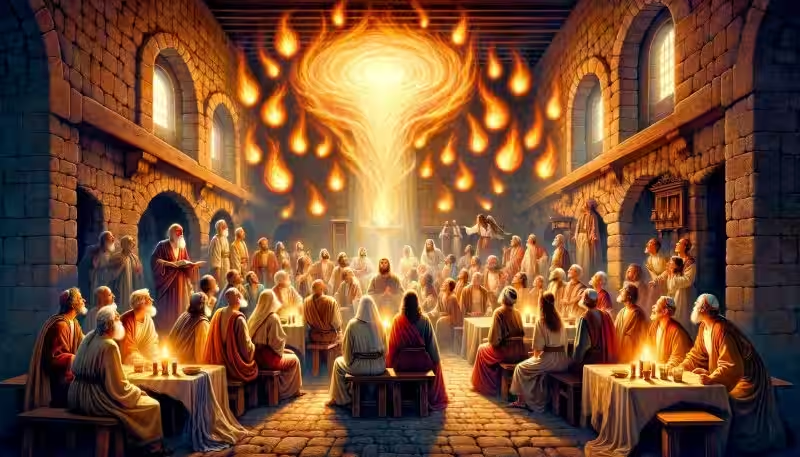
Throughout religious history, artists and theologians have grappled with how to represent this incorporeal power. From the descending dove to tongues of fire, these visual metaphors, these symbolic holy spirit pictures, serve as anchors for our contemplation, helping us to grasp the ineffable. They are not meant to be literal representations, but rather echoes of the Spirit’s transformative work in the world and in our lives.
Understanding the Divine Advocate: More Than Just a Symbol
The Holy Spirit is not merely an abstract concept or a fleeting emotion. Within the Christian tradition, particularly, it is understood as the third person of the Trinity, co-equal and co-eternal with God the Father and God the Son. This means the Spirit is fully divine, actively involved in creation, redemption, and ongoing spiritual formation within believers. Think of it like a three-legged stool; each leg is distinct, but all are essential for the stool to stand. The Holy Spirit is one of those vital legs, providing stability and purpose to our faith.
When we speak of the Holy Spirit, we are referring to God’s active power and presence in the world. It’s the whisper of conviction that draws us to repentance, the surge of courage that emboldens us to stand for what is right, and the deep sense of peace that calms us in the midst of turmoil. It’s the divine spark that ignites understanding, transforming dry theological concepts into living truths. This is why many find solace and inspiration in contemplating a holy spirit picture, as it serves as a visual reminder of this active, personal divine engagement.
The Spirit’s Work in Everyday Life
The influence of the Holy Spirit isn’t confined to grand religious ceremonies or moments of profound revelation. Its work is intricately woven into the fabric of our daily existence. It’s the gentle nudge to offer a word of encouragement to a struggling friend, the inner strength that helps us forgive someone who has wronged us, or the creative impulse that leads to a beautiful piece of art or a groundbreaking invention. These everyday occurrences, often overlooked, are powerful manifestations of the Spirit’s presence, guiding and empowering us.
Consider the feeling of understanding a complex idea after struggling with it for days. Or the sudden urge to help a stranger in need. These aren’t random events; they are often the subtle, yet powerful, promptings of the Holy Spirit. This divine energy is our advocate, our comforter, and our guide, helping us navigate the complexities of life with wisdom and grace. The visual cues we associate with the Holy Spirit, like the imagery of a guiding light or a gentle dove, are intended to help us recognize this pervasive influence, even when we can’t see a literal holy spirit picture.
Expressions and Manifestations of the Spirit’s Power
Across various religions, the Holy Spirit, or its equivalent divine animating force, is expressed in diverse and often awe-inspiring ways. In Christianity, biblical accounts speak of the Spirit descending as a dove at Jesus’ baptism, a powerful holy spirit picture symbolizing purity and divine approval. Later, at Pentecost, the Spirit appeared as tongues of fire, signifying empowerment and the ability to communicate the divine message to all nations. These are not just historical events but enduring symbols of the Spirit’s transformative power.
Beyond these dramatic biblical depictions, the Spirit’s presence is often felt through spiritual gifts. These can include prophecy, healing, teaching, wisdom, and discernment. These gifts are not mere talents; they are divine endowments that enable believers to serve others and to further God’s kingdom. Imagine a musician who can flawlessly compose a breathtaking melody – some believe this inspiration flows from the Holy Spirit. Likewise, a person with an extraordinary ability to offer comfort and guidance to those in distress might be channeling the Spirit’s compassionate nature. The contemplation of a holy spirit picture can serve as a reminder of these diverse manifestations, encouraging us to be open to the Spirit’s work in our own lives and in the lives of others.
The Spirit as a Source of Comfort and Guidance
One of the most profound roles of the Holy Spirit is that of the Comforter, or Advocate, as Jesus promised his disciples. In times of grief, confusion, or fear, the Spirit intercedes for us, offering solace and inner strength that transcends human understanding. This isn’t about erasing problems, but about providing the peace and resilience to face them. It’s like a warm blanket on a cold night, offering not just physical warmth but a deep sense of security and well-being.
Furthermore, the Spirit acts as a constant guide, illuminating our path and directing our steps. It’s the inner knowing that helps us discern right from wrong, the wisdom that informs our decisions, and the clarity that cuts through confusion. This guidance isn’t always a booming voice from the heavens; often, it’s a subtle impression, a persistent thought, or a feeling of confirmation. The various artistic renderings, the symbolic holy spirit pictures, are meant to evoke this sense of divine guidance, reminding us that we are never truly alone in our journey.
Connecting with the Divine: The Role of Faith and Practice
While the Holy Spirit is ever-present, actively connecting with this divine force requires intentionality and openness. This connection is often fostered through prayer, meditation, and the study of religious texts. These practices create a space for the Spirit to work within us, to speak to our hearts, and to transform our perspectives. Think of it as tuning a radio; you need to be on the right frequency to receive the broadcast. Our spiritual practices help us attune ourselves to the Spirit’s frequency.
Engaging with visual representations, such as a meaningful holy spirit picture, can also be a powerful tool for connection. These images can serve as focal points for prayer and contemplation, drawing our minds and hearts towards the Divine Presence. They are not idols, but aids to worship, helping us to internalize the attributes and work of the Holy Spirit. By regularly engaging with these aids, we cultivate a deeper awareness of the Spirit’s active role in our faith and in the world around us.
Living a Spirit-Empowered Life
Ultimately, the Christian life is meant to be a Spirit-empowered life. This means living not by our own limited strength or wisdom, but by the power and guidance of the Holy Spirit. It’s about yielding to its influence, allowing it to shape our character, and empowering us to live lives that reflect God’s love and truth. This transformation is a continuous process, a journey of becoming more like Christ, guided by the Spirit every step of the way.
When we embrace this Spirit-led existence, we experience a profound shift. Our actions become more purposeful, our relationships more loving, and our faith more vibrant. We find ourselves equipped to face challenges with courage, to extend grace with generosity, and to live with an authentic joy that comes from deep within. The presence of a holy spirit picture, whether in our minds or in our physical spaces, can serve as a constant reminder of this empowering reality, encouraging us to continually seek and embrace the Spirit’s presence in all aspects of our lives.
The Holy Spirit is the third person of the Trinity, alongside God the Father and God the Son (Jesus Christ). It is understood as the divine presence and power of God active in the world and in the lives of believers.
How is the Holy Spirit depicted visually?
There is no single, definitive “picture” of the Holy Spirit. Throughout history and in various traditions, the Holy Spirit has been symbolized in several ways:
Dove: This is the most common and widely recognized symbol, often seen at Jesus’ baptism.
Fire: Representing purification, passion, and the descent of the Spirit at Pentecost.
Wind: Symbolizing its unseen power, movement, and life-giving force.
Water: Representing spiritual cleansing, rebirth, and the outpouring of God’s grace.
Oil: Signifying anointing, consecration, and empowerment.
Light/Radiance: Depicting divine illumination and truth.
These are symbolic representations, not literal portraits, as the Holy Spirit is understood to be spirit and not corporeal.
What role does the Holy Spirit play in religion?
In Christianity, the Holy Spirit is believed to:
Inspire scripture and prophets.
Guide believers into truth.
Empower believers for service and witness.
Sanctify individuals, helping them to live a life pleasing to God.
Grant spiritual gifts.
Unite believers in the body of Christ.
In other religions, similar concepts of divine presence, guidance, or immanent power may exist, though the specific theological understanding and terminology will differ.
Are there different interpretations of the Holy Spirit across Christian denominations?
Yes, while the core understanding of the Holy Spirit as the third person of the Trinity is shared, denominations may have different emphases on its role and operation. For example, Pentecostal and Charismatic traditions often emphasize the experiential and miraculous manifestations of the Holy Spirit, such as speaking in tongues or divine healing, more prominently than some other denominations.
Can the Holy Spirit be seen?
No, in most theological interpretations, the Holy Spirit is understood as a divine spirit and therefore cannot be seen in a physical, human-like form. The visual representations mentioned are symbolic means to convey its nature and actions.