In the tapestry of religious teachings, certain phrases resonate with a profound and enduring power, offering not just comfort but a practical guide for living. Among these, Jesus’ Beatitudes, spoken from a mountainside to a gathered crowd, stand as cornerstones of Christian ethics and spiritual aspiration. These seemingly simple pronouncements are, in fact, profound insights into the nature of true blessedness, a state that often defies conventional worldly wisdom. They invite us to re-evaluate our priorities and to cultivate virtues that lead to a deeper, more meaningful connection with the divine and with our fellow human beings.
These are not mere platitudes or abstract philosophical concepts. The Beatitudes provide a concrete framework for understanding what it means to live a life aligned with spiritual principles, a life that is truly blessed, regardless of external circumstances. They offer a counter-cultural perspective, suggesting that true fulfillment is found not in material wealth or social standing, but in the cultivation of specific character traits and a humble, receptive heart. Embracing these teachings can transform our understanding of success and happiness, guiding us towards a more authentic and fulfilling spiritual journey.
The Foundation of True Happiness: Recognizing Our Need
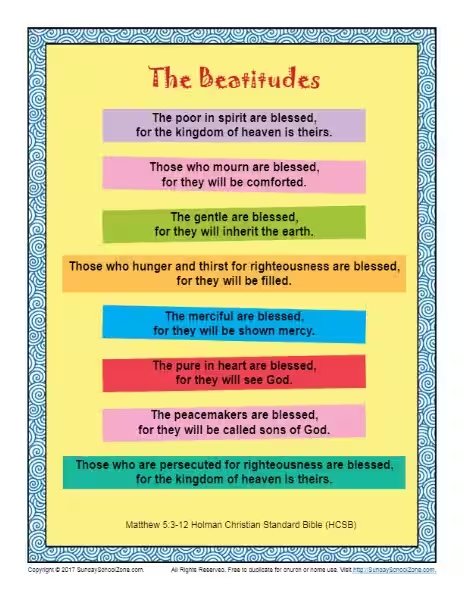
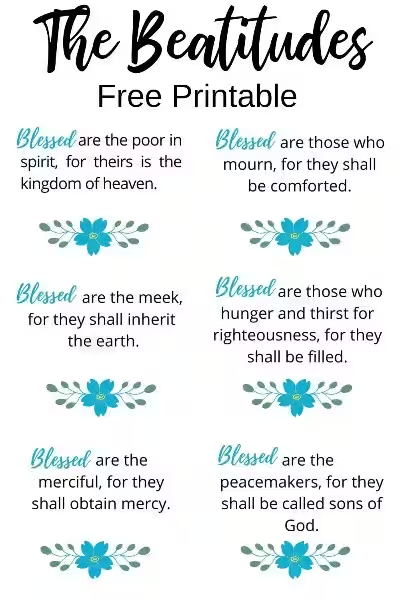
The very first Beatitude, “Blessed are the poor in spirit, for theirs is the kingdom of heaven,” sets the tone for the entire discourse. This isn’t about financial poverty, though that can certainly foster humility. Instead, it speaks to a spiritual destitution, a recognition of our utter dependence on God. It’s the awareness that we have nothing to offer that is truly worthy on our own, and that our salvation and spiritual well-being are entirely gifts. This profound humility is the fertile ground upon which all other spiritual growth can occur. It’s like a parched desert realizing its need for rain before it can bloom.
Consider the person who believes they have all the answers, who is arrogant and self-sufficient. Such a person is closed off to divine revelation and spiritual growth. Conversely, the “poor in spirit” are those who acknowledge their limitations, their flaws, and their inherent separation from God without His grace. This acknowledgment of spiritual bankruptcy is the first step towards receiving the riches of God’s kingdom. It’s an open hand, ready to receive, rather than a clenched fist, trying to hold onto perceived self-importance. This mindset is crucial for any genuine religious experience.
The next two Beatitudes delve into the realm of human emotion and interaction: “Blessed are those who mourn, for they will be comforted,” and “Blessed are the meek, for they will inherit the earth.” Mourning, in this context, is not just about personal sadness over loss, but also a deep sorrow for sin – both our own and the world’s. It’s a sensitivity to the brokenness around us, a profound empathy that grieves over injustice and suffering. This isn’t a passive resignation but an active engagement with the pain of existence, leading to a deeper understanding and a desire for healing.
The meek, often misunderstood as weak or timid, are in reality those who possess inner strength and self-control. They are not easily provoked to anger or domination. They allow God to direct their lives and are not driven by a need to assert their own will aggressively. Think of a powerful river that flows with immense force but chooses to carve its path gently, rather than a raging torrent that destroys everything in its path. This gentle strength is what allows them to “inherit the earth,” not through conquest, but through a deep and abiding presence that brings peace and stability. It’s about a quiet confidence that comes from trusting in a higher power.
The Power of Righteous Hunger and Merciful Hearts
Moving further, we encounter the invigorating call to action: “Blessed are those who hunger and thirst for righteousness, for they will be filled,” and “Blessed are the merciful, for they will be shown mercy.” This hunger and thirst for righteousness is a passionate desire for justice, truth, and moral integrity. It’s not a passive wish but an active pursuit, a yearning to live accordance with God’s will and to see His will established in the world. It’s the feeling of being ravenous for something essential for survival, but applied to our spiritual and moral lives.
The call to mercy is equally potent. “Blessed are the merciful, for they will be shown mercy” emphasizes a reciprocal relationship with the divine and with humanity. It means extending compassion, forgiveness, and understanding to others, even when they falter or offend us. This isn’t about condoning wrongdoing, but about recognizing our shared humanity and our collective need for grace. Imagine a gardener who carefully waters and tends to a struggling plant; that same care is what we are called to offer to those around us, knowing that we too rely on the mercy of others and, ultimately, on God’s boundless mercy.
The Beatitudes continue to refine our inner landscape with “Blessed are the pure in heart, for they will see God,” and “Blessed are the peacemakers, for they will be called children of God.” Purity of heart signifies singleness of purpose and a life free from hypocrisy and divided loyalties. It’s about having an undivided focus on God and living with genuine intentions. This isn’t about achieving a sinless state, but about a consistent striving for unblemished motives and a sincere devotion. Think of a clear, unclouded lens that allows you to see a beautiful landscape without distortion.
Peacemakers, on the other hand, are those who actively work to reconcile divisions and foster harmony. They are bridge-builders, mediators, and agents of reconciliation in their homes, communities, and the wider world. This requires courage, wisdom, and a willingness to step into difficult situations with a spirit of love and understanding. It’s about actively sowing seeds of peace rather than allowing discord to fester. Their efforts are a reflection of the divine nature, earning them the title “children of God.”
Enduring Persecution with Faith and Resilience
Finally, the Beatitudes culminate in a challenging, yet ultimately triumphant statement: “Blessed are those who are persecuted for righteousness’ sake, for theirs is the kingdom of heaven.” This final pronouncement acknowledges that living a life dedicated to spiritual principles will inevitably bring challenges and opposition. Persecution is not necessarily physical violence; it can manifest as ridicule, social ostracism, or professional disadvantage for standing up for what is right. This is the ultimate test of faith, where our commitment is forged in the fires of adversity.
It’s crucial to understand that this blessing is not for suffering itself, but for suffering endured for the sake of righteousness. It speaks to the profound spiritual reward that comes from remaining steadfast in one’s faith and moral convictions, even when it comes at a personal cost. The promise of the “kingdom of heaven” serves as a powerful assurance that such faithfulness is not in vain. It’s about the deep inner peace and ultimate vindication that awaits those who remain true to their spiritual calling, knowing they are aligned with a divine purpose far greater than any earthly tribulation.
Frequently Asked Questions About the Beatitudes and Religion
What are the Beatitudes?
The Beatitudes are a set of eight blessings or pronouncements of happiness, given by Jesus in the Sermon on the Mount in the Gospel of Matthew (Matthew 5:3-12). They describe the character and circumstances of those who are truly blessed in the eyes of God.
The Beatitudes are primarily found in the Gospel of Matthew, chapter 5, verses 3 through 12, as part of Jesus’ Sermon on the Mount. They are also echoed in a similar passage in the Gospel of Luke (Luke 6:20-23), known as the “Sermon on the Plain.”
What is the religious significance of the Beatitudes?
In Christianity, the Beatitudes are considered a core teaching of Jesus, outlining the values and attitudes that characterize his followers. They offer a spiritual perspective on happiness, emphasizing inward qualities and reliance on God rather than worldly possessions or status. They are seen as a path to spiritual fulfillment and a glimpse into the values of God’s kingdom.
Do the Beatitudes apply to all religions?
The Beatitudes are specifically a Christian concept, originating from the teachings of Jesus Christ. While other religions may have similar ethical teachings or expressions of virtue that promote compassion, humility, or peacemaking, the specific list and theological context of the Beatitudes are unique to Christianity.
What does it mean to be “poor in spirit” according to the Beatitudes?
Being “poor in spirit” does not necessarily mean having no material wealth. In a religious context, it refers to a spiritual humility, a recognition of one’s dependence on God, and an absence of spiritual pride or self-sufficiency. It’s about acknowledging one’s need for God’s grace and mercy.
How do the Beatitudes relate to living a good life?
The Beatitudes are often interpreted as a guide for living a virtuous and spiritually fulfilling life. They encourage qualities like compassion, humility, justice, and perseverance in the face of suffering, suggesting that these attributes lead to true blessedness and a deeper relationship with God.
Are the Beatitudes promises of earthly happiness?
While some Beatitudes speak of receiving comfort or inheriting the earth, they are generally understood more as spiritual promises and character descriptions than guarantees of immediate earthly happiness. They often highlight the blessings that come through suffering or persecution for one’s faith, pointing towards ultimate reward and peace in God’s kingdom.