For centuries, lighthouses have stood as steadfast beacons against the encroaching darkness, their powerful beams cutting through fog and tempest to guide ships safely to shore. They represent hope, safety, and a sure path through treacherous waters. This potent imagery finds a profound echo within the pages of religious scripture, where the concept of divine guidance functions much like a celestial lighthouse, illuminating our spiritual journey and protecting us from the storms of doubt and despair. The idea of a guiding light, a source of unwavering truth, is a fundamental pillar across various faith traditions, offering solace and direction to countless souls navigating the complexities of life.
Just as a sailor relies on the lighthouse to avoid hidden reefs and navigate the unpredictable seas, we too seek spiritual anchors to guide us through our personal challenges. This quest for guidance is not a new phenomenon; it is deeply ingrained in the human experience. The wisdom of ages, preserved in religious texts, offers a timeless compass for the soul. Whether we face personal crises, ethical dilemmas, or existential questions, the scriptures provide a wellspring of divine illumination, much like the powerful beam of a lighthouse piercing the night sky.
Scripture as a Spiritual Lighthouse
The Bible, in its rich tapestry of narratives and teachings, frequently employs metaphors that resonate with the function of a lighthouse. We find verses that speak directly to this idea of spiritual illumination and guidance. Consider Psalm 119:105: “Your word is a lamp to my feet and a light to my path.” This verse beautifully encapsulates the essence of scripture as our spiritual lighthouse. It’s not just about distant illumination, but about practical, everyday guidance. This divine word, when applied to our lives, illuminates the immediate steps we need to take, preventing us from stumbling in the darkness of uncertainty.
This “word” acts as a constant, unwavering source of illumination, much like a lighthouse meticulously tended by its keeper. It doesn’t promise a life free from storms, but it assures us that even in the fiercest tempests, there is a divine signal to follow. This guidance is not rigid or demanding; it’s a gentle but persistent beam, revealing the next safe step, the righteous direction, and the loving path. For those seeking clarity, this lighthouse scripture verse offers a profound reassurance that we are never truly lost.
Life, much like the sea, is often unpredictable and fraught with challenges. We encounter storms of doubt, fog of confusion, and the treacherous currents of temptation. During these times, it is easy to feel adrift, overwhelmed by the vastness and uncertainty of our circumstances. However, religious teachings consistently point us towards a divine presence that acts as our ultimate guide, a spiritual lighthouse that never extinguishes.
The scriptures offer a multitude of promises and admonishments that serve as markers on our spiritual voyage. They are not merely ancient stories but living principles designed to steer us away from spiritual wreckage. Just as a lighthouse warns ships of dangerous coastlines, these verses warn us of pitfalls and guide us towards safe harbors. The reliability of these divine signals is a cornerstone of faith, providing a constant point of reference in a world that is often shifting and unstable.
Biblical Examples of Divine Guidance
Throughout the Bible, numerous figures demonstrate the power of heeding divine guidance. Noah, instructed by God to build an ark, was guided through an unprecedented flood. Abraham, called to leave his homeland, trusted in God’s promises, a celestial lighthouse guiding him to an unknown future. Even Jesus himself, while facing his greatest tribulation, acknowledged his reliance on his Father’s will, demonstrating that even divine beings seek and follow the light of ultimate truth.
These stories are not just historical accounts; they are parables for our own lives. When we feel lost, we can look to these examples and remember the power of obedience and trust. By seeking and following the lighthouse scripture verse – the divinely inspired word – we can navigate our own personal floods, leave behind the familiar but limiting shores of our past, and embark on journeys of faith with a beacon of hope leading the way.
The Intrinsic Value of Scripture as a Guiding Light
The value of scripture as a spiritual lighthouse lies in its timeless relevance and its profound depth. It speaks to the universal human longing for meaning, purpose, and connection. Unlike fleeting trends or man-made philosophies, the teachings found within sacred texts offer a stable and enduring foundation for our beliefs and actions. They provide a moral compass, helping us discern right from wrong, and offer solace and encouragement during times of hardship.
This divine illumination is not always a blinding spotlight; often, it’s a gentle, persistent glow that reveals the next step in our path. It’s about daily discipleship, about consistently turning towards the lighthouse scripture verse for direction. This consistent engagement with the sacred texts allows us to internalize its wisdom, making it an intuitive guide rather than a distant, abstract concept.
Practical Applications of Scriptural Guidance
Applying scriptural guidance to our daily lives can be as simple as making a conscious effort to recall a relevant verse when faced with a decision. For instance, when struggling with anger, remembering Ephesians 4:26: “Be angry and do not sin; do not let the sun go down on your anger,” can serve as a powerful, immediate lighthouse scripture verse, prompting us to address the issue constructively and with grace. Similarly, when facing financial difficulties, verses about trust in God’s provision, such as Philippians 4:19, can offer immense comfort and a renewed perspective.
This is not about memorizing verses for the sake of recitation, but about allowing the principles behind the words to shape our thoughts, attitudes, and actions. It is about actively seeking the illumination of divine wisdom in every aspect of our existence. By doing so, we transform the abstract concept of a spiritual lighthouse into a tangible, guiding force in our everyday lives, ensuring we navigate the currents of life with purpose and unwavering faith.
Frequently Asked Questions about the Lighthouse Scripture Verse
What is the lighthouse scripture verse?
The most commonly referenced scripture verse associated with the concept of a lighthouse is:
“Your word is a lamp to my feet and a light to my path.” (Psalm 119:105, New International Version)
What does this verse mean in the context of a lighthouse?
This verse uses the metaphor of a lamp and light to describe the guidance and illumination that God’s word provides. Much like a lighthouse guides ships through darkness and dangerous waters, God’s word is seen as a source of direction, wisdom, and truth in the journey of life. It helps believers navigate challenges, make sound decisions, and stay on a righteous course.
Are there other Bible verses that convey a similar idea?
Yes, several other verses touch upon similar themes of God’s word or presence as a source of light and guidance:
Proverbs 6:23: “For this command is a lamp, and this teaching a light, and the reproofs of discipline are the way of life.”
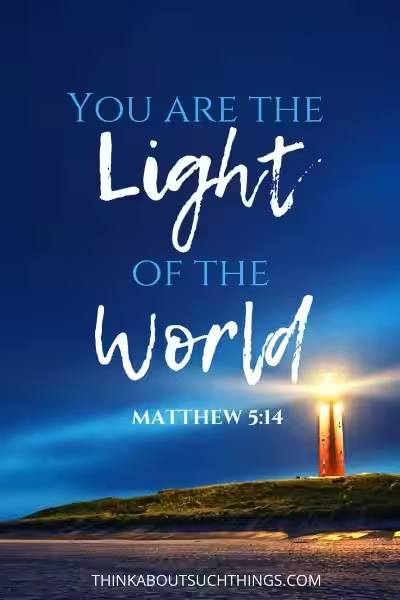
Matthew 5:14: “You are the light of the world. A city set on a hill cannot be hidden.” (While this speaks to believers being light, it’s rooted in God’s light within them.)
John 1:9: “The true light, which gives light to everyone, was coming into the world.”
These verses, while not explicitly using the “lighthouse” imagery, reinforce the idea of divine guidance and illumination through spiritual understanding.
What is the religious significance of this lighthouse concept?
In many religions, particularly in Christianity, the concept of divine guidance is central. The lighthouse imagery represents:
Salvation and Hope: A lighthouse offers hope and a path to safety for those lost at sea, similar to how faith can be a beacon of hope in difficult times.
Truth and Revelation: God’s word or divine wisdom is seen as revealing truth and dispelling the darkness of ignorance or sin.
Moral Compass: The light guides towards safe harbors, symbolizing adherence to moral principles and righteous living.
Dependability: A lighthouse is a constant source of light, signifying God’s unwavering presence and reliability.
The lighthouse serves as a powerful and relatable metaphor for the role of faith and scripture in providing direction and security.