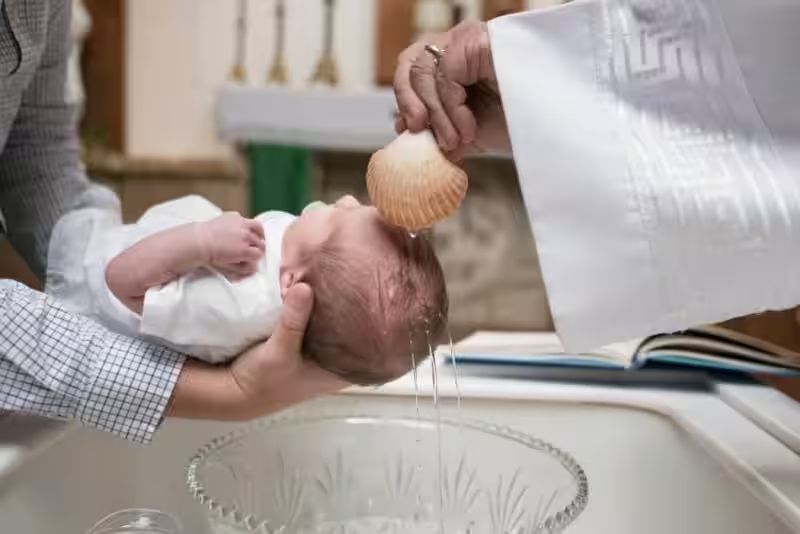
Baptism. The word conjures images of flowing water, sacred promises, and a profound spiritual transition. It’s a cornerstone ritual in many faiths, marking a believer’s entry into a community of worship and their commitment to a spiritual path. But a fundamental question often arises amidst this solemnity: who can actually perform a baptism? This isn’t just a procedural detail; it delves deep into the understanding of religious authority, the role of designated individuals, and the very essence of what makes a baptism valid within different traditions. Understanding this aspect of the sacrament offers not only clarity on a specific practice but also a window into the diverse theological landscapes that shape our religious lives.
The authority to perform a baptism is rarely a matter of personal whim or spontaneous decision. Instead, it’s typically vested in individuals who have undergone specific training, ordination, or are recognized as leaders within their religious community. This recognition is crucial because baptism isn’t merely an act of pouring water; it’s imbued with theological meaning, representing cleansing, rebirth, and a covenant with the divine. Therefore, the person performing the rite is seen as an instrument of God’s grace, acting on behalf of the church or faith community.
Theological Foundations: Why Specific Individuals Perform Baptisms
At the heart of who can perform baptisms lies a deep theological bedrock. Different religions have distinct interpretations of Christ’s commandment to baptize, and these interpretations directly influence who is deemed qualified to carry out this sacred duty. The concept of apostolic succession, for instance, is central to many Christian denominations. This belief posits that the authority passed down from Jesus to his apostles has been continuously transmitted through a line of bishops. Consequently, bishops and priests, who are seen as successors to the apostles, are generally the authorized individuals to perform baptisms within these traditions.
In essence, the theological framework dictates that the sacrament of baptism derives its efficacy from the divine authority channeled through ordained ministers. It’s not about the individual’s personal holiness alone, but about their divinely appointed role within the ordained structure of the church. Think of it like a legal document needing an official seal: the seal signifies authenticity and authority. Similarly, the ordination of clergy serves as that spiritual seal, ensuring the baptism is recognized as a valid sacrament by the wider religious body. This understanding emphasizes the communal nature of faith and the importance of established traditions in mediating God’s grace.
The Role of Ordained Clergy in Christian Traditions
Within the vast spectrum of Christianity, the primary individuals authorized to perform baptisms are ordained clergy. This typically includes bishops, priests, and deacons. Their ordination is a public affirmation of their calling and their qualification to administer the sacraments. The process of ordination often involves rigorous theological study, spiritual formation, and a formal ceremony where they are set apart for ministry by a bishop. This ensures they are equipped to understand and convey the profound meaning of baptism, which symbolizes a believer’s death to sin and resurrection to new life in Christ.
For example, in the Catholic Church, a priest typically performs baptisms during regular services or in preparation for full communion. While a deacon can also baptize, this is usually done in specific circumstances. In emergencies, however, even a layperson can administer a valid baptism, provided they have the intention to do what the Church does and use the proper Trinitarian formula (in the name of the Father, and of the Son, and of the Holy Spirit). This emergency provision highlights the paramount importance of the sacrament itself, allowing for its administration when an ordained minister is unavailable and a person’s spiritual well-being is at stake.
Specific Denominational Practices and Understandings
The specific practices regarding who can perform baptisms can vary significantly between Christian denominations. Protestant traditions, for instance, often have a broader understanding of who can baptize. While ordained ministers are the norm, some denominations may permit licensed ministers, elders, or even trained lay leaders to perform baptisms, especially in contexts where ordained clergy are scarce. For example, a Methodist local pastor or a Presbyterian elder might be authorized to baptize. This reflects a theological emphasis on the priesthood of all believers, suggesting that all Christians have a role in sharing their faith and initiating others into it.
However, the underlying principle remains consistent: the act of baptism is entrusted to individuals recognized by the community as having the spiritual understanding and authority to convey the sacrament. The Lutheran Church, for instance, generally authorizes pastors to baptize, while acknowledging that in exceptional circumstances, a baptized Christian can perform the rite with the intention of the Church. These variations, while seemingly minor, underscore the diverse ways different Christian traditions interpret the authority and practice of baptism.
Beyond Ordination: Lay Participation and Emergency Baptisms
While ordained clergy are the customary ministers of baptism, the role of laypeople in this sacrament is also significant, particularly in certain situations. The concept of “ministerial baptism” by ordained individuals is the norm, but the validity of baptism isn’t solely contingent on their presence. This is particularly evident in the understanding of emergency baptisms. In situations where a person is in danger of death and desires baptism, and no ordained minister is available, any baptized Christian can perform the baptism.
The key elements for a valid emergency baptism are: the use of water, the Trinitarian formula (in the name of the Father, and of the Son, and of the Holy Spirit), and the minister’s intention to do what the Church does. For example, if a baby is born prematurely and is not expected to survive, and a priest or pastor cannot be reached, a baptized nurse or family member can perform the baptism. This provision underscores the Church’s pastoral concern for the spiritual well-being of individuals and its recognition that God’s grace is not limited by bureaucratic structures.
The Importance of Intention and Water in Lay Baptisms
Even when a layperson performs a baptism, the act is still considered a sacrament because the intention is to administer what the Church understands baptism to be. This means the person performing the baptism is not acting on their personal authority but as an instrument of God’s grace, fulfilling the Church’s mandate. They are essentially stepping into the liturgical role of the ordained minister, not out of personal power, but out of love for the individual and obedience to Christ’s command.
The use of water is a non-negotiable element in all valid baptisms, whether performed by a bishop or a layperson. The water symbolizes cleansing from sin and spiritual rebirth. The Trinitarian formula is equally crucial, as it invokes the name of God as understood in Christian theology. Therefore, a layperson performing an emergency baptism would pour water over the person’s head (or immerse them) while saying, “I baptize you in the name of the Father, and of the Son, and of the Holy Spirit.” This ensures that the essential components of the sacrament are present, regardless of who is performing it.
Baptism in Other Religious Traditions: A Different Approach
While baptism is most commonly associated with Christianity, it’s important to note that other religions have their own initiation rites and rituals that may bear superficial resemblances but have fundamentally different theological underpinnings and require different officiants. For instance, in Judaism, the ritual of mikveh is a purification bath that plays a significant role in conversion and ritual cleansing. However, the mikveh is typically performed by the individual themselves or overseen by a rabbin or a Beit Din (a rabbinical court). It’s not a sacrament conferred by an individual in the same way as Christian baptism.
Similarly, in some forms of Islam, there are rituals of purification and ceremonies marking a child’s entry into the community, such as the adhan (call to prayer) whispered in a newborn’s ear followed by a symbolic shaving of the head. These acts are usually performed by family members, often the father or a respected elder, and are not sacraments in the Christian sense. The emphasis is on community welcome and prayer, rather than a divinely conferred grace through a specific officiant. Understanding these distinctions is crucial to appreciating the unique theological significance of baptism within Christianity.
The Role of Purity and Initiation Rites in Other Faiths
Many religions incorporate rituals that symbolize purity, spiritual cleansing, and initiation into the faith community. In Hinduism, for instance, there are various ceremonies like Upanayanam (sacred thread ceremony for boys) or Namakarana (naming ceremony for infants), which are performed by Brahmins (priests) or learned individuals. These rituals involve prayers, blessings, and symbolic acts, signifying a child’s entry into a particular stage of life or spiritual journey. The officiant’s role is to guide the ritual and invoke divine blessings.
In Sikhism, the Anand Karaj (wedding ceremony) is a significant ritual, and initiation into the Khalsa community involves Amrit Sanskar, where an individual is baptized with sweetened water stirred with a double-edged sword. This rite is performed by the Panj Pyare (Five Beloved Ones), who are chosen members of the Khalsa. These examples demonstrate that while the concept of ritualistic entry and purification is widespread, the specific officiants and the theological meaning behind these acts are distinct from Christian baptism and are deeply tied to the unique doctrines and traditions of each faith.
Conclusion: A Sacred Trust and a Community’s Affirmation
Ultimately, the question of who can perform baptisms is answered by examining the specific religious tradition’s theology, its understanding of authority, and its sacramental practices. In Christianity, while ordained clergy are the primary officiants, the concept of emergency baptism highlights the boundless nature of God’s grace and the importance of intention and essential elements. The act of baptism, regardless of who performs it, is a profound expression of faith, a cleansing from sin, and a new beginning in spiritual life, always signifying a sacred trust and a community’s affirmation of that new life.
The authority to baptize is not a power to be wielded lightly; it is a sacred responsibility entrusted to individuals who are seen as conduits of God’s grace. Whether it’s a bishop presiding over a solemn ceremony, a priest guiding a congregation, a deacon assisting in a rite, or a layperson acting in love during an emergency, the act of baptism is always rooted in faith, intention, and the profound belief in spiritual rebirth. It is a testament to the enduring power of ritual to mark significant life transitions and to unite believers in a shared spiritual journey.
Frequently Asked Questions: Who Can Perform Baptisms?
What is baptism?
Baptism is a religious rite of purification and initiation, a sacrament in many Christian denominations. It symbolizes washing away of sin and entry into the Christian faith.
Who can perform a baptism?
In most Christian denominations, baptism is performed by an ordained minister, priest, pastor, or elder. In some traditions, deacons may also be authorized. The authority to perform sacraments is typically conferred through ordination and within the established structure of a church or religious organization.
Can anyone perform a baptism in an emergency?
In certain situations, particularly in the event of a life-threatening illness or imminent death, many Christian traditions allow for “emergency baptism.” In such cases, any baptized Christian who has the intention of doing what the Church does in baptism may perform the rite, provided they use the Trinitarian formula (invoking the Father, Son, and Holy Spirit) and water. However, this is generally considered a provisional baptism and may be followed by a formal church ceremony if the individual survives.
Are there specific requirements for the person performing a baptism?
Generally, the person performing a baptism must be a baptized Christian, have a sincere intention to perform the sacrament as understood by the church, and use the correct form (water and the Trinitarian formula). Ordination is typically required for regular church baptisms.
Does the denomination of the person performing the baptism matter?
Yes, the denomination typically matters. While the core elements of baptism are shared across many Christian traditions, specific liturgical practices, theological understandings, and the authority to administer sacraments are defined within each denomination. A baptism performed by a minister of one denomination is generally recognized by others, but interdenominational recognition can vary.
Can a non-Christian perform a baptism?
No, a non-Christian cannot perform a baptism. Baptism is a sacrament within Christianity, and therefore, only a baptized Christian is considered qualified to administer it.