Embarking on a spiritual journey often involves understanding the foundational beliefs that shape our relationship with the divine. For many, this includes exploring the rich tapestry of Islam and Christianity, two of the world’s largest monotheistic religions. While both share a profound reverence for God and a commitment to ethical living, their paths diverge in significant and illuminating ways. This article aims to be your guide, demystifying these key differences in a way that is both informative and relatable, helping you to appreciate the unique identities of these vibrant faiths.
Imagine two magnificent rivers, both originating from the same towering mountain of faith, yet carving distinct paths through the landscape of human belief. Both are vital sources of spiritual sustenance, but their currents, their tributaries, and the very soil they nourish are unique. Understanding these differences isn’t about declaring one superior to the other; rather, it’s about gaining a deeper appreciation for the diverse expressions of divine truth that have shaped billions of lives across centuries and continents. We will explore these distinctions by focusing on the very essence of their teachings, from the nature of God to the role of prophets and the path to salvation.
At the heart of Islam lies the concept of Tawhid, an absolute and uncompromising oneness of God. This is the foundational pillar, the bedrock upon which all Islamic doctrine rests. Muslims believe that Allah is indivisible, without partners, offspring, or equals. The Quran, their holy book, reiterates this constantly, emphasizing that there is no god but Allah. This singular focus shapes every aspect of a Muslim’s life, from prayer to morality, fostering a deep sense of submission to God’s will. For instance, when a Muslim prays, they are directing their supplications to the One and Only God, a direct and unmediated connection.
Christianity, on the other hand, understands God as a Trinity: Father, Son (Jesus Christ), and Holy Spirit. This is a complex doctrine that posits one God existing in three co-equal, co-eternal persons. This doesn’t mean three gods, but rather one God in three distinct yet unified manifestations. This concept can be challenging to grasp, often explained through analogies such as water (ice, liquid, steam) or a clover (three leaves, one plant), though no analogy is perfect. The Christian understanding of God is inherently relational, with the divine interacting with humanity through the person of Jesus. This means that while Christians also worship one God, their understanding involves a more intricate divine nature.
The Nature of Jesus Christ: Prophet vs. Son of God
In Islam, Jesus (referred to as Isa) is revered as a highly esteemed prophet, one of the most important in a long lineage that includes Abraham, Moses, and Muhammad. Muslims believe Jesus was born of a virgin mother, Mary (Maryam), performed miracles, and will return before the Day of Judgment. However, they firmly reject the Christian belief that Jesus is the Son of God in a literal, divine sense, or that he is part of the Trinity. For Muslims, attributing divinity to a human being is considered shirk, the gravest sin of idolatry. Jesus’s role is that of a messenger, a guide, but ultimately a human being chosen by God.
Christianity’s central tenet is the divinity of Jesus Christ. Christians believe Jesus is not merely a prophet, but the Son of God, fully divine and fully human, who came to earth to redeem humanity from sin through his crucifixion and resurrection. His birth, life, death, and resurrection are seen as the pivotal events in human history, offering a path to salvation and reconciliation with God. The concept of atonement, where Jesus’s sacrifice bridges the gap between God and sinful humanity, is fundamental to Christian theology. His title, “Savior,” encapsulates this profound belief.
The Role of Prophets and Revelation
Both Islam and Christianity acknowledge a lineage of prophets who received divine guidance. However, the finality and content of revelation differ significantly. Islam teaches that Muhammad is the final prophet, the “Seal of the Prophets,” through whom God delivered His ultimate and complete message in the Quran. The Quran is considered the literal word of God, revealed to Muhammad over 23 years. Muslims believe that previous scriptures, including the Torah and the Gospels, were divinely inspired but have been subject to alteration or misinterpretation over time. The Quran is the unadulterated word of God, the ultimate guide for all humanity.
Christianity also recognizes prophets, but its ultimate revelation is found in Jesus Christ himself, often referred to as the “Word of God.” While the Bible, composed of the Old and New Testaments, is considered divinely inspired scripture, its interpretation and understanding are often seen as unfolding through Jesus’s teachings and the subsequent guidance of the Holy Spirit. The New Testament, in particular, is viewed as fulfilling and superseding much of the Old Testament law. For Christians, the incarnation of God in Jesus is the supreme act of revelation, offering a living embodiment of God’s love and will.
The Path to Salvation and the Afterlife
In Islam, salvation is achieved through submission to Allah’s will, living a righteous life according to the teachings of the Quran and the Sunnah (practices and sayings of Prophet Muhammad), and performing the Five Pillars of Islam: the declaration of faith (Shahada), prayer (Salat), charity (Zakat), fasting during Ramadan (Sawm), and pilgrimage to Mecca (Hajj). Good deeds are weighed against bad deeds on the Day of Judgment, and entry into Paradise is through God’s mercy. There is a clear emphasis on personal accountability and the direct relationship between a believer and God. The concept of Jannah (Paradise) is described as a place of eternal bliss and reward for the righteous.
Christianity offers salvation primarily through faith in Jesus Christ and his atoning sacrifice. While good works are considered important as a natural outflow of a believer’s faith, they are not seen as the means by which one earns salvation. The belief is that through repentance and accepting Jesus as Lord and Savior, one is forgiven of sins and granted eternal life. The concept of grace, God’s unmerited favor, is central to Christian salvation. The afterlife is understood as either eternal life with God in Heaven or eternal separation from God in Hell, based on one’s relationship with Jesus Christ. The resurrection of believers to be with God is a core hope.
Religious Practices and Community
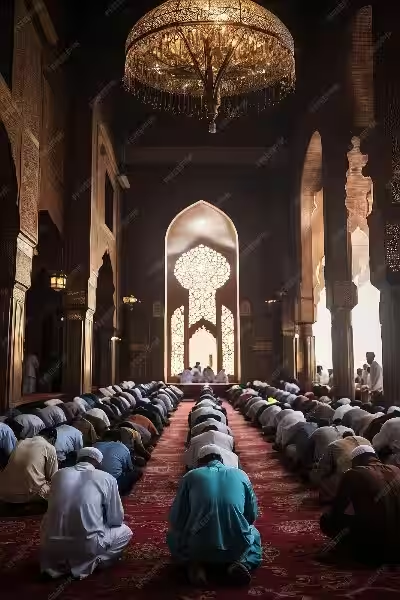
The daily lives of Muslims are guided by the Five Pillars, which are practical acts of worship and devotion that foster a strong sense of community and submission. Mosques are central places of worship, and communal prayer, especially on Fridays, reinforces the bonds of the Ummah (global Muslim community). Islamic law, Sharia, provides a comprehensive framework for personal and societal conduct. Dietary laws, such as the prohibition of pork and alcohol, and the importance of Halal practices, are integral to Muslim life. The call to prayer (Adhan) five times a day serves as a constant reminder of God’s presence.
Christian practice varies widely among denominations, but common elements include regular church attendance, baptism, and communion (Eucharist). Churches serve as places of worship and community gathering. The Bible is the central text, and its teachings form the basis for Christian ethics and theology. While there are dietary guidelines in some Christian traditions, they are generally less stringent than in Islam. The emphasis in Christian practice is often on fellowship, mutual support, and spreading the Gospel (good news) of Jesus Christ. Prayer is a constant thread, both individually and corporately.
Sacred Texts and Their Authority
The Quran is the ultimate and uncreated word of God in Islam, revealed verbatim to Prophet Muhammad. Muslims believe it is perfect and incorruptible, serving as the final and complete guidance for humanity. Its Arabic language is considered sacred, and its recitation is an act of worship. The Hadith, collections of the sayings and actions of Prophet Muhammad, provide further explanation and practical application of the Quranic teachings, holding a secondary but crucial position of authority. The authority of the Quran is absolute and unquestionable for Muslims.
The Bible, comprising the Old and New Testaments, is the sacred scripture of Christianity. Christians believe it is divinely inspired, meaning God guided human authors to record His message accurately. While there are varying views on the literal interpretation of every verse, the Bible is universally recognized as the authoritative source of Christian faith and practice. The New Testament is particularly important as it details the life and teachings of Jesus Christ and the early Christian church, seen as the fulfillment of Old Testament prophecies.
In conclusion, while Islam and Christianity share fundamental monotheistic roots and a commitment to ethical living, their distinct understandings of God, the nature of Jesus Christ, the role of prophets, and the path to salvation offer unique spiritual pathways. Recognizing these differences allows for a more profound appreciation of the richness and diversity within the global religious landscape, fostering a spirit of understanding and respect between followers of these two magnificent faiths.
Frequently Asked Questions: Islam and Christianity
What is the fundamental difference in their understanding of God?
Christianity is a monotheistic religion that believes in one God who exists as a Trinity: God the Father, God the Son (Jesus Christ), and God the Holy Spirit. Islam is also strictly monotheistic, believing in one God, Allah, who is indivisible and has no partners or equals. Muslims do not believe in the Trinity.
How do Islam and Christianity view Jesus Christ?
Christians believe Jesus Christ is the Son of God, divine, and part of the Trinity, who was crucified and resurrected as a sacrifice for the sins of humanity. Muslims revere Jesus (Isa) as a highly important prophet of God, born of a virgin, who performed miracles and will return before the Day of Judgment. However, they do not believe he is divine, the Son of God in a literal sense, or that he was crucified.
What are the holy books of each religion?
The holy book of Christianity is the Bible, which consists of the Old Testament and the New Testament. Muslims believe the Quran is the literal word of God revealed to the Prophet Muhammad, and is the final and complete revelation. They also acknowledge earlier scriptures like the Torah and the Gospels but believe they have been altered over time.
What are the core practices or pillars of each religion?
The core practices in Islam are the Five Pillars: Shahada (declaration of faith), Salat (prayer), Zakat (charity), Sawm (fasting during Ramadan), and Hajj (pilgrimage to Mecca). Christianity’s core practices vary among denominations but often include prayer, baptism, communion (Eucharist), and participation in church services.
Who are the key figures in each religion’s history?
In Christianity, the central figure is Jesus Christ, considered the Son of God and Messiah. Other important figures include the apostles, prophets of the Old Testament, and significant theologians throughout history. In Islam, the most important figure is Prophet Muhammad, considered the final prophet of God. Other significant prophets acknowledged in Islam include Adam, Noah, Abraham, Moses, and Jesus.