The concept of “family” has long been a cornerstone of human society, a seemingly immutable institution. Yet, beneath this perceived constancy lies a dynamic reality. Today, we are witnessing a profound evolution in family structures, a reflection of broader societal shifts and a testament to the power of social change. This transformation, however, is not a uniform march forward. It is deeply intertwined with issues of family diversity, persistent inequalities, and the often-overlooked, yet profoundly influential, role of religion. Understanding these interconnected threads is crucial to grasping the complexities of modern life and charting a path towards a more equitable future.
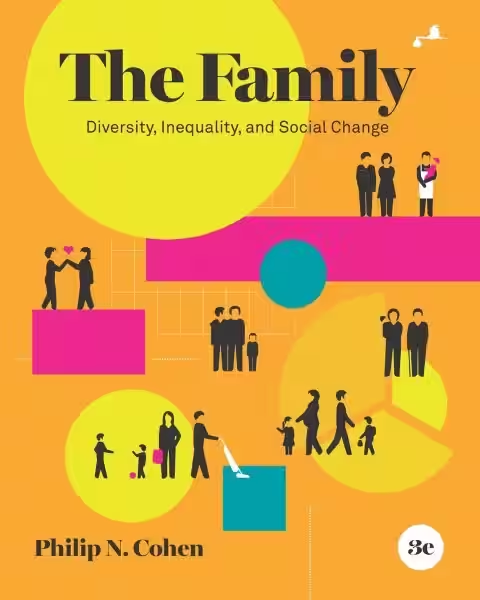
The idea of a single, idealized family model – a heterosexual married couple with biological children – is increasingly giving way to a rich mosaic of family forms. Single-parent households, blended families, same-sex parent families, chosen families, and extended families living together are no longer outliers but are becoming increasingly visible and accepted. This family diversity is not just a demographic shift; it represents a fundamental rethinking of what constitutes love, commitment, and belonging. As societies become more accepting of different lifestyles and identities, so too do the definitions of family expand to encompass these realities.
This burgeoning family diversity is a direct consequence of social change. Shifting economic realities, evolving gender roles, increased individual autonomy, and greater visibility for marginalized groups have all contributed to this diversification. For instance, the rise of dual-income households, while offering economic benefits, has also necessitated new models of childcare and household labor distribution, impacting traditional family dynamics. Similarly, the growing acceptance of LGBTQ+ individuals has opened the door for same-sex couples to form families, challenging long-held societal norms and legal definitions.
Navigating the Currents of Inequality Within Family Diversity
While family diversity celebrates a wider range of lived experiences, it also brings into sharp relief the persistent issue of inequality. Not all families, regardless of their structure, experience the same opportunities or face the same challenges. Socioeconomic status, race, ethnicity, geographic location, and access to resources create significant disparities, impacting everything from a child’s educational outcomes to a family’s overall well-being. The very diversity that enriches our social fabric can, in the absence of deliberate intervention, exacerbate existing inequalities.
Consider the stark reality of economic inequality. A single-parent household, particularly one headed by a woman of color, often faces significantly greater financial hurdles than a two-parent, affluent family. This inequality is not inherent to the family structure itself but is a product of systemic issues like wage gaps, lack of affordable childcare, and limited access to social support systems. These families are often forced to make difficult choices between basic necessities, impacting their ability to thrive and participate fully in society.
Furthermore, inequality can manifest in subtle yet profound ways within diverse family structures. For example, in blended families, differing parenting styles or established dynamics can create tension and disadvantage for certain children. This is not a failure of the family itself, but a reflection of the societal pressures and the need for increased support and understanding to navigate these complex relationships. The challenge lies in ensuring that family diversity leads to greater equity, rather than simply accommodating a wider spectrum of disadvantage.
Religion’s Multifaceted Role in Shaping Families and Social Change
Religion has historically played a pivotal role in defining family norms, and its influence continues to be a potent force in shaping family diversity, mitigating or perpetuating inequality, and driving social change. For some, religious doctrines provide a framework for marital commitment and family life, offering guidance and community. For others, religious beliefs have been a catalyst for challenging existing norms and advocating for greater inclusivity and justice within families and society at large.
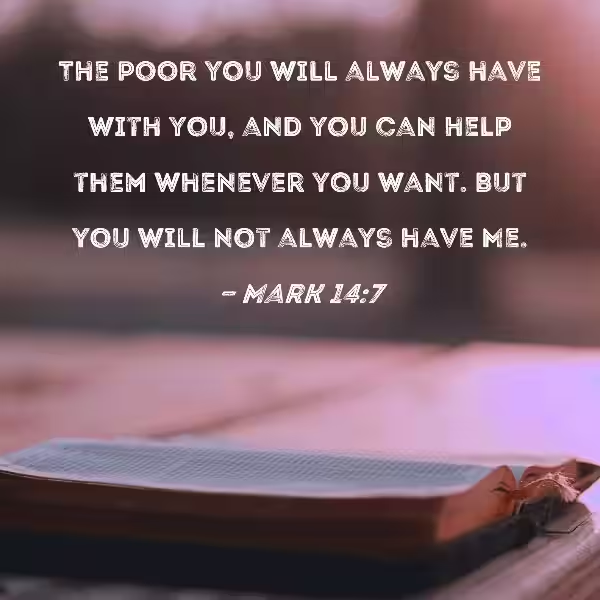
Many religious traditions offer strong community bonds and a sense of belonging, which can be particularly vital for families facing inequality. Support networks within congregations can provide practical assistance, emotional comfort, and a shared sense of purpose. For example, a church or mosque might offer meal trains for new parents, tutoring for struggling students, or financial aid to families in crisis, effectively buffering the impacts of socioeconomic inequality.
However, the impact of religion on family diversity and inequality is far from monolithic. While some faiths have embraced evolving family structures and championed LGBTQ+ rights, others adhere to more traditional interpretations that can lead to exclusion and discrimination. This religious diversity within the broader concept of religion itself creates a complex landscape of influence, where some communities foster greater acceptance while others reinforce existing societal divisions.
Religious Interpretations and Evolving Family Forms
The way different religious groups interpret sacred texts and traditions has a direct impact on how they view and accommodate family diversity. Some denominations have actively worked to reconcile their faith with contemporary understandings of marriage and family, opening their doors and affirming LGBTQ+ families, for instance. This has been a significant driver of social change, demonstrating that faith and inclusivity can coexist.
Conversely, other religious communities maintain strict interpretations of family, often leading to the marginalization of those who do not conform. This can create significant internal and external conflict for individuals within these faiths who identify with diverse family structures. The struggle to reconcile personal identity with religious doctrine is a deeply felt experience for many, highlighting the complex interplay between religion, family diversity, and individual well-being. It is through these ongoing dialogues and evolving interpretations that religion continues to shape the very definition of family.
Faith-Based Movements for Equality and Social Justice
Beyond doctrinal interpretations, religion has also been a powerful engine for social change through faith-based movements advocating for equality. Throughout history, religious leaders and congregations have been at the forefront of movements fighting against injustice, including those advocating for civil rights, gender equality, and LGBTQ+ rights. These movements often draw upon religious principles of compassion, justice, and the inherent dignity of all human beings.
For example, the Civil Rights Movement in the United States was profoundly shaped by the leadership and activism of clergy and religious organizations. Their moral authority and ability to mobilize communities provided a crucial foundation for challenging racial inequality. Similarly, many contemporary advocacy groups, rooted in various faiths, actively work to combat poverty, support refugees, and promote human rights, demonstrating the enduring capacity of religion to be a force for positive social change.
The Interconnectedness of Family Diversity, Inequality, and Social Change in a Religious Context
The intricate dance between family diversity, inequality, and social change is profoundly influenced by the multifaceted role of religion. As societies grapple with evolving family structures, it is within religious communities that many individuals find their primary source of belonging, values, and community support. The way these communities respond to family diversity can either reinforce existing inequalities or become powerful engines for greater inclusivity and justice, driving significant social change.
When religious institutions embrace family diversity, they can become powerful agents of social change. They can offer a sanctuary for individuals and families who may face discrimination elsewhere, fostering acceptance and understanding. For instance, a welcoming congregation for a same-sex couple with adopted children provides not only emotional support but also a public affirmation that challenges broader societal prejudices. This acceptance can, in turn, influence wider social attitudes and legal frameworks, contributing to a more equitable society.
However, when religion upholds rigid definitions of family, it can inadvertently perpetuate inequality. Individuals who fall outside these prescribed norms may experience alienation, shame, and a lack of spiritual or communal belonging. This can exacerbate existing social and economic disadvantages, creating a cycle of marginalization. The challenge, therefore, lies in fostering an environment where religious belief can be a force for inclusion, recognizing the inherent worth and dignity of all families, regardless of their composition. This requires ongoing dialogue, education, and a commitment to the core principles of compassion and justice that many faiths espouse.
Frequently Asked Questions
What is family diversity?
Family diversity refers to the wide range of family structures, forms, and relationships that exist in society. This includes, but is not limited to, nuclear families, single-parent families, blended families, same-sex parent families, extended families, cohabiting couples, and chosen families.
How does family diversity relate to inequality?
Family diversity can intersect with inequality in various ways. Certain family structures might face systemic disadvantages due to societal norms, legal frameworks, or economic disparities. For instance, single-parent families, often disproportionately led by women, may experience higher rates of poverty. Same-sex parent families may face discrimination or lack legal protections in some regions. The recognition and support for diverse family forms can either exacerbate or mitigate existing social and economic inequalities.
What is social change in the context of families?
Social change concerning families refers to the transformations in family structures, roles, norms, and expectations over time. This can be driven by economic shifts, technological advancements, evolving cultural values, and movements for social justice. Examples include the rise of dual-income households, increased acceptance of cohabitation, and changing perceptions of gender roles within families.
How does religion influence family diversity and social change?
Religion can have a complex and often contradictory influence. Some religious doctrines may uphold traditional family structures and resist changes, while others may offer frameworks for inclusivity and adaptation. Religious communities can be sites of both social conservatism and progressive social change, impacting how family diversity is perceived and experienced, and contributing to or challenging societal norms around family life. Some religions have evolved their interpretations to be more inclusive of diverse family forms, while others maintain more rigid definitions.