Have you ever felt stuck, like you’re running in place despite your best efforts? Perhaps you’ve faced recurring challenges or found yourself repeating the same unhelpful patterns. This persistent feeling of stagnation isn’t necessarily a reflection of your capabilities or desires, but rather a signal that your underlying framework of beliefs and assumptions – your paradigm – might be limiting your vision. The profound truth is, when you change your paradigm, you change your life. This isn’t just a catchy phrase; it’s a fundamental principle that holds immense power, especially when viewed through the illuminating lens of spirituality and religion.
Imagine your paradigm as the operating system of your mind. It dictates how you perceive reality, interpret events, and consequently, how you respond to them. If your operating system is outdated or filled with glitches, even the most advanced software (your actions) will struggle to perform optimally. Religion and spiritual traditions, across millennia and cultures, offer not just a set of doctrines, but often a complete overhaul of this operating system, providing new perspectives that can radically transform your life by altering your fundamental understanding of yourself, the world, and your place within it.
The Invisible Walls: Understanding Your Current Paradigm
Our paradigms are built over years, shaped by our upbringing, education, cultural influences, and personal experiences. They are the unconscious filters through which we process information, and often, they operate so seamlessly that we’re entirely unaware of their existence. This is why, when you try to implement changes from the outside – a new diet, a different job, a resolution – without addressing the internal blueprint, the results are often temporary. You might be trying to build a skyscraper on a foundation designed for a shed.
Think about a time you were absolutely convinced of something, only to later discover you were fundamentally wrong. Perhaps you believed a certain type of person was inherently untrustworthy, and then you met someone who defied that stereotype and became a dear friend. That shift in understanding, that recalibration of your belief system, is a micro-example of paradigm change. Religions often provide narratives, teachings, and practices that challenge our ingrained assumptions about worthiness, success, suffering, and the very nature of reality, creating fertile ground for significant personal growth.
The Power of Belief: How Assumptions Shape Our Reality
Our beliefs are not passive observations; they are active forces that shape our perceptions and behaviors. If you believe you are incapable of learning a new skill, you will likely approach the learning process with hesitation, making mistakes more probable and reinforcing your initial belief. Conversely, if you approach a challenge with the belief that you can learn and grow, you are more likely to persevere, seek solutions, and ultimately succeed. This is the essence of the “change your paradigm, change your life” summary in action.
Religious teachings frequently emphasize the importance of faith and the transformative power of believing in something greater. This could be a belief in divine intervention, the inherent goodness of humanity, or the promise of spiritual liberation. These beliefs, when deeply internalized, can shift your perspective from one of limitation and fear to one of hope and possibility, influencing everything from your daily choices to your long-term aspirations. For instance, a belief in divine providence might help someone navigate a financial crisis with less anxiety, trusting that there is a plan and support beyond their immediate circumstances.
Spirituality as a Catalyst for Paradigm Shift
Spirituality, in its broadest sense, is the exploration of meaning, purpose, and connection. Religions offer structured pathways for this exploration, providing a framework for understanding our existence and our relationship with the divine or the universe. These traditions often present alternative narratives to the secular, materialistic worldview that can dominate modern life, offering profound insights into what truly matters.
Consider the concept of detachment from material possessions found in many spiritual traditions. If your paradigm is heavily centered on accumulating wealth and status, the suffering that can arise from loss or dissatisfaction is immense. However, a spiritual paradigm that emphasizes inner peace, compassion, and service can redefine success, leading to a life of greater contentment and reduced anxiety, regardless of external circumstances. This is a clear example of how a change your paradigm, change your life summary is deeply embedded within spiritual teachings.
Redefining Success and Fulfillment Through Faith
Many religious narratives challenge the conventional definitions of success, which are often tied to external achievements like wealth, power, or fame. Instead, they propose that true fulfillment lies in spiritual growth, ethical conduct, and service to others. This shift in perspective can be incredibly liberating, freeing individuals from the relentless pursuit of fleeting external validation.
For example, the Christian concept of “the meek shall inherit the earth” or the Buddhist emphasis on non-attachment and mindfulness directly contradict the aggressive, competitive drive often lauded in secular society. By embracing these spiritual values, an individual can find profound satisfaction in acts of kindness, in cultivating inner peace, and in contributing to the well-being of their community, thereby experiencing a radical transformation of their life.
Practical Applications: Embracing a New Operating System
The journey of changing your paradigm isn’t always easy. It requires conscious effort, introspection, and a willingness to question deeply held beliefs. But the rewards are immeasurable. Religions offer a wealth of tools and practices to facilitate this transformation, from prayer and meditation to communal worship and ethical guidelines.
Here are some ways to actively engage in this process:
Engage with Sacred Texts: Read and reflect on scriptures from your own tradition or explore those of others. Look for universal truths and insights that resonate with you.
Practice Mindfulness and Prayer: Dedicate time each day for quiet reflection. This allows you to observe your thoughts and feelings without judgment and to connect with a higher power or inner wisdom.
Embrace Community: Connect with like-minded individuals within religious or spiritual groups. Shared experiences and support can be invaluable.
Live Ethically: Strive to embody the ethical principles taught by your faith. Consistent action reinforces new beliefs.
Cultivate Gratitude: Regularly acknowledge the blessings in your life, both big and small. This shifts your focus from what’s lacking to what’s abundant.
By actively incorporating these practices, you are not just adopting new habits; you are rewiring your neural pathways and fundamentally altering your operating system. This is the heart of the “change your paradigm, change your life” summary within a spiritual context.
From Doubt to Devotion: The Journey of Transformation
The path to a new paradigm is often marked by moments of doubt and resistance. Old patterns and beliefs are deeply ingrained, and letting go can feel like losing a part of yourself. However, with consistent spiritual practice, these doubts can gradually give way to a deeper sense of trust and devotion.
Think of it like learning to trust a new navigation system after relying on an old, unreliable one for years. Initially, you might second-guess its directions, but as you see its accuracy and efficiency, your trust grows, and you begin to rely on it implicitly. Similarly, by consistently applying spiritual principles and witnessing their positive impact on your life, you build a new foundation of belief that allows for unprecedented freedom and fulfillment. The promise of a transformed life, where challenges are met with grace and opportunities are embraced with courage, becomes not just a possibility, but a tangible reality. This is the ultimate testament to the power of a paradigm shift, change your life.
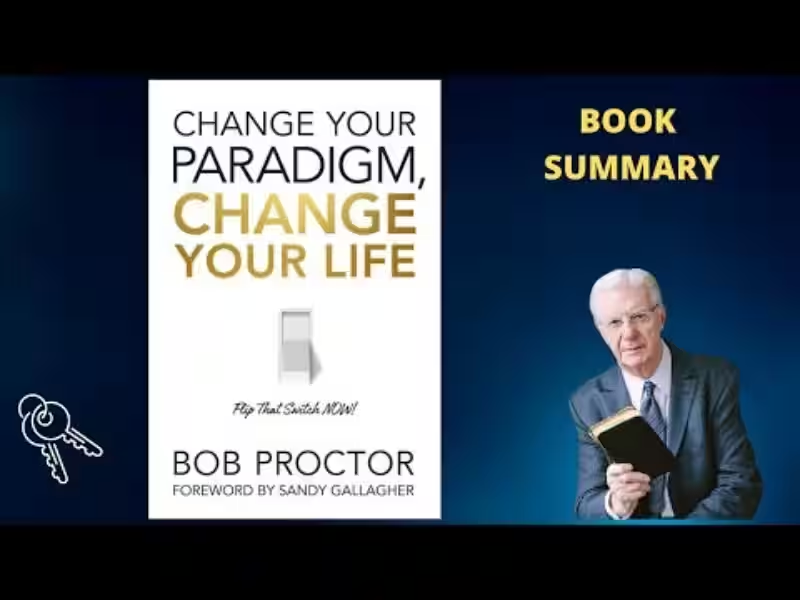
Change Your Paradigm, Change Your Life Summary: Religion
What is the book’s general stance on religion?
The book’s general stance on religion is that it, like any other paradigm, can profoundly shape an individual’s perception of reality, their values, and their behavior. It suggests that religious beliefs, when deeply ingrained, can become a powerful paradigm that influences how individuals interpret their lives and the world around them.
How does the book suggest religious paradigms can be changed?
The book suggests that religious paradigms can be changed through conscious effort, critical examination of beliefs, exposure to different perspectives, and a willingness to question deeply held assumptions. It emphasizes that shifting a religious paradigm is a significant personal transformation, akin to any other paradigm shift.
Does the book advocate for or against specific religions?
No, the book does not advocate for or against any specific religion. It treats religion as one of many potential paradigms that an individual might adopt. Its focus is on the process of paradigm change itself, rather than on the content of any particular belief system.
Can religious dogma act as a limiting paradigm, according to the book?
Yes, the book suggests that rigid religious dogma can certainly act as a limiting paradigm. If dogma prevents individuals from considering new information, adapting to changing circumstances, or questioning established beliefs, it can hinder personal growth and limit their potential.
How does changing a religious paradigm affect one’s “life” as described in the book’s title?
Changing a religious paradigm, according to the book, can lead to a fundamental “change your life.” This is because religious beliefs often form the core of an individual’s worldview, influencing their sense of purpose, morality, relationships, and their understanding of suffering and joy. A shift in this core paradigm can therefore lead to profound changes in how one lives their life.