The question, “Where does God come from?” is perhaps one of the most profound and enduring inquiries humanity has ever posed. It’s a question that has echoed through millennia, sparking endless contemplation, theological debates, artistic expression, and the very formation of civilizations. It’s not a simple query with a single, universally accepted answer. Instead, it delves into the deepest aspects of human consciousness, our yearning for meaning, and our attempts to understand the vast, often inscrutable, universe we inhabit. Exploring this question is less about finding a definitive origin point and more about understanding the diverse ways we conceptualize, experience, and relate to the divine.
From the earliest whispers of human history, to the grandest cathedrals and the most intimate personal prayers, the concept of a higher power has been a constant. This exploration will journey through different perspectives, examining how various cultures and belief systems have grappled with the origin and nature of God, ultimately revealing that the answer to “where does God come from” is as varied and complex as humanity itself.
One compelling perspective suggests that the origin of our concept of God is not an external revelation but an internal, inherent human characteristic. This idea posits that our minds are wired, or at least predisposed, to seek patterns, causality, and meaning beyond the immediately observable. We look at a complex sunset and wonder about its cause; we experience overwhelming joy or sorrow and seek a reason beyond mere biological or sociological factors. This innate human urge for the transcendent, for something greater than ourselves, is a powerful driver in our conceptualization of God. It’s like an artist instinctively reaching for a brush to capture a beautiful landscape; our consciousness seems to naturally gravitate towards understanding the “why” behind existence, and God becomes the ultimate answer to that “why.”
Consider the simple act of a child asking “why?” repeatedly. This insatiable curiosity, this drive to understand the underlying mechanisms of the world, is a fundamental aspect of human development. As we grow, this childlike wonder can evolve into a more sophisticated search for ultimate explanations. This inherent psychological predisposition can manifest in various ways, from animistic beliefs in nature spirits to elaborate theological systems. The recurring presence of divine figures across diverse cultures, even in the absence of direct contact, strongly suggests a shared human capacity for conceiving of the divine – a built-in blueprint, if you will, for imagining what lies beyond the tangible.
Psychological and Evolutionary Roots of Belief
From a psychological standpoint, the concept of God can be seen as a projection of our deepest desires, fears, and needs. We seek comfort in times of distress, so we envision a benevolent provider. We crave justice, so we imagine an ultimate arbiter. We yearn for purpose, so we believe in a divine plan. This doesn’t necessarily diminish the validity of faith; rather, it highlights the profound psychological role religion plays in our lives. These deeply ingrained psychological needs, often rooted in our evolutionary past, may have paved the way for the development and persistence of religious thought. Think of it like our need for shelter: it’s a fundamental survival instinct that has driven us to build homes, and similarly, our psychological needs may have driven us to construct concepts of the divine.
Evolutionary psychology offers another fascinating lens. Some theories suggest that our capacity for belief in supernatural agents, including God, may have conferred an evolutionary advantage. By fostering cooperation within groups, promoting adherence to social norms, and providing explanations for natural phenomena (thereby reducing anxiety), early religious beliefs could have strengthened social cohesion and improved survival rates. The ability to attribute agency to unseen forces, for instance, might have encouraged caution around dangerous predators or natural disasters, leading to a selective advantage for those who believed in protective spirits or divine warnings. This perspective doesn’t necessarily explain where God comes from in a literal sense, but rather why the concept of God is so pervasive and enduring in human societies.
Cultural and Societal Origins of Divine Concepts
While individual psychology plays a role, the specific forms and narratives of God are undeniably shaped by culture and society. The concept of God is not static; it evolves and adapts within different historical and geographical contexts. When we ask “where does God come from,” we must also consider the social tapestry that weaves these beliefs into existence. Early human societies, living intimately with the forces of nature – the sun, the moon, the rain, the storms – often attributed divine power to these phenomena. Gods and goddesses of fertility, harvest, and weather were born from direct observation and the need to appease or understand these powerful, life-giving, and life-taking forces. The stories we tell about God are often reflections of our societal values, our aspirations, and our struggles.
Consider the polytheistic pantheons of ancient Greece or Rome. These gods, with their human-like flaws and interventions in mortal affairs, mirrored the social structures and political dynamics of their respective societies. Later, as societies became more complex and philosophical thought deepened, the concept of God often evolved towards a more singular, abstract, and omnipotent being. The development of monotheistic religions, for example, often coincided with the rise of centralized empires and a desire for a singular, unifying authority. This demonstrates how the “origin” of our understanding of God is inextricably linked to the collective human experience and the way we organize ourselves.
Mythology and Sacred Narratives as Foundations
Every religion has its origin stories, its myths, and its sacred narratives that explain the creation of the world, the nature of humanity, and the role of the divine. These stories are not merely historical accounts; they are powerful vehicles for transmitting values, moral codes, and a shared understanding of reality. Whether it’s the Genesis account in Judaism, Christianity, and Islam, the Rigveda in Hinduism, or the creation myths of indigenous cultures, these narratives provide a framework for understanding where our world, and by extension, our concept of God, came from. They are the foundational texts that inform our collective consciousness about the divine.
These myths often serve as a collective memory, providing a sense of continuity and belonging. They offer answers to existential questions that science, at least in its early stages, could not address. For instance, a creation myth might explain why there is suffering in the world, or why humans are mortal. These narratives, passed down through generations, shape our very perception of God and the divine realm. They are the bedrock upon which individual faith is built, offering a shared language and imagery to discuss the ineffable and the ultimate.
Beyond the psychological and societal roots, profound philosophical and theological traditions have dedicated themselves to the question of God’s origin and nature. These explorations often move beyond literal interpretations and delve into abstract reasoning and metaphysical inquiry. Philosophers and theologians grapple with concepts like the First Cause, the Unmoved Mover, or the Absolute Being, attempting to logically deduce or rationally understand the existence and origin of God. This intellectual pursuit is a crucial part of understanding where the concept of God comes from in our structured intellectual and spiritual lives.
For example, the cosmological argument, famously explored by thinkers like Thomas Aquinas, suggests that everything that begins to exist has a cause, and since the universe began to exist, it must have a cause. This infinite regress of causes, they argue, must ultimately lead to an uncaused cause – God. Similarly, the teleological argument points to the apparent design and order in the universe as evidence for an intelligent designer. These philosophical frameworks provide intellectual scaffolding for understanding God, moving beyond simple faith to reasoned belief. They are attempts to build a logical bridge to the divine, to understand its origin through the power of human intellect.
The Concept of God as an Abstract Principle
In many philosophical traditions, God is not necessarily conceived as a personal being who “comes from” somewhere in a temporal sense, but rather as an abstract, eternal principle underlying reality. Think of concepts like “The Absolute,” “Brahman,” or “The Tao.” In these frameworks, God is not a created entity but the very ground of being, the source from which all existence flows. The question “where does God come from?” then becomes less about a point of origin and more about the fundamental nature of reality itself. It’s like asking where the essence of “blueness” comes from; it’s not something that originates at a specific time, but a fundamental quality.
This perspective often transcends the need for a narrative origin story. Instead, it focuses on understanding the ultimate reality, the fundamental truth of existence. God, in this context, is not a subject of empirical investigation but a concept apprehended through intuition, contemplation, and philosophical reasoning. The pursuit is not to find a historical beginning for God, but to grasp the eternal nature of the divine as the ultimate foundation of all that is. This is a more abstract form of answering “where does God come from,” by positing God as the unorigentable source.
Personal and Experiential Dimensions of Faith
Ultimately, for many individuals, the question of “where does God come from” is answered not through grand philosophical treatises or cultural narratives, but through personal experience and inner conviction. This is the realm of lived faith, where the divine is encountered in moments of profound insight, overwhelming love, deep connection, or a sense of awe in the face of life’s mysteries. These are the moments when God feels undeniably real, regardless of any external explanation for His origin. It’s like experiencing the warmth of the sun; you don’t need to know the intricate physics of nuclear fusion to appreciate its presence and its effect on you.
This personal dimension often transcends intellectual understanding. It’s the feeling of being guided, protected, or loved by a force beyond the material world. It can arise from a moment of crisis where a sense of peace prevails, from acts of selfless compassion, or from a deep appreciation for the beauty and wonder of the natural world. For these individuals, God is not a concept to be proven or disproven, but a living presence that informs their lives and answers the fundamental question of existence from within. The origin of God, in this context, is the origin of their own faith, an inner blossoming of belief.
Across many religious traditions, the concept of God’s origin is understood through divine revelation. This is the belief that God has actively revealed Himself and His will to humanity through prophets, scriptures, or direct spiritual experiences. In this view, God doesn’t “come from” anywhere in the human sense of origin; rather, He is eternal and has chosen to make Himself known. The sacred texts of various religions are considered the repositories of these revelations, offering insights into God’s nature and His relationship with creation. This perspective places the onus on God’s initiative, rather than human inquiry, as the source of our knowledge of the divine.
Spiritual encounters, whether through prayer, meditation, or mystical experiences, can also provide a profound sense of connection to the divine. These experiences are often described as transformative, offering a direct apprehension of God’s presence that bypasses rational thought. For those who have experienced such encounters, the question of God’s origin becomes secondary to the undeniable reality of His presence. The feeling of divine immanence, of God being present within us and all around us, can be a powerful answer in itself, suggesting that God’s origin is not a past event but an eternal present. This is a deeply personal way of understanding “where does God come from,” by experiencing Him as always being.
Frequently Asked Questions about God and Religion
Where does God come from?
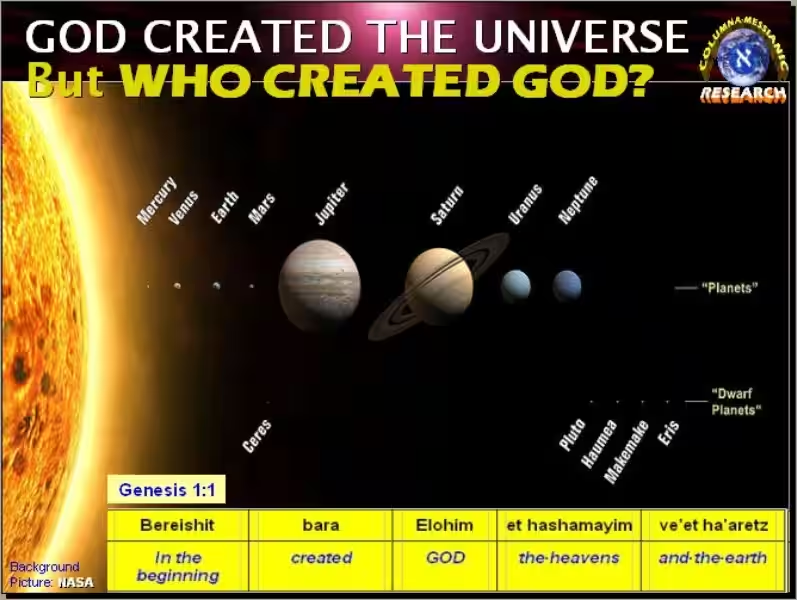
The concept of God’s origin varies significantly across different religions and theological perspectives. In many monotheistic traditions, such as Christianity, Judaism, and Islam, God is considered to be eternal and without beginning or end. He is often described as the uncreated creator of all existence, existing outside of time and space. Other traditions might have different understandings, sometimes involving a divine source or a pantheon of deities with their own origins, or a more abstract, impersonal divine force. Ultimately, the question of God’s origin often leads to philosophical and theological discussions that extend beyond empirical understanding.
What is religion?
Religion is a broadly defined term that encompasses systems of belief and worship, often focused on a supernatural power or powers. It typically involves a set of doctrines, rituals, moral codes, and practices that provide a framework for understanding the world, humanity’s place within it, and the meaning of life. Religions can be monotheistic (believing in one God), polytheistic (believing in many gods), or non-theistic (not centered around deities). They often serve to foster community, provide comfort and guidance, and address fundamental questions about existence, morality, and the afterlife.