The names Matthew, Mark, Luke, and John are instantly recognizable to billions around the world, intrinsically linked to the very foundation of Christianity. But for those outside of this faith, or even for those exploring its tenets, a natural question arises: who are Matthew, Mark, Luke, and John? These four individuals are not merely historical figures; they are the authors of the Gospels, the foundational narratives that tell the story of Jesus Christ’s life, teachings, death, and resurrection. Understanding their unique perspectives and contributions is essential to grasping the depth and breadth of Christian belief and practice.
These Gospels are the cornerstone of religious knowledge for Christians. They offer distinct yet complementary portraits of Jesus, providing the primary source material for understanding his divine nature, his earthly ministry, and the transformative message he proclaimed. The impact of their writings extends far beyond the religious sphere, influencing art, literature, philosophy, and Western civilization for millennia. To delve into the lives and accounts of Matthew, Mark, Luke, and John is to embark on a journey into the heart of one of the world’s most influential religions.
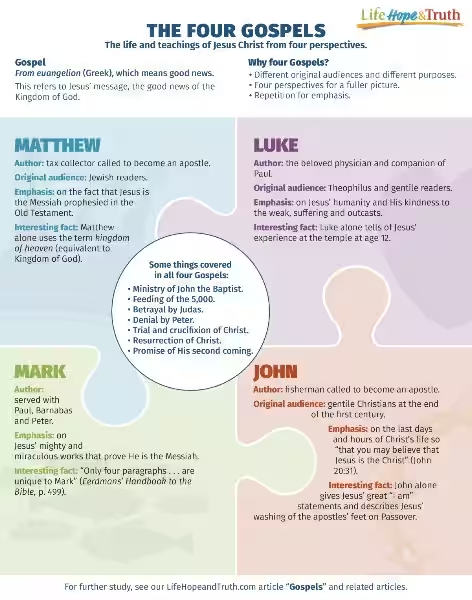
The New Testament of the Christian Bible features four books bearing the names of these individuals: the Gospel of Matthew, the Gospel of Mark, the Gospel of Luke, and the Gospel of John. While they all recount the same core events, each Gospel author approached their task with a unique audience and purpose in mind, resulting in different emphases and styles. This diversity is not a contradiction but a richness, offering a multifaceted understanding of Jesus. Think of it like four different photographers capturing the same breathtaking landscape; each shot will highlight different aspects – the grandeur of the mountains, the softness of the light, the detail of the flora, the vastness of the sky – yet all are depicting the same awe-inspiring scene.
The unity of their message lies in their unwavering focus on Jesus Christ as the Son of God, the Savior of humanity. They all describe his miraculous deeds, his profound parables that taught spiritual truths through everyday analogies, his challenging of religious authorities, and ultimately, his sacrificial death and triumphant resurrection. The differences in their accounts serve to illuminate different facets of Jesus’ character and mission, appealing to a broader range of human experiences and understanding. To truly appreciate their work, it’s important to consider each voice individually while recognizing their shared, vital narrative.
Traditionally believed to be Matthew the tax collector, one of Jesus’ twelve apostles, the Gospel of Matthew is often seen as written with a predominantly Jewish audience in mind. Matthew meticulously weaves in references to the Old Testament prophecies, demonstrating how Jesus’ life and ministry fulfilled ancient scriptures. He presents Jesus as the Messiah, the King whom the Jewish people had been awaiting, emphasizing his royal lineage and his role as the ultimate fulfillment of the Law.
For example, Matthew frequently quotes Old Testament passages and then explicitly states, “This happened to fulfill what was spoken by the prophet…” This approach would have resonated deeply with Jewish readers seeking confirmation that Jesus was indeed the promised deliverer. The structure of Matthew’s Gospel, with its emphasis on Jesus’ teachings organized into distinct discourses (like the Sermon on the Mount), also makes it a compelling manual for discipleship, outlining the principles of living in God’s kingdom. This makes Matthew’s Gospel particularly valuable for understanding the ethical and moral framework of early Christianity.
Mark: The Dynamic Messenger of Action
The Gospel of Mark is the shortest and often considered the most action-packed of the four Gospels. Attributed to John Mark, a close companion of both Peter and Paul, it is believed to be the earliest Gospel written. Mark’s style is direct and fast-paced, emphasizing Jesus’ powerful deeds and authority. He portrays Jesus as the Servant of God, constantly on the move, performing miracles, and confronting opposition.
Mark’s Gospel is rich with vivid descriptions and a sense of urgency. He doesn’t dwell as much on lengthy discourses as Matthew does, but rather on Jesus’ immediate impact on people’s lives. The constant use of the word “immediately” underscores the dynamic nature of Jesus’ ministry and the rapid unfolding of events. This Gospel is particularly effective in conveying the sense of wonder and awe that Jesus’ actions inspired, making it a powerful testament to his divine power. For readers who are drawn to stories of action and immediate impact, Mark’s Gospel offers a compelling and accessible entry point.
Luke, a physician and a Gentile convert, is credited with writing the third Gospel, as well as the Book of Acts. His Gospel is known for its detailed and orderly account, presenting Jesus as the Savior of all humanity, with a special concern for the marginalized, the poor, and the outcasts. Luke’s meticulous research and his aim to provide a “sequential account” make his Gospel a valuable historical document, as well as a profound theological one.
Luke includes many stories not found in the other Gospels, such as the parables of the Good Samaritan and the Prodigal Son, which highlight Jesus’ compassion and inclusive love. He emphasizes Jesus’ continuous prayer life and his interaction with women, demonstrating a holistic and empathetic portrayal of Christ. For readers who appreciate detailed narratives and a focus on social justice, Luke’s Gospel offers a deeply moving and comprehensive picture of Jesus’ earthly ministry and his universal message of salvation. His inclusion of Jesus’ birth narrative, with its tender details, further solidifies this compassionate and human dimension.
John: The Theologian’s Profound Revelation
The Gospel of John stands apart from the Synoptic Gospels (Matthew, Mark, and Luke) in its theological depth and unique perspective. John, believed to be the beloved disciple, focuses on the divine nature of Jesus, presenting him as the Word of God made flesh. His Gospel is less concerned with the chronological sequence of events and more focused on revealing Jesus’ identity and his relationship with the Father.
John’s Gospel is filled with profound theological pronouncements, such as Jesus’ “I Am” statements (e.g., “I am the bread of life,” “I am the light of the world”). He uses symbolic language and extended dialogues to explore the deeper meaning of Jesus’ mission. For readers seeking to understand the essence of Jesus’ divinity and his eternal significance, John’s Gospel offers unparalleled insight. His emphasis on belief, love, and eternal life provides a powerful conclusion to the Gospel narratives, solidifying the central tenets of Christian faith.
The Enduring Legacy of Matthew, Mark, Luke, and John
The collective work of Matthew, Mark, Luke, and John forms the bedrock of Christian theology and practice. Their Gospels are not simply ancient texts; they are living accounts that continue to inspire, challenge, and guide believers across generations and cultures. The diversity of their perspectives ensures that the multifaceted nature of Jesus Christ is accessible to a wide range of individuals, each finding resonance with the voice that speaks most directly to their heart and mind.
Ultimately, the question of who are Matthew, Mark, Luke, and John leads us to a profound understanding of the life and message of Jesus. Their faithful witness, preserved through the ages, provides the essential narrative for anyone seeking to explore the foundations of Christianity and its enduring impact on the world. Their stories, though written centuries ago, remain remarkably relevant, offering universal truths about love, forgiveness, redemption, and the hope of eternal life.
Frequently Asked Questions: Matthew, Mark, Luke, and John, and Religion
Who are Matthew, Mark, Luke, and John?
Matthew, Mark, Luke, and John are traditionally recognized as the authors of the four Gospels in the New Testament of the Christian Bible. These Gospels are considered the primary accounts of the life, teachings, death, and resurrection of Jesus Christ.
What are the Gospels?
The Gospels are narrative accounts that present the life and ministry of Jesus from different perspectives. While they share a common focus on Jesus, each Gospel has its own unique emphasis, style, and intended audience, offering a rich and multifaceted understanding of Jesus’ identity and mission.
What is the religion associated with these figures?
The religion associated with Matthew, Mark, Luke, and John, and the content of their Gospels, is Christianity. Christianity is a monotheistic religion centered on the life and teachings of Jesus of Nazareth.
What is the significance of these Gospels in Christianity?
The Gospels are foundational texts in Christianity. They are central to Christian belief and practice, providing the narrative basis for the Christian faith, the understanding of Jesus as the Son of God and Savior, and the ethical teachings that guide Christian life.