Have you ever found yourself holding a Bible, perhaps during a quiet moment of reflection or amidst the bustling chaos of life, and wondered, “Why was the Bible made in the first place?” It’s a question that resonates deeply, touching upon the very foundations of faith for billions. This ancient collection of texts, revered as sacred scripture by Judaism and Christianity, isn’t just a book; it’s a library of narratives, laws, prophecies, and wisdom that has shaped civilizations, inspired countless works of art, and offered solace and guidance to individuals through millennia. Understanding why the Bible was made is to embark on a journey of discovery, unraveling the profound purpose behind its compilation and its enduring impact on the human story.
The genesis of the Bible is a complex tapestry woven with divine revelation, human experience, and a desire to preserve and transmit foundational truths. It wasn’t a single event or a singular author but a gradual process spanning centuries, involving numerous individuals inspired by a higher power. The core motivation behind its creation was to establish a covenant relationship between God and humanity, outlining divine expectations, promises, and the path to salvation. This understanding forms the bedrock of why the Bible was made – to serve as a divine roadmap for living, a testament to God’s character, and a source of hope in a world often fraught with uncertainty.
At its heart, the question of why was the Bible made is inextricably linked to the concept of divine communication. Religions, particularly those that trace their lineage to Abraham, believe that God actively sought to reveal Himself and His will to humankind. The Bible, in this view, represents the culmination of these divine revelations. It’s not a philosophical treatise arrived at through human reasoning alone, but rather a collection of inspired writings, believed to be breathed by God (as suggested in 2 Timothy 3:16). This divine origin imbues the text with an authority and purpose that transcends ordinary literature. Consider it like receiving a set of highly detailed instruction manuals for a complex piece of machinery; the Bible, from a believer’s perspective, provides the essential instructions for navigating life, understanding our purpose, and achieving spiritual fulfillment.
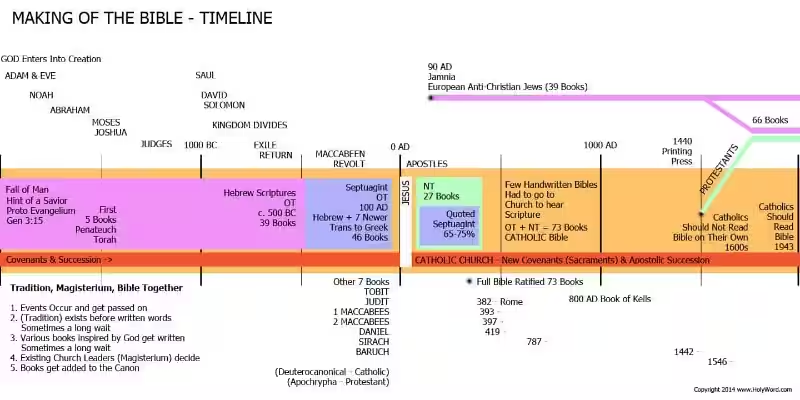
Furthermore, a significant driving force behind the Bible’s creation was the establishment and maintenance of a covenant relationship. A covenant is a solemn agreement, a binding promise. In the Old Testament, God makes covenants with individuals like Noah, Abraham, Moses, and David, outlining His faithfulness and His expectations for His chosen people. The Torah, the first five books of the Old Testament, lays out the laws and commandments that were to govern the Israelites, demonstrating God’s desire for a righteous and ordered society. This covenantal framework wasn’t merely about rules; it was about fostering a deep, abiding connection between the Creator and His creation, a relationship built on love, obedience, and mutual commitment. The Bible, therefore, was made to document and facilitate this sacred bond, ensuring that future generations would understand and participate in God’s redemptive plan.
The act of writing down these revelations was crucial for their preservation and transmission. Oral traditions, while rich and meaningful, are susceptible to alteration and loss over time. By committing these divine truths to scripture, the authors and compilers of the Bible ensured that God’s message would endure through the ages. This required careful selection, meticulous copying, and a deep understanding of the theological significance of each narrative and teaching. Think of it like a family passing down precious heirlooms; each generation has a responsibility to care for and protect these treasures, ensuring their beauty and significance are not diminished. The Bible, in this analogy, represents the most treasured heirloom of all, passed down through millennia, carrying the very essence of divine love and wisdom.
The compilation of the Bible wasn’t a haphazard affair; it involved distinct stages and a gradual canonization process. The Old Testament, for example, comprises texts that were gradually recognized as authoritative within Jewish tradition. Later, the New Testament emerged, chronicling the life, teachings, death, and resurrection of Jesus Christ, along with the early spread of Christianity. The decision to acknowledge certain texts as divinely inspired and therefore part of the biblical canon was a rigorous process, undertaken by religious authorities who sought to ensure that the scriptures accurately reflected God’s revealed will. This deliberate effort underscores the profound importance placed on the Bible’s role as the authoritative word of God, a guiding light for faith and practice.
A Blueprint for Living: Morality, Meaning, and Purpose
Beyond its theological underpinnings, a fundamental reason why was the Bible made is to provide a comprehensive blueprint for human flourishing. It offers a moral framework, ethical guidelines, and wisdom literature that addresses the complexities of human existence. The Ten Commandments, for instance, are not just ancient decrees; they offer timeless principles for ethical conduct, advocating for honesty, respect for life, and healthy relationships. The Psalms offer a spectrum of human emotion, from profound grief to ecstatic praise, demonstrating that faith is meant to be lived out in its entirety, encompassing our joy, sorrow, doubt, and hope. The Proverbs, on the other hand, provide practical wisdom for daily life, offering counsel on everything from diligence and speech to financial responsibility and the pursuit of knowledge. Together, these elements create a holistic guide for navigating the challenges and opportunities of life with integrity and purpose.
Furthermore, the Bible addresses the existential questions that have plagued humanity for as long as we have been conscious: What is our purpose? Where do we come from? Where are we going? The creation narratives in Genesis offer a foundational understanding of humanity’s origin and relationship with God. The overarching narrative of redemption, culminating in Jesus Christ, provides a message of hope and reconciliation, offering a solution to the problem of sin and separation from God. The Bible doesn’t shy away from suffering or injustice; instead, it offers a redemptive perspective, suggesting that even in the darkest moments, God’s plan is at work and that there is ultimate hope for healing and restoration. It provides a meaningful narrative arc for human existence, offering a sense of destiny and ultimate belonging.
The Bible also serves as a unifying force for the faith community. It provides a shared narrative, common beliefs, and a collective identity for those who adhere to its teachings. The teachings of Jesus, as recorded in the Gospels, emphasize love, compassion, and service to others, forming the basis for the Christian church’s mission. The epistles, written by apostles like Paul, offer further instruction and encouragement to early Christian communities, addressing specific challenges and theological questions. This shared foundation allows believers to worship together, learn together, and support one another in their spiritual journey. It’s the common language of faith, enabling connection and shared understanding across diverse backgrounds and experiences.
The stories within the Bible are not merely historical accounts; they are parables of the human condition, illustrating timeless truths about faith, doubt, perseverance, and the consequences of our choices. The story of Abraham’s faith in leaving his homeland, the courage of David facing Goliath, or the humility of Ruth gleaning in the fields – these narratives serve as powerful examples and encouragements for believers today. They demonstrate that the journey of faith is rarely a straight line, but often involves struggle, learning, and growth. By reflecting on these accounts, individuals and communities can glean timeless wisdom and find inspiration to navigate their own challenges with courage and conviction. This is a crucial aspect of why was the Bible made: to provide a rich tapestry of human experience, illuminated by divine purpose, for the edification of all.
A Source of Hope and Transformation
Perhaps one of the most profound answers to why was the Bible made lies in its capacity to offer unwavering hope and profound personal transformation. In moments of despair, loss, or uncertainty, the scriptures provide comfort and reassurance. The promises of God’s enduring love, His forgiveness, and His ultimate victory over suffering offer a beacon of light in the darkest of times. Passages like Psalm 23, “The Lord is my shepherd; I shall not want,” or Romans 8:28, “And we know that in all things God works for the good of those who love him,” have provided solace and strength to countless individuals facing adversity. The Bible offers the assurance of something greater than our immediate circumstances, a divine perspective that transcends earthly troubles.
Moreover, the Bible is not simply a book of comforting words; it is presented as a transformative force. The belief is that engaging with its message, not just intellectually but also spiritually, can lead to a change of heart and mind. The teachings of Jesus, particularly His call to love God and love our neighbors, challenge individuals to live lives of greater compassion, humility, and service. The concept of being “born again” within Christian theology speaks to a radical internal transformation, a spiritual rebirth facilitated by faith in God’s redemptive work. This emphasis on personal renewal and ethical living is a central tenet of why the Bible was made – to be an agent of positive change in the lives of individuals and, by extension, in the world.
The enduring legacy of the Bible is evident in its profound influence on history, culture, and individual lives. It has inspired acts of immense kindness, social justice movements, and the establishment of charitable organizations that have served millions. From the abolitionist movement to modern-day humanitarian efforts, the principles found within its pages have motivated individuals to act with courage and compassion in the face of injustice and suffering. The stories of biblical figures who stood up for what was right, even when it was difficult, serve as a powerful call to action for believers. This is a testament to the Bible’s role not just as a source of passive comfort, but as a catalyst for meaningful engagement with the world.
Ultimately, the question of why was the Bible made is a question about divine love, human purpose, and eternal hope. It’s a rich tapestry of stories, laws, prophecies, and wisdom designed to guide humanity, foster a relationship with the Creator, and offer a path to redemption. Whether viewed as a historical document, a philosophical text, or the divinely inspired Word of God, its impact on the human experience is undeniable. It continues to be a source of inspiration, guidance, and transformation for billions, a testament to its enduring relevance and its profound significance in the ongoing narrative of faith.
Frequently Asked Questions: The Bible and Religion
Why was the Bible made?
The Bible was compiled over centuries by various authors, inspired by their understanding and relationship with God. It was written to record God’s relationship with humanity, to teach about His nature, His laws, and His plan for salvation. It serves as a foundational text for Judaism and Christianity, guiding believers in faith, life, and understanding of the divine.
What is religion?
Religion is a system of beliefs, practices, and rituals that connect individuals to something larger than themselves, often a divine or supernatural power. It provides a framework for understanding the meaning of life, morality, and ethical conduct. Religions typically involve worship, community, and a set of doctrines or teachings that shape the worldview and behavior of its adherents.