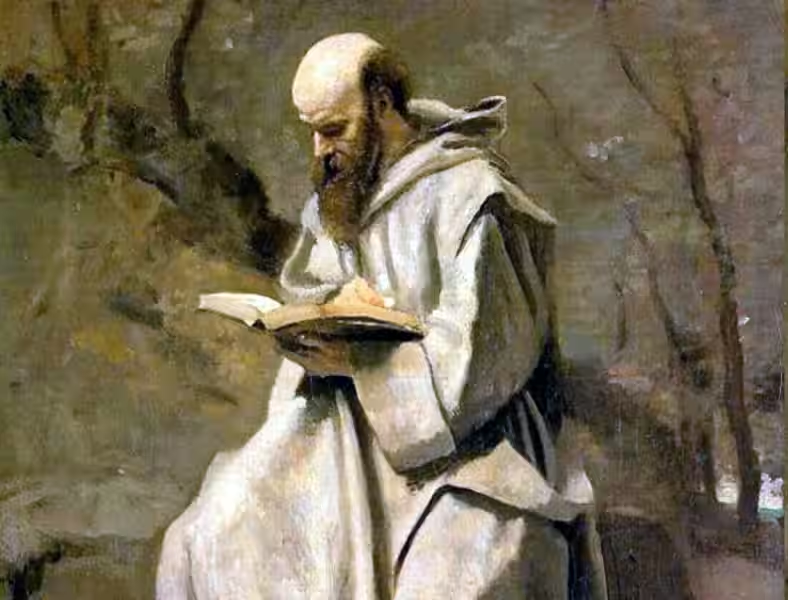
When we encounter the name “St. Bernard,” a figure of immense historical and spiritual significance immediately comes to mind. But who is St. Bernard, really? Beyond the often-cited hagiographies and theological treatises, he was a man of passion, intellect, and unwavering devotion whose influence resonated deeply within the religious landscape of the 12th century and continues to inspire us today. He wasn’t just a theologian or a mystic; he was a tireless advocate for reform, a profound spiritual guide, and a figure whose life offers valuable lessons for anyone seeking a deeper connection with their faith, regardless of their specific religious tradition.
St. Bernard of Clairvaux, as he is most commonly known, was born in 1090 in the Burgundy region of France and died in 1153. His life spanned a period of considerable upheaval and change within the Christian world, a time when monasticism was a cornerstone of religious life and intellectual discourse was flourishing. Understanding who St. Bernard was requires delving into his prolific writings, his active role in church affairs, and the enduring impact of his spiritual teachings, all of which paint a picture of a man who sought to live and preach a life of authentic Christian devotion.
St. Bernard’s journey into religious life was marked by a profound personal conversion. After a period of worldly education and a promising start in secular pursuits, he experienced a spiritual awakening that led him to join the Benedictine monastery of Cîteaux in 1112. This was no small decision; it meant embracing a life of austere simplicity, ardent prayer, and manual labor. This commitment to basic monastic ideals became a hallmark of the Cistercian order, which St. Bernard would soon revitalize and expand.
His leadership qualities were evident early on. By 1115, he was instrumental in founding the Abbey of Clairvaux, which would become the mother house for numerous other Cistercian foundations across Europe. Under his guidance, Clairvaux became a renowned center of spiritual learning and disciplined living. It was here that St. Bernard truly honed his theological insights and developed his distinctive style of preaching and writing, deeply rooted in the contemplation of Christ’s suffering and love.
Theological Contributions: Bridging Faith and Reason
One of the most remarkable aspects of who St. Bernard was lies in his intellectual prowess. While often celebrated for his mystical experiences and his deep emotional connection to God, he was equally a formidable theologian and preacher. He navigated complex theological debates with clarity and passion, often using scriptural exegesis and personal reflection to illuminate divine truths. His sermons, particularly those on the Song of Songs, are considered masterpieces of spiritual literature, offering profound insights into the soul’s journey towards God.
St. Bernard’s approach to theology was not purely academic; it was deeply intertwined with his lived faith. He believed that true understanding of God came through love and experience, not just intellectual assent. This is evident in his emphasis on devotion to the Virgin Mary, a theme he explored with particular tenderness and depth. His writings on Mary, such as his treatise “On the Nativity of the Blessed Virgin,” helped shape popular piety and devotional practices for centuries, highlighting her role as a mediator of grace and a model of humility.
St. Bernard’s Influence on the Church and Society
The impact of who St. Bernard was extended far beyond the cloistered walls of monasteries. He was a significant figure in the political and ecclesiastical landscape of his time, often called upon to mediate disputes and offer counsel to popes and kings. His involvement in the Second Crusade is a notable, albeit controversial, chapter of his life. He preached with his characteristic fervor, galvanizing support for the expedition, demonstrating his ability to mobilize people for a cause he believed in, even if the ultimate outcome was not as intended.
Furthermore, St. Bernard was a champion of papal authority and a staunch defender of orthodox doctrine. He actively combated heresies that challenged the established teachings of the Church, employing his formidable intellect and persuasive rhetoric. His influence was instrumental in shaping the trajectory of medieval Christianity, and his legacy as a reformer and a spiritual leader continued to inspire subsequent generations of religious thinkers and practitioners.
Key Teachings and Enduring Relevance
For anyone asking who is St. Bernard and what can we learn from him, his teachings offer a rich tapestry of spiritual wisdom. At the heart of his message is the primacy of love – love for God, love for Christ, and love for one’s neighbor. He taught that genuine faith is not merely an intellectual exercise but a transformative experience of divine love that reshapes our hearts and actions. His emphasis on humility, obedience, and contemplation are timeless virtues that remain relevant for individuals seeking a more meaningful spiritual life.
St. Bernard also championed the idea of “knowing by loving.” He believed that through a sincere and earnest love for God, we can gain a deeper, more intuitive understanding of divine mysteries than through mere reason alone. This concept, often referred to as “affective knowledge,” offers a powerful reminder that faith often involves a surrender to something greater than ourselves, a willingness to be led by the heart as well as the mind. His enduring relevance lies in his ability to connect the divine with the human, offering a path to spiritual growth that is both intellectually rigorous and profoundly personal.
St. Bernard, often called Bernard of Clairvaux, was a French abbot and a pivotal figure in the 12th-century Cistercian movement. He was a theologian, preacher, and writer, known for his spiritual writings, his role in promoting the Second Crusade, and his influence on the papacy and European politics.
What is St. Bernard’s religion?
St. Bernard was a devout Christian, specifically a member of the Roman Catholic Church. He was a monk and later an abbot within the Cistercian order, a reformed branch of the Benedictine monastic tradition.