For millennia, amidst the sands of time and the whispers of generations, the concept of Israel’s return has resonated through religious texts and the hearts of believers. It’s a narrative woven with threads of ancient promises, periods of dispersion, and an unwavering hope for national restoration. This isn’t just a historical footnote; it’s a story that continues to unfold, touching upon deep theological questions and profoundly influencing the modern world. Understanding the prophecies surrounding Israel’s emergence as a nation offers a unique lens through which to view faith, history, and the enduring power of divine commitment.
The very idea of a nation being prophesied into existence is a remarkable one. It speaks to a belief system that sees history not as a random series of events, but as part of a grand, divinely orchestrated plan. This prophetic vision for Israel wasn’t about a mere political aspiration; it was intrinsically linked to a spiritual destiny, a role destined to be played out on the world stage. The scriptures, particularly within the Judeo-Christian tradition, are replete with passages that foretell a time when a scattered people would be regathered and re-established in their ancestral homeland.
The prophetic utterances concerning Israel’s future nationhood are not a recent development. They are deeply rooted in the foundational narratives of the Hebrew Bible. From the covenant God made with Abraham, promising him descendants “as numerous as the stars in the sky” and land, to the pronouncements of prophets like Isaiah and Jeremiah, the seeds of a future national rebirth were sown thousands of years ago. These ancient texts didn’t just offer vague inklings; they painted vivid pictures of a restored people and a re-established kingdom.
Consider the narrative of Abraham. God’s promise to him was not just about personal lineage but about the formation of a great nation that would be a blessing to all the families of the earth. This was a divine blueprint, a prophetic declaration that transcended immediate circumstances. Even during periods of exile and hardship, when the Israelites were scattered among other nations, these prophecies served as anchors of hope, reminding them of an unfulfilled destiny and a promised restoration.
The Weight of Exile and the Persistence of Hope
The history of the Jewish people is marked by periods of profound suffering and dispersion, often referred to as the Diaspora. Yet, through it all, the prophetic word about returning to Zion remained a potent force. This wasn’t a passive longing; it was an active, sustained hope that fueled cultural and religious identity across continents. The annual observance of Passover, with its cry of “Next year in Jerusalem,” is a powerful testament to this enduring prophetic expectation.
Imagine a family separated by war or circumstance, always holding onto the belief that they will one day reunite in their ancestral home. This is a simplified analogy for the deep-seated hope that characterized the Jewish people throughout centuries of exile. The prophecies offered not just a destination, but a divine assurance that this reunion was not a pipe dream, but a foretold certainty. This relentless belief, rooted in prophecy, played a crucial role in preserving their identity and paving the way for their eventual return.
The Modern Manifestation: A Nation Reborn
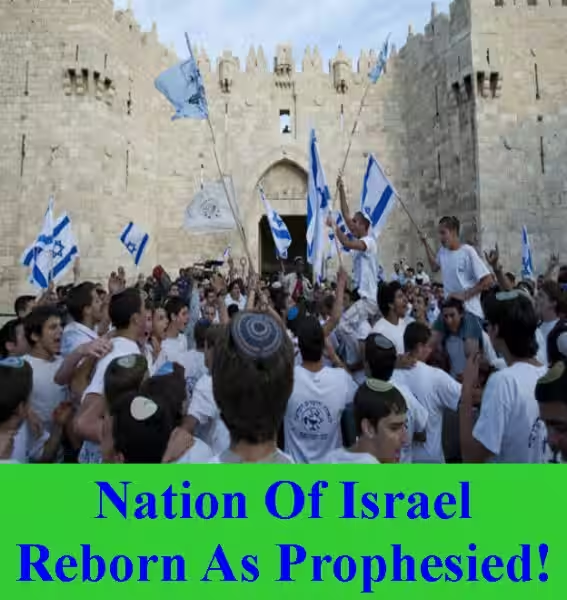
The establishment of the State of Israel in 1948 is viewed by many as a stunning fulfillment of ancient prophecy. After nearly two millennia without a sovereign nation, a people scattered across the globe were re-gathered to their ancestral land, forming a modern state. This event, occurring in a secular age, has ignited intense debate and awe, with many seeing it as direct evidence of divine intervention and the realization of biblical predictions.
The sheer improbability of this event, against the backdrop of historical trends and geopolitical realities, has led to significant theological reflection. For those who believe in the literal interpretation of prophecy, the re-establishment of Israel is a powerful signpost, indicating the imminent fulfillment of further prophetic events. It’s a narrative that continues to resonate deeply within religious communities, offering a tangible link to the past and a vision for the future.
Signs and Symbols in the Contemporary World
The ongoing existence and development of Israel are frequently interpreted through a prophetic lens. Events, both large and small, are often scrutinized for signs that align with eschatological prophecies. This can manifest in diverse ways, from interpreting geopolitical shifts to observing the growth and prosperity of the nation itself. The prophetic framework provides a way to understand current events within a broader, divinely guided historical trajectory.
For instance, the reclamation of the land, the flourishing of Hebrew as a living language after centuries of disuse, and the ingathering of exiles from various nations are all seen by many as tangible manifestations of prophecy. These developments are not simply historical occurrences; they are viewed as divine affirmations, evidence of a covenant being honored. This perspective imbues the present with a sense of sacred significance and prophetic urgency.
Prophecy and Religious Significance: A Deep Connection
The prophetic promises concerning Israel’s national rebirth are not merely historical curiosities; they are central to the theological understanding of several major religions, particularly Judaism and Christianity. For Judaism, it represents the covenantal faithfulness of God and the culmination of a long journey towards national redemption. For many Christians, it is seen as a fulfillment of Old Testament prophecies and a precursor to further spiritual and eschatological events.
The return of the Jewish people to their land and the establishment of a state are often viewed as divinely appointed milestones. They are seen as proof of God’s enduring promises to Abraham and his descendants. This understanding fuels a profound sense of faith and anticipation within these religious communities, shaping their theological interpretations and their engagement with the world.
Enduring Faith and Future Expectations
The prophetic narrative of Israel’s nationhood continues to inspire faith and shape expectations for the future. It speaks to a divine plan that transcends human limitations and a promise that has persevered through millennia of hardship. Whether viewed as a historical event, a theological sign, or a harbinger of future events, the emergence of Israel as a nation remains a powerful and deeply resonant story, interwoven with the very fabric of religious belief.
The prophetic declarations offer not just a historical account but a spiritual roadmap. They provide a framework for understanding the hand of God in history and the enduring nature of divine covenants. This enduring faith, fueled by the unfolding tapestry of prophecy, continues to be a source of strength, guidance, and unwavering hope for millions around the globe.
Frequently Asked Questions: Prophecy About Israel Becoming a Nation
What are some of the biblical prophecies concerning the re-establishment of Israel as a nation?
There are numerous prophecies in the Old Testament that speak to the future restoration of Israel. Key examples include verses found in Ezekiel 37:11-14, which describes dry bones being brought back to life, symbolizing the scattered people of Israel being regathered and given breath. Isaiah 11:11-12 speaks of God gathering the dispersed of Israel from all nations and bringing them back to the land of Israel. Jeremiah 30:3 and 31:8-10 also foretell a future return from exile and the rebuilding of the land.
How do different religious perspectives interpret these prophecies?
Judaism generally views these prophecies as literal and awaiting their ultimate fulfillment, often associated with the coming of the Messiah. The establishment of the modern state of Israel is seen by many as a significant step towards this fulfillment, though the full messianic era is still anticipated.
Christianity holds a range of interpretations. Many denominations see the re-establishment of Israel as a sign of the times, either as a precursor to the second coming of Christ or as part of God’s ongoing plan for salvation history. Some Christian Zionists strongly support Israel’s existence based on these prophecies. Other interpretations are more symbolic or allegorical, seeing “spiritual Israel” (the Church) as the primary fulfillment of these promises.
Islam acknowledges the Abrahamic lineage and the importance of Jerusalem (Al-Quds) and the land of Israel. While not as focused on the literal re-establishment of a nation in the same way as Jewish or some Christian interpretations, Islamic tradition holds that prophets and significant events occurred in this region, and there are narratives that can be seen as aligning with certain prophetic themes of return and divine favor.
When did the prophecy of Israel becoming a nation begin to be fulfilled?
While the concept of the Land of Israel is central to Jewish identity and faith throughout history, the modern political re-establishment of the nation of Israel is widely considered to have begun with the Zionist movement in the late 19th century, leading to the establishment of the State of Israel on May 14, 1948. This event is seen by many as the tangible fulfillment of ancient prophecies concerning the return of the Jewish people to their ancestral homeland and the formation of a sovereign state.
Are there any prophecies that speak to challenges or conflicts associated with Israel’s restoration?
Yes, many prophecies also allude to periods of tribulation, conflict, and opposition that would accompany or follow Israel’s restoration. For instance, Ezekiel 38-39 describes a future battle involving a coalition of nations against Israel. Zechariah 12-14 speaks of a time of great distress for Jerusalem and surrounding nations, followed by a period of divine intervention and peace. These passages are often interpreted as foreshadowing ongoing geopolitical challenges and spiritual warfare surrounding the existence and sovereignty of Israel.