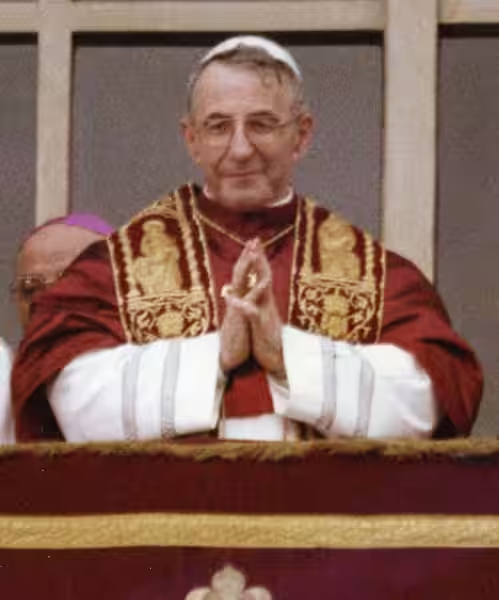
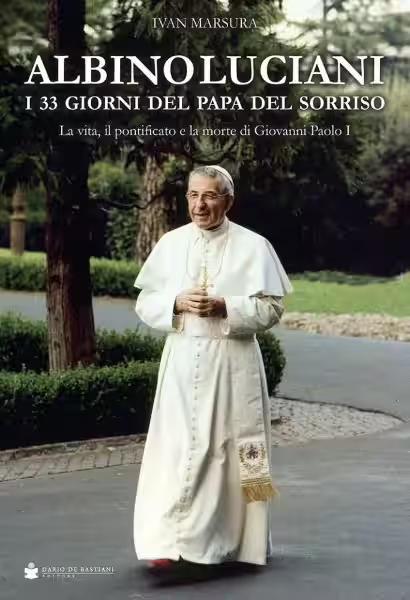
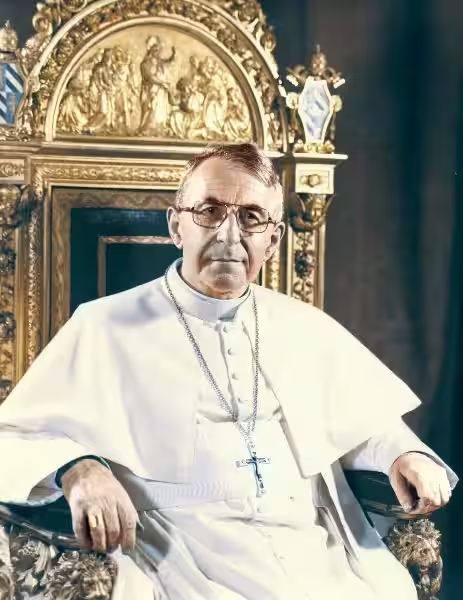
The story of John Paul I, born Albino Luciani, is one that resonates with a disarming simplicity and an enduring hope. In a world often characterized by grand pronouncements and complex theological debates, his brief pontificate, lasting a mere 33 days in 1978, offered a refreshing glimpse of a papacy rooted in pastoral care, humility, and genuine human connection. His rise to the highest office in the Catholic Church was not the culmination of a lifelong ambition for power, but rather a gentle unfolding of God’s will, as many who knew him would attest. He was a scholar and a shepherd, a man who found profound spiritual meaning in the everyday lived experiences of believers. His background was far removed from the gilded palaces of power; he hailed from a humble village in the Veneto region of Italy, a testament to the idea that extraordinary leaders can emerge from ordinary circumstances. This grounding in the common life of the faithful would profoundly shape his approach to his ministry.
Luciani’s journey through the ranks of the Church was marked by a consistent dedication to serving God’s people. From his early days as a parish priest to his time as Bishop of Vittorio Veneto and later as Patriarch of Venice, he was known for his approachable demeanor and his ability to explain profound religious truths in accessible language. He wasn’t a firebrand or a divisive figure; instead, he was a quiet force for good, a spiritual guide who sought to illuminate the path of faith for all. His election as Pope was a surprise to many, including, it is said, himself. The conclave, in its wisdom, chose a man who embodied a different kind of leadership – one characterized by kindness, intellectual honesty, and a deep love for Jesus Christ. This selection signaled a desire for a more relatable and perhaps even a more modern approach to the papacy, one that prioritized genuine spiritual guidance over institutional rigidity. His choice of the papal name, John Paul I, a double tribute to his immediate predecessors, further emphasized his desire to build upon their legacies while forging his own distinct path.
The core of John Paul I’s brief pontificate was his unwavering commitment to simplicity and service. He eschewed the traditional use of the plural “we” in papal discourse, opting instead for the more personal and humble “I.” This seemingly small change was a powerful statement, injecting a sense of directness and personal accountability into his pronouncements. He believed that the message of the Gospel was meant to be understood by everyone, not just theologians or scholars. For instance, when discussing the concept of purgatory, instead of delving into intricate theological arguments, he might have used an analogy like a mother washing her children’s clothes before they could meet their father, illustrating the idea of spiritual purification in a way that resonated with the common person. His approach was about making the profound accessible, bridging the gap between abstract doctrine and the lived reality of faith. This emphasis on clarity and relatable explanation was a hallmark of his pastoral style, a deliberate effort to connect with the faithful on a deeply human level.
Furthermore, John Paul I embodied a spirit of service that extended beyond mere pronouncements. Stories abound of his willingness to engage directly with those in need, to listen intently, and to offer words of comfort and encouragement. He was not content to remain cloistered in the Vatican; his heart yearned to be among the people, to understand their struggles, and to offer them the solace of the Catholic faith. This commitment to active charity and empathetic engagement was a direct reflection of his understanding of Christian discipleship. He envisioned a Church that was not just a hierarchical institution, but a vibrant community of believers actively participating in God’s work in the world. His vision for religion was one of practical application, where faith informed actions and where compassion was the guiding principle. He sought to remind all Catholics that the teachings of Jesus were meant to be lived out, not just intellectually appreciated. This focus on tangible acts of love and service was his way of demonstrating the power and relevance of religion in the modern age.
John Paul I’s pontificate, though tragically short, was a beacon of hope for countless individuals within and outside the Catholic Church. In a period of significant social and religious upheaval, he offered a voice of calm reassurance and a steadfast reminder of the enduring power of faith. His accessible style and his genuine warmth projected an image of a Church that was not afraid to engage with the complexities of life, but rather one that offered spiritual grounding and unwavering support. He understood that many people grappling with the uncertainties of the world were seeking something solid, something that could provide them with a sense of purpose and belonging. His very presence as Pope, with his gentle smile and his evident love for humanity, seemed to promise a renewal of the Church’s mission. For those who felt disconnected or disillusioned, his papacy offered a renewed sense of possibility, a feeling that religion could indeed be a source of profound personal meaning and communal strength.
His legacy, therefore, is not measured in the length of his time in office, but in the impact of his message and the inspiration he provided. He called for a deeper, more authentic engagement with faith, urging believers to move beyond superficial adherence and to embrace the transformative power of Christ’s teachings. He championed the idea that religion was a journey of personal growth, a continuous striving to live a life that reflected the values of love, justice, and mercy. His quiet determination to bring a renewed focus on pastoral care and evangelization served as a powerful impetus for the Church to re-examine its priorities. Even after his passing, the memory of John Paul I continues to inspire those who seek a religion that is both deeply spiritual and profoundly human, a faith that guides, comforts, and empowers us in our daily lives. His brief reign serves as a potent reminder that true leadership often lies not in grand pronouncements, but in the quiet, unwavering commitment to serving God and humanity.
Frequently Asked Questions about John Paul I’s Religion
Who was John Paul I?
John Paul I, born Albino Luciani, was the Pope of the Catholic Church for a brief period in 1978. His pontificate lasted only 33 days, making him one of the shortest-reigning popes in history.
John Paul I was born into a devout Catholic family in the Veneto region of Italy. He was ordained a priest and later became a bishop, eventually serving as the Patriarch of Venice before his election to the papacy.
What were his key religious beliefs and teachings?
As Pope, John Paul I emphasized humility, simplicity, and the teachings of Jesus Christ. He was known for his pastoral approach and his commitment to the poor and marginalized. His brief pontificate did not allow for extensive new doctrines, but his actions and words reflected a deep adherence to Catholic tradition and a call for spiritual renewal.
Was John Paul I considered a conservative or liberal pope?
John Paul I’s pontificate was too short to be definitively categorized as conservative or liberal in the way later popes were. However, his focus on pastoral care and his simple lifestyle suggested a pastoral sensibility rather than a rigidly ideological stance. Observers often viewed him as a pastor who sought to unite rather than divide.
Did John Paul I have any specific theological contributions?
Due to the brevity of his papacy, John Paul I did not leave behind a vast body of theological works or encyclicals. However, his simple yet profound style of communication and his emphasis on core Christian values were seen as a spiritual balm and a call to deeper faith for many within the Church.
What was the religious impact of his short papacy?
Despite its brevity, John Paul I’s pontificate had a significant emotional and spiritual impact. He was affectionately known as the “Smiling Pope” and was seen as a figure of hope and gentle leadership. His reign offered a moment of reflection and a reminder of the fundamental tenets of Catholicism for many, leaving a lasting impression of kindness and humility.