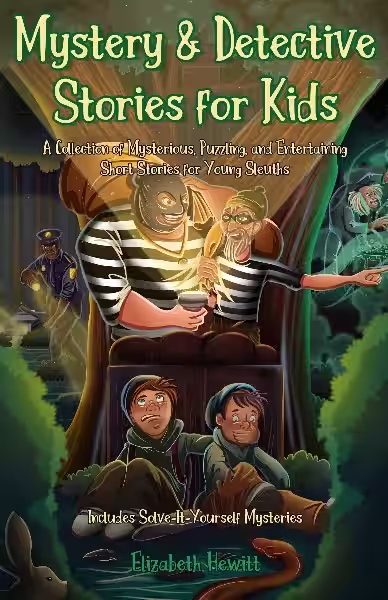
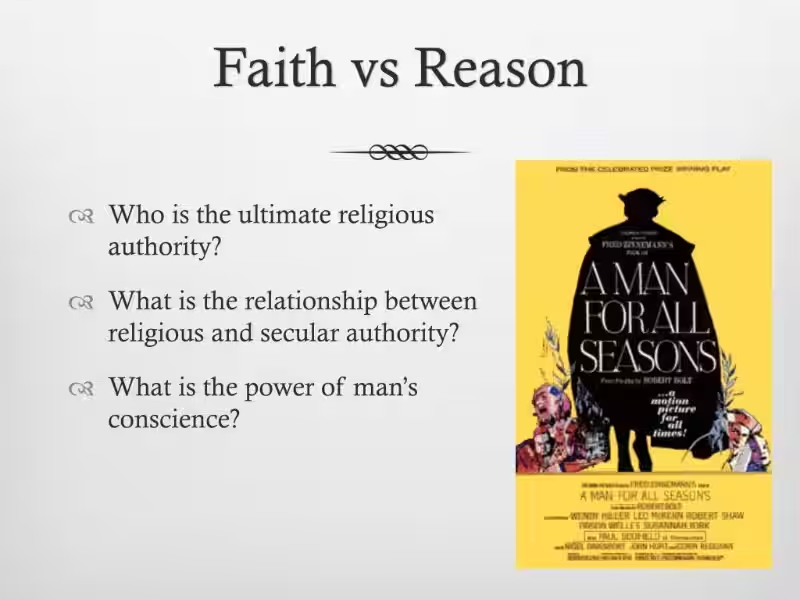
From the whispers of ancient scriptures to the hushed confessions in modern confessionals, the human quest for understanding the unknown is deeply intertwined with both mystery stories and the fabric of religion. These two powerful forces, often perceived as separate domains, share a profound commonality: the exploration of what lies beyond our immediate comprehension. Whether it’s a detective piecing together fragments of evidence to reveal a hidden truth or a theologian seeking divine revelation, the underlying impulse is the same – to illuminate the shadows and make sense of the inexplicable.
Consider the enduring appeal of a well-crafted mystery. The meticulous unraveling of clues, the unexpected twists, and the ultimate resolution resonate with a deep-seated human need for order and meaning. Religion, in its myriad forms, offers a similar framework for navigating the mysteries of life, death, morality, and the cosmos. Both provide narratives that help us process anxieties, find solace in certainty, and grapple with the profound questions that have occupied humanity since the dawn of consciousness.
At their core, both detectives and religious adherents are seekers of truth. The detective, armed with logic and observation, meticulously examines the physical world for answers. They look for the discrepancies, the misplaced objects, the subtle inconsistencies that betray a hidden reality. Similarly, many religious traditions encourage a dedicated pursuit of spiritual understanding, often through prayer, meditation, scripture study, and communal rituals. This pursuit aims to discern the divine will, the underlying spiritual laws, and the ultimate purpose of existence.
Think of Sherlock Holmes, painstakingly analyzing footprints at a crime scene. His method involves deduction, evidence gathering, and a relentless pursuit of the truth, no matter how uncomfortable. In a parallel vein, a devout scholar might spend years poring over ancient texts, seeking to understand the nuances of divine teaching or the historical context of sacred events. Both are engaged in a form of investigation, albeit with vastly different tools and ultimate goals. The satisfaction of solving a complex case mirrors the spiritual enlightenment sought through deep religious practice – a moment when the fog lifts and clarity is achieved.
The Sacred Text as a Crime Scene: Interpreting the Divine Narrative
Religious texts themselves often read like intricate mystery stories. They are filled with allegories, parables, prophecies, and accounts of miraculous events that require careful interpretation. The faithful often engage in a form of textual detective work, seeking to understand the author’s intent, the historical context, and the deeper, allegorical meanings. Just as a detective must consider the motives of suspects and the forensic evidence of a crime, a religious reader must ponder the symbolism, the historical backdrop, and the theological implications of sacred narratives.
Consider the Book of Revelation in the Christian Bible. Its apocalyptic imagery and symbolic language have generated centuries of debate and interpretation, akin to a colossal, ongoing cryptic puzzle. Scholars and theologians alike grapple with its meaning, proposing various theories and explanations, much like detectives dissecting a particularly baffling case. The search for the “truth” within scripture, whether it’s the historical accuracy of an event or the spiritual guidance it offers, involves a similar process of analysis, comparison, and reasoning to arrive at a coherent understanding. This journey of interpretation can be as thrilling and revealing as any fictional detective story.
Moral Mazes and Spiritual Deductions: The Ethics of Revelation
Many mystery stories are fundamentally about moral dilemmas and the consequences of human actions. The detective often confronts the dark side of human nature, uncovering greed, betrayal, and violence. The resolution of the mystery frequently involves not just identifying the perpetrator but also exploring the underlying motivations and the ethical implications of the crime. Religion, too, is deeply concerned with morality, providing ethical frameworks, commandments, and teachings that guide believers toward righteous living.
Imagine a classic Agatha Christie novel where the motive for murder stems from a long-held secret and a sense of injustice. The detective, in solving the crime, often forces the characters, and the reader, to confront uncomfortable truths about human nature and the complexities of right and wrong. Similarly, religious teachings often present moral quandaries, from the Ten Commandments to the Sermon on the Mount, urging individuals to make ethical choices. The consequences of these choices, both in this life and potentially in the next, are central to many religious beliefs, mirroring the sense of accountability that a detective seeks to establish.
The Confessional as a Detective’s Interrogation Room: Seeking Absolution and Truth
The sacrament of confession, a cornerstone of some Christian traditions, can be viewed through a metaphorical lens of mystery-solving. The penitent, burdened by secret transgressions, enters a private space to confront their own hidden wrongs. The priest, acting as a spiritual guide and confessor, listens intently, much like a detective gathering information. The goal isn’t to assign blame in a legalistic sense, but to facilitate acknowledgment, remorse, and ultimately, forgiveness and reconciliation.
The act of confessing involves a deeply personal unburdening and a willingness to reveal the “truth” of one’s actions. The priest’s role is to guide the conversation, offer counsel, and provide absolution, a form of spiritual closure. This process, while rooted in faith and divine grace, shares a thematic resonance with a detective carefully interviewing witnesses and suspects, piecing together a narrative of events to understand what truly transpired and to bring about a resolution. The relief that follows sincere confession can be as profound as the satisfaction of a solved mystery.
The Unseen Hand: Divine Intervention and the Unforeseen Clue
One of the most compelling aspects of both mystery stories and religious belief is the concept of the unseen force at play. In a mystery, it might be the cunning of a mastermind criminal, their actions deliberately concealed. In religion, it is often the perceived presence of God, divine providence, or the workings of grace that guide events and offer unexpected solutions. These unseen forces can manifest as startling coincidences, serendipitous encounters, or moments of profound insight that seem to defy logical explanation.
Consider the detective who stumbles upon a crucial piece of evidence by chance, a “lucky break” that unlocks the entire case. This often feels like an external intervention, a nudge from fate or a hidden hand. Religious narratives are replete with examples of divine intervention – a timely miracle, a guiding vision, or an unexpected turn of events that saves the faithful or reveals a hidden truth. These fortuitous occurrences can feel like the universe itself conspiring to reveal a deeper order, much like a well-plotted mystery where all the pieces, however disparate, eventually fall into place to reveal the perpetrator and their crime.
The Ultimate Revelation: Faith, Certainty, and the End of Mystery
Ultimately, the allure of both mystery stories and religion lies in their promise of resolution and understanding. A good mystery provides a satisfying conclusion, where all loose ends are tied, and the truth, however dark, is revealed. Religion, in its own way, offers a framework for understanding the ultimate mysteries of life, death, and the universe, providing a sense of certainty and purpose. While the detective’s work concludes with the apprehension of a criminal, the spiritual journey aims for a more profound and eternal revelation.
The satisfaction of finishing a gripping mystery novel, where the final page brings clarity and closure, is a powerful human experience. Similarly, for believers, the attainment of faith can bring a deep sense of peace and an answer to the existential questions that plague us. This final revelation, whether it’s the identity of the murderer or the nature of the divine, offers a respite from the uncertainty and a sense of having finally grasped the unseen threads that weave the fabric of reality. The ongoing interplay between grappling with the unknown and seeking definitive answers is a testament to our inherent human drive to understand, a drive that fuels both the thrill of a good mystery and the depth of religious devotion.
Frequently Asked Questions about Mystery Stories and Religion
Can religious themes be explored in mystery stories?
Yes, religious themes can absolutely be explored in mystery stories. Many mystery novels incorporate elements of faith, doubt, religious institutions, or spiritual journeys as central to the plot, character development, or the underlying moral questions of the mystery.
How does religion influence the motives of characters in a mystery?
Religious beliefs can powerfully shape a character’s motivations. A character might commit a crime out of a twisted sense of divine justification, to protect their faith or religious community, or even as a response to perceived spiritual corruption. Conversely, characters might be driven to solve a mystery by a desire for justice rooted in their religious tenets or a need to uncover truth based on their spiritual values.
Are there specific types of mystery stories that lend themselves well to religious exploration?
Certain subgenres can naturally accommodate religious themes. Cozy mysteries often take place in small communities with established churches or religious organizations. Historical mysteries can delve into the role of religion in past societies and conflicts. Thrillers might explore extremist religious groups or cults. Even classic detective stories can touch on morality and redemption, which are often linked to religious concepts.
How can religious symbolism be used in a mystery?
Religious symbolism can add layers of meaning and foreshadowing to a mystery. Objects, rituals, or biblical references can serve as clues, represent abstract concepts like good versus evil, or reflect the internal struggles of characters. This can enrich the narrative and provide deeper engagement for readers familiar with the symbolism.
Can a mystery story be both religiously inspiring and entertaining?
Certainly. A well-crafted mystery can entertain readers with its plot and suspense while also offering thoughtful reflections on faith, morality, and the human condition. The exploration of religious themes doesn’t have to detract from the mystery’s excitement; it can often enhance it by providing a richer context and more profound stakes.