The world of religious art has long served as a powerful conduit for understanding, expressing, and experiencing faith. For centuries, artists have strived to translate the intangible aspects of spirituality into tangible forms, offering viewers pathways to contemplation and connection. Among contemporary artists, the Marko Rupnik mosaics stand out as a particularly compelling force, breathing new life into ancient traditions while speaking directly to the modern spiritual seeker. These mosaics, characterized by their vibrant colors, expressive figures, and profound theological depth, are not merely decorative elements; they are visual sermons that invite us to engage with fundamental tenets of Christian belief on a deeply personal level.
The impact of Marko Rupnik mosaics extends far beyond their aesthetic appeal. They are found in some of the most significant religious sites around the globe, from the Sanctuary of Our Lady of Fatima in Portugal to the Chapel of the Redemptoris Mater in the Vatican. Each tessera, meticulously placed, contributes to a larger narrative, transforming walls and ceilings into luminous theological landscapes. This omnipresence underscores their universal appeal and enduring relevance in conveying the timeless messages of religion, offering a visual language that transcends cultural and linguistic barriers.
A Dialogue Between Ancient Art and Modern Faith: The Genesis of Marko Rupnik Mosaics
The art of mosaic itself boasts a rich history, stretching back to ancient Mesopotamia and flourishing in the Byzantine Empire. These early mosaics were often commissioned for churches and palaces, serving to educate the illiterate illiterate populace about biblical stories and the lives of saints. By depicting sacred narratives in durable and luminous materials like glass and stone, they offered a lasting testament to faith. This historical context is crucial to understanding the significance of Marko Rupnik mosaics, as Rupnik consciously draws upon this venerable tradition, reinterpreting it for a contemporary audience.
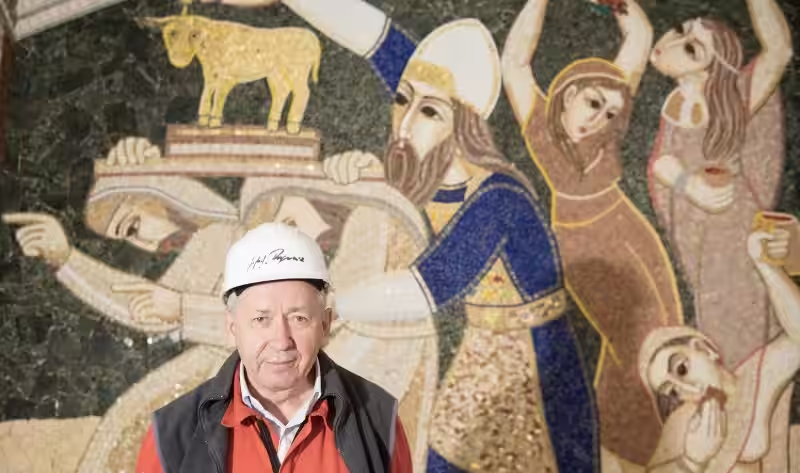
Marko Rupnik, a Slovenian Jesuit priest and artist, has become synonymous with this revival of sacred mosaic art. His approach is not simply about replicating old styles; it is about infusing them with a new spiritual energy. Rupnik’s iconographic language, deeply rooted in Orthodox and Catholic traditions, is immediately recognizable. His figures, often rendered with stark outlines and intense gaze, possess a poignant humanity, inviting viewers to connect with the emotional and spiritual core of the depicted scenes. This ability to marry historical tradition with personal expression is what makes the Marko Rupnik mosaics so uniquely powerful in the realm of religion.
The Theological Narrative Woven into Every Tessera
At the heart of Marko Rupnik mosaics lies a profound engagement with theology, presented in a way that is both accessible and deeply moving. Rupnik’s work is not about abstract theological treatises; it’s about making the mysteries of faith tangible and relatable. He often focuses on key moments in salvation history, from the Annunciation and the Nativity to the Resurrection and Pentecost. Each scene is meticulously crafted to convey specific theological truths, encouraging contemplation and personal reflection on the divine mystery at play.
Consider, for example, a typical depiction of the Nativity in a Marko Rupnik mosaic. You won’t find overly ornate settings or distracting details. Instead, the focus is on the divine simplicity of the event. The Virgin Mary is often portrayed with a serene, knowing gaze, and the infant Jesus, radiating a gentle light, symbolizes the incarnation of God. The bold, jewel-like colors Rupnik employs, such as deep blues, radiant golds, and earthy reds, are not arbitrary choices; they are symbolic, evoking the heavens, divine glory, and the earthly realm respectively. This careful use of color and form in his religious art guides the viewer’s understanding and emotional response.
Communicating Core Religious Concepts Through Visual Storytelling
The power of Marko Rupnik mosaics lies in their ability to communicate complex religious concepts through compelling visual narratives. Rupnik masterfully employs iconography, a visual language developed over centuries, to convey theological meaning. For instance, the recurring motif of light in his mosaics, often emanating from Christ or the Holy Spirit, symbolizes divine presence, grace, and enlightenment. Similarly, the hands of his figures are often depicted with expressive gestures, conveying blessings, prayers, or divine intervention.
This visual storytelling is particularly effective in conveying the mysteries of the Trinity. Rupnik might depict the Baptism of Christ with the Father’s voice from the heavens, the Son immersed in the Jordan, and the Holy Spirit descending as a dove, all rendered with an intensity that draws the viewer into the divine communion. The bold outlines and fragmented surfaces of the mosaics, while seemingly abstract at first glance, actually allow for a dynamic interplay of light and shadow, enhancing the spiritual atmosphere and inviting the viewer to actively participate in the creation of meaning. This active engagement is a hallmark of how Marko Rupnik mosaics contribute to the experience of religion.
The Human Face of Divinity: Rupnik’s Figures and Their Spiritual Connection
One of the most striking aspects of Marko Rupnik mosaics is their profound portrayal of the humanity of divine figures. While representing sacred beings, Rupnik imbues his characters with a relatable emotion and a palpable sense of presence. The faces of the saints and of Christ himself are rendered with an intense, often soulful, gaze that seems to look directly into the viewer’s own soul, fostering a sense of personal encounter. This is not distant, idealized divinity; it is divinity that has entered into the fabric of human experience.
In his depictions of the Virgin Mary, for example, Rupnik often captures a blend of maternal tenderness and profound sorrow, acknowledging her role as both mother and witness to Christ’s suffering. This emotional resonance allows viewers to connect with her experience on a human level, making the religious narrative more accessible and impactful. This is a testament to how Marko Rupnik mosaics can bridge the gap between the transcendent and the immanent, making the divine feel closer and more comprehensible in the context of religion.
Evoking Contemplation and Personal Spiritual Growth
The immersive quality of Marko Rupnik mosaics is designed to foster deep contemplation and encourage personal spiritual growth. Stepping into a space adorned with his work is akin to entering a sacred dialogue. The sheer scale and luminous quality of the mosaics draw the viewer in, inviting them to linger and absorb the visual narratives. Each element, from the carefully chosen colors to the expressive gestures of the figures, is intended to spark introspection and a deeper understanding of religious truths.
For example, a mosaic depicting the Parable of the Prodigal Son might focus on the father’s welcoming embrace, powerfully conveying the theological concept of unconditional divine love and forgiveness. The viewer is invited to see themselves in the parable, to consider their own journeys and the ever-present mercy of God. This is the transformative power of Marko Rupnik mosaics: they don’t just tell stories; they inspire personal spiritual journeys within the framework of religion.
The Enduring Legacy of Faith in Stone and Glass
The Marko Rupnik mosaics represent a significant contribution to the landscape of contemporary religious art. They demonstrate that the ancient art form of mosaic can still speak powerfully to the human heart and spirit in the 21st century. By grounding his work in rich theological tradition and infusing it with a unique artistic vision, Rupnik has created pieces that are both timeless and relevant. Their enduring appeal lies in their ability to connect viewers to the core tenets of their faith, offering moments of beauty, reflection, and profound spiritual encounter.
As we stand before these luminous creations, we are reminded of the enduring power of religion to inspire, to console, and to guide. Marko Rupnik mosaics serve as a testament to this enduring power, transforming sacred spaces into vibrant altars of visual theology, where the divine is made manifest in stone and glass, inviting all who behold them to a deeper engagement with the mystery of faith. The legacy of these religious artworks is not just in their visual splendor, but in the seeds of contemplation and spiritual renewal they plant in the hearts of those who experience them.
Frequently Asked Questions: Marko Rupnik Mosaics and Religion
What is the religious significance of Marko Rupnik’s mosaics?
Marko Rupnik’s mosaics are deeply rooted in Christian theology and iconography. They are intended to express and communicate the core tenets of the Catholic faith, often drawing inspiration from scripture, patristic writings, and the liturgy. His work aims to make the mysteries of faith accessible and visible to worshippers, fostering prayer and contemplation.
In what religious contexts are Marko Rupnik’s mosaics typically found?
Rupnik’s mosaics are predominantly found in Catholic churches, chapels, and other religious institutions. They are commissioned for spaces dedicated to worship, prayer, and religious formation, including cathedrals, basilicas, shrines, and retreat centers.
How do Rupnik’s mosaics engage with religious themes?
Rupnik’s artistic style is characterized by its symbolic representation and its focus on conveying theological concepts. He often depicts key figures and events from salvation history, such as the life of Christ, the Blessed Virgin Mary, the saints, and the sacraments. His use of color, light, and composition is carefully chosen to evoke spiritual meaning and encourage a deeper understanding of religious narratives.
Are Marko Rupnik’s mosaics considered traditional or contemporary in their religious expression?
Rupnik’s work bridges traditional religious art with contemporary artistic approaches. While he draws heavily on the rich history of Christian iconography and mosaic art, his style is distinct and recognizable, often featuring a stylized, expressive quality that is modern in its sensibility. This blend allows his mosaics to resonate with contemporary viewers while remaining faithful to ancient theological traditions.
What is the intended spiritual impact of viewing Marko Rupnik’s mosaics?
The intended spiritual impact is multifaceted. Rupnik’s mosaics aim to inspire awe, wonder, and a sense of the divine. They are designed to draw the viewer into a meditative state, encouraging reflection on the mysteries of faith and fostering a personal encounter with God. They serve as visual aids to prayer, helping to bridge the gap between the earthly and the divine.
Do Marko Rupnik’s mosaics adhere to specific liturgical or doctrinal guidelines?
Yes, as his commissions are for religious spaces, his work generally adheres to the guidelines and teachings of the Catholic Church. His artistic interpretations are intended to be theologically sound and to support the worship and teaching of the Church.