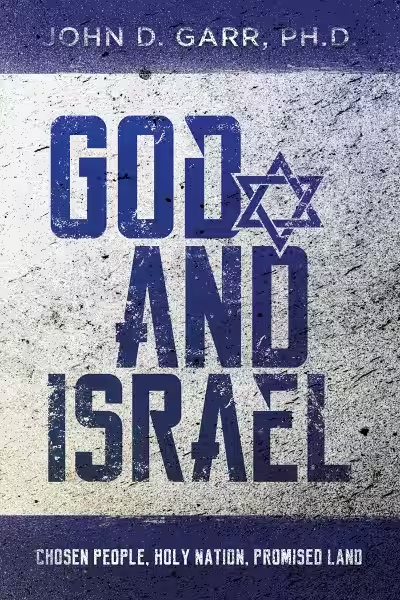
The question of whether Israel is God’s chosen nation is one that has resonated through millennia, shaping theological discourse, influencing geopolitical events, and holding profound significance for billions across the globe. This concept, deeply embedded within the Abrahamic faiths, especially Judaism and Christianity, is not merely an abstract theological point; it’s a narrative that has shaped identities, inspired movements, and continues to be a focal point for understanding the divine relationship with humanity. To grapple with this idea is to delve into the very heart of religious belief, exploring themes of covenant, destiny, and the unfolding of God’s plan.
Understanding the significance of Israel as God’s chosen nation requires us to look beyond simplistic interpretations and engage with the rich tapestry of scripture, history, and theological interpretation. It’s a journey that invites us to consider the unique role attributed to this people and land, and to reflect on what “chosenness” truly signifies within a religious context. This article aims to provide a comprehensive and relatable exploration of this pivotal concept, offering insights that are both informative and thought-provoking for anyone seeking to understand this fundamental aspect of religious belief.
The Origins of Chosenness: A Covenantal Foundation
The idea that Israel is God’s chosen nation is not a casual declaration but is rooted in a foundational concept known as the Abrahamic covenant. According to religious texts, particularly the Hebrew Bible (Old Testament), God made a solemn promise to Abraham, the patriarch of the Israelite people. This promise wasn’t merely a blessing for Abraham himself, but a declaration that through his descendants, all nations on earth would be blessed. This established a unique and enduring relationship, setting Abraham’s lineage apart for a specific divine purpose. This foundational agreement, a sacred covenant, formed the bedrock upon which the concept of chosenness was built.
This covenant was not about inherent superiority or an exclusive claim to divine favor in a way that excluded others. Instead, it was about a divine commission, a calling to be a unique instrument in God’s broader redemptive plan. Think of it like a conductor choosing a specific violin to play a crucial solo in an orchestra. The violin isn’t inherently better than the other instruments, but it’s selected for a particular role that will enhance the entire symphony. Similarly, the narrative asserts that Israel is God’s chosen nation to serve as a conduit for divine revelation, to demonstrate God’s character to the world, and ultimately, to be a blessing to all humanity. This chosenness, therefore, carried with it immense responsibility and a demanding mandate.
The Abrahamic Covenant: Promises and Responsibilities
The Abrahamic covenant, as detailed in texts like Genesis, is characterized by specific promises. God promised Abraham innumerable descendants, a vast inheritance of land (eventually Canaan, the land of Israel), and that through him, a lineage would arise that would impact the entire world. These promises were not conditional on Abraham’s perfection but were expressions of God’s faithfulness and sovereign will. This established a divine promise that would guide the history of the Israelite people through generations, shaping their identity and their understanding of their place in the world. It was a narrative of destiny, woven with threads of divine intention.
However, this covenant was not a one-sided affair. It also entailed significant responsibilities for Abraham and his descendants. They were called to live according to God’s laws, to uphold justice, and to remain faithful to the covenant relationship. This meant not only receiving blessings but also adhering to a particular way of life that would exemplify God’s righteousness. The concept of Israel being God’s chosen nation therefore implies a reciprocal relationship, where divine election comes with the imperative to live a life that honors God and serves as a testimony to others. This dual nature of promise and obligation is crucial for a nuanced understanding.
The Exodus and the Sinaitic Covenant: A National Identity Forged
The story of the Exodus from Egypt marks a pivotal moment in solidifying the understanding of Israel as God’s chosen nation. It’s a dramatic narrative of liberation, where God intervenes powerfully to rescue the Israelites from slavery. This act of redemption, often seen as a grand demonstration of God’s power and love, further cemented their unique relationship with the divine. The parting of the Red Sea, the miraculous provision of manna in the desert – these events are not just historical accounts but are viewed as divine affirmations of their special status. This epic journey was a testament to God’s unwavering commitment.
Following the Exodus, at Mount Sinai, God established a new covenant with the assembled Israelites. This Sinaitic covenant, often referred to as the Mosaic covenant, involved the giving of the Torah (the Law). This was a comprehensive set of commandments and guidelines that were meant to govern every aspect of their lives – from their worship and rituals to their social justice and ethical conduct. The Torah served as the blueprint for how Israel is God’s chosen nation to live out their covenantal relationship, providing a framework for holiness and a distinct identity that would set them apart from surrounding nations. This was more than just a set of rules; it was a divine constitution for a chosen people.
The Ten Commandments and the Law: A Framework for Life
The Ten Commandments, delivered at Sinai, are perhaps the most well-known aspect of the Mosaic covenant. These fundamental principles, such as “You shall have no other gods before me” and “You shall not murder,” laid the groundwork for a moral and spiritual compass. They were not simply arbitrary rules but were designed to foster a just and godly society, reflecting the very character of God. The adherence to these commandments was seen as a direct expression of their commitment to the covenant and their understanding of what it meant for Israel to be God’s chosen nation.
Beyond the Ten Commandments, the Torah encompasses a vast array of laws and statutes covering everything from dietary regulations and agricultural practices to civil laws and worship. This intricate legal system was intended to create a holy nation, a people set apart, whose lives would serve as a testament to God’s presence and their unique relationship with Him. This comprehensive framework provided a clear path for living out their chosenness, ensuring that their daily lives were imbued with a divine purpose. It was a holistic approach to faith and nationhood.
Prophetic Voices and the Nuances of Chosenness
Throughout Israel’s history, prophets played a crucial role in interpreting the meaning of chosenness and holding the nation accountable. Figures like Isaiah, Jeremiah, and Amos often spoke with fire and conviction, denouncing injustice, idolatry, and unfaithfulness. They reminded the people that being chosen was not a guarantee of automatic salvation or immunity from consequence, but a call to righteousness and a demonstration of God’s judgment on sin. These prophetic voices served as a crucial check and balance, ensuring that the concept of Israel being God’s chosen nation was not distorted into an excuse for complacency or arrogance.
These prophets also offered a vision of hope and restoration, often speaking of a future messianic age where God’s kingdom would be fully established. They often emphasized that God’s ultimate desire was for blessing and redemption not just for Israel, but for all nations. This highlights a crucial nuance: the chosenness of Israel was not an end in itself, but a means to a greater end – the salvation and reconciliation of the entire world. Therefore, the narrative of Israel as God’s chosen nation is inextricably linked to a universal scope of divine love and redemptive intent.
Accountability and Consequences: The Cost of Chosenness
The prophetic messages frequently underscored that chosenness came with a heavy burden of accountability. When the Israelites strayed from God’s path, indulged in injustice, or turned to idolatry, the prophets did not shy away from declaring divine judgment. This could manifest as hardship, exile, or loss of their land. The Babylonian exile, for instance, served as a stark reminder that their covenantal relationship was conditional on their obedience and faithfulness. This underscores that Israel being God’s chosen nation meant they were subject to the same divine standards of righteousness as any individual or nation.
The prophets’ warnings were not meant to be purely punitive; they were also a call to repentance and a pathway back to God. Their pronouncements often contained a glimmer of hope, a promise of restoration for those who would turn back to God. This cyclical pattern of falling away, facing consequences, and ultimately returning to God is a recurring theme in the biblical narrative, demonstrating the dynamic and often challenging nature of their chosen status. The concept of Israel as God’s chosen nation is thus a story of both divine faithfulness and human responsibility, often played out on a grand historical stage.
Chosenness in Judaism and Christianity: Divergent and Convergent Paths
Within Judaism, the understanding of Israel as God’s chosen nation remains a central and foundational tenet. It signifies a unique, eternal covenant between God and the Jewish people, characterized by a profound spiritual connection and a mandate to uphold the Torah and its commandments. This chosenness is seen as an inherent aspect of their identity, a gift and a responsibility that has been passed down through generations. It fosters a deep sense of collective purpose and a commitment to maintaining their distinct religious and cultural heritage. This is not about exclusion but about a specific divine assignment.
Christian theology offers a different, yet in some ways, convergent perspective. While acknowledging the historical foundation of God’s covenant with Israel, many Christians believe that through Jesus Christ, a new covenant has been established. For many, the concept of “spiritual Israel” has emerged, where believers from all nations who accept Jesus as their Messiah are considered inheritors of the promises and part of God’s chosen people. However, this does not necessarily negate the ongoing significance of ethnic Israel in God’s plan. The relationship between the chosenness of ethnic Israel and the broader concept of God’s chosen people in Christianity is a subject of ongoing theological discussion and interpretation. It’s a complex interplay of history, faith, and future hope. This has led to diverse viewpoints on the current status and future role of Israel as God’s chosen nation.
Spiritual Israel and the Universal Church
In many Christian traditions, the concept of Israel being God’s chosen nation is understood to extend beyond the Jewish people to encompass all believers in Christ. This “spiritual Israel” refers to the Church, the community of faith formed by individuals from every tribe, tongue, and nation who have accepted Jesus. The promises made to Abraham are seen as fulfilled in Christ, and through faith in Him, all believers become heirs to those promises. This perspective emphasizes the universal scope of God’s salvific plan, where chosenness is ultimately accessed through a relationship with Jesus. The Church, in this view, becomes a new covenant community, a spiritual descendant of Abraham.
This understanding often leads to a view where the Church plays a central role in fulfilling God’s redemptive purposes for the world. While acknowledging the unique historical role of ethnic Israel, the emphasis shifts to the universal call to discipleship and the mission of spreading the Gospel. This doesn’t necessarily diminish the significance of the original promises made to the Jewish people, but rather reinterprets their ultimate fulfillment within a broader, Christocentric framework. The ongoing debate centers on how these two understandings of chosenness – that of ethnic Israel and that of the universal Church – relate to each other and to God’s overarching plan for humanity. It’s a testament to the depth and complexity of the concept of Israel as God’s chosen nation.
Contemporary Relevance and Enduring Questions
The question of whether Israel is God’s chosen nation continues to be a subject of immense interest and debate in the contemporary world. For many Jews, it remains a core element of their religious identity and historical narrative. For Christians, interpretations vary widely, with some seeing continued prophetic significance for the modern state of Israel, while others focus on the spiritual implications of chosenness within the Church. This ongoing engagement reflects the enduring power of this concept to shape beliefs, influence actions, and provoke deep theological reflection.
Beyond religious circles, the idea of Israel as God’s chosen nation has also had significant geopolitical implications, often influencing foreign policy and international relations. Understanding the theological underpinnings of this belief is crucial for grasping the motivations and perspectives of various actors on the world stage. It’s a concept that transcends theological classrooms and permeates discussions about faith, identity, and destiny in the 21st century. The exploration of this idea is not just an academic exercise but a vital component of understanding a significant facet of global religious and cultural discourse. The journey to understanding Israel as God’s chosen nation is a continuous one, marked by profound questions and enduring faith.
Frequently Asked Questions: Israel and God’s Chosen Nation
Is Israel God’s Chosen Nation?
The concept of Israel as “God’s chosen nation” is a central tenet in Judaism and Christianity. In Judaism, it refers to a covenant relationship established between God and the descendants of Abraham, Isaac, and Jacob, through which they were set apart to receive and transmit divine law and to be a light to the nations. In Christianity, the idea of a chosen people is often interpreted in both a historical and a spiritual sense, encompassing both the nation of Israel and those who have faith in Jesus Christ.
What is the religious significance of Israel?
For Judaism, the Land of Israel holds immense religious significance as the biblical homeland from which Jewish law and tradition originated. It is home to sacred sites, including the Western Wall, and plays a crucial role in Jewish prayer and practice. For Christianity, Israel is the birthplace of Jesus and the setting for key events in the New Testament, making Jerusalem and other sites holy. Islam also reveres Jerusalem and considers prophets from the lineage of Abraham, who is central to the biblical narrative of Israel, as part of its own religious history.