The resurrection of Jesus Christ stands as the absolute bedrock of Christian faith. It’s not merely a historical event; it’s a transformative truth that reshapes our understanding of life, death, and eternity. Without this pivotal moment, the very foundations of Christianity would crumble. This article will delve into the profound significance of the resurrection, exploring key Bible verses that vividly describe and explain this miraculous event and its enduring impact on believers. We’ll uncover why it matters so deeply, not just for those who lived in the first century, but for us today, in our everyday lives.
Imagine a world where death was the absolute end, where all hope evaporated with the last breath. This was the grim reality before Christ’s resurrection. The empty tomb didn’t just signify an absence; it announced a triumphant victory over the ultimate enemy. This victory offers a radical departure from despair, presenting a message of eternal life and renewed hope. Understanding the biblical accounts of the resurrection is not an academic exercise; it’s an invitation to embrace a life-altering reality that has inspired billions across millennia.
The Prophetic Glimpses: Old Testament Anticipations
Long before the events in Jerusalem unfolded, the Old Testament prophets, guided by divine inspiration, offered tantalizing glimpses of a coming Messiah who would ultimately conquer death. These prophecies, often veiled in metaphor and symbolism, served as divine breadcrumbs, pointing towards the astonishing reality of the resurrection. They weren’t mere predictions; they were promises of redemption, hinting at a future where the power of sin and death would be broken.
One of the most striking anticipations comes from the prophet Isaiah. While not explicitly mentioning a resurrection, Isaiah 53:10 speaks of the suffering servant, saying, “Yet it was the Lord’s will to crush him and cause him to suffer, and though the Lord makes his life an offering for sin, he will see his offspring and prolong his days, and the will of the Lord will prosper in his hand.” This passage, when understood in light of Christ, speaks of an offering for sin that leads to prolonged days and ultimate victory, a profound foreshadowing of resurrection life. Another significant hint can be found in Psalm 16:10, where David, under the inspiration of the Spirit, writes, “You will not abandon my soul to the realm of the dead, nor will you let your faithful one see decay.” This verse, quoted by Peter in Acts 2:27, is understood as a direct prophecy concerning Jesus’ resurrection.
The Empty Tomb: The Undeniable Evidence
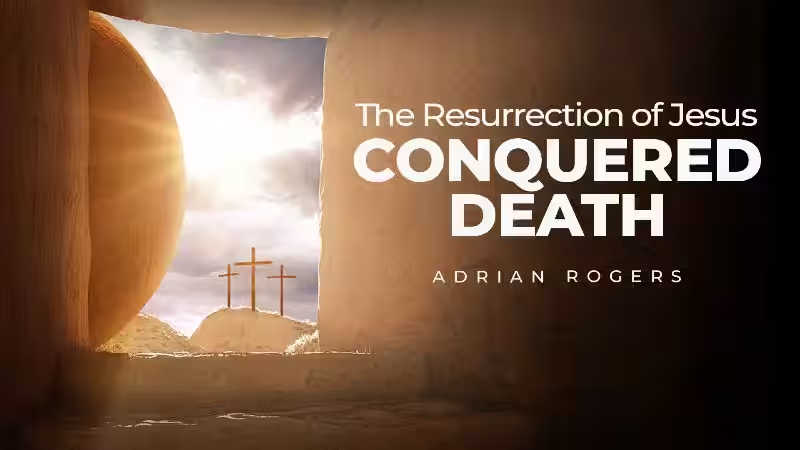
The most direct and compelling evidence for Christ’s resurrection is the empty tomb. The Gospels meticulously recount the events of that first Easter morning, painting a picture of confusion, awe, and ultimately, overwhelming joy. The narrative consistently points to a tomb that was sealed, guarded, and then found inexplicably empty. This wasn’t a case of a missing body; it was a divine intervention that defied all natural explanation. The sheer impossibility of the disciples, in their state of grief and fear, orchestrating such an elaborate hoax, coupled with the testimony of numerous witnesses, makes the empty tomb a cornerstone of historical and theological truth.
Consider the account in Matthew 28:1-10. It describes a violent earthquake, an angel of the Lord descending from heaven to roll away the stone, and the terrifying yet exhilarating appearance to the women. The angel’s words, “He is not here; he has risen, just as he said,” were the first pronouncements of this world-changing news. Similarly, Luke 24:1-12 details the women finding the stone rolled away, entering the tomb, and seeing two men in dazzling clothes who reminded them of Jesus’ words about his coming death and resurrection. The disciples’ initial disbelief, as described in Mark 16:9-14, also serves as powerful evidence; if the resurrection was a manufactured event, why would the initial reports highlight the disciples’ skepticism?
Witnesses to the Risen Christ: Transformed Lives
Beyond the empty tomb, the New Testament presents a compelling array of witnesses who encountered the resurrected Christ. These were not vague apparitions; they were tangible encounters that fundamentally altered the lives and destinies of those who experienced them. The disciples, who had scattered in fear after Jesus’ crucifixion, were transformed into bold proclaimers of the resurrection, willing to suffer and even die for their faith. This dramatic shift in their demeanor and conviction is powerful testament to the reality of their encounters.
The Apostle Paul, initially a staunch persecutor of Christians, recounts his own profound encounter on the road to Damascus in 1 Corinthians 15:3-8. He writes, “For what I received I passed on to you as of first importance: that Christ died for our sins according to the Scriptures, that he was buried, that he was raised on the third day according to the Scriptures, and that he appeared to Cephas, and then to the Twelve. After that, he appeared to more than five hundred of his brothers at the same time, most of whom are still living, though some have fallen asleep. Then he appeared to James, then to all the apostles, and last of all he appeared to me also as to one abnormally born.” This wasn’t a fleeting vision; it was a life-altering revelation, solidifying Paul’s commitment and leading him to become one of Christianity’s most influential figures. The transformation of the disciples, from terrified followers to fearless evangelists, is a compelling narrative of authentic experience.
Theological Significance: Victory Over Sin and Death
The resurrection of Jesus is not merely about proving he was divine; it’s about the profound theological implications for humanity. It signifies God’s ultimate victory over sin and death, offering believers a new covenant and the promise of eternal life. This wasn’t an accidental victory; it was a deliberate act of redemption, planned from eternity to reconcile humanity with God.
The Apostle Paul, in Romans 6:4-5, eloquently explains this theological significance: “We were therefore buried with him through baptism into death in order that, just as Christ was raised from the dead through the glory of the Father, we too may live a new life. For if we have been united with him in this death, we will certainly be united with him in his resurrection.” This passage highlights the transformative power of the resurrection, linking our spiritual new birth to Christ’s victory. It means that through faith in Christ, our sins are forgiven, and we are granted the gift of eternal life, a life that transcends the limitations of our earthly existence. 1 Corinthians 15:17 powerfully states, “And if Christ has not been raised, your faith is futile; you are still in your sins.” This verse underscores that the resurrection is not an optional extra; it is essential for salvation.
The Resurrection’s Impact: Hope for Today and Tomorrow
The resurrection of Christ is not a relic of the past; it’s a living reality that offers hope and purpose for believers today. It provides the assurance that death is not the end, but a transition to an everlasting future with God. This hope is not based on wishful thinking, but on the incontrovertible evidence of Christ’s victory over the grave. It empowers us to face life’s challenges with courage and resilience, knowing that our ultimate destiny is secure.
In 1 Peter 1:3, we are reminded, “Praise be to the God and Father of our Lord Jesus Christ! In his great mercy he has given us new birth into a living hope through the resurrection of Jesus Christ from the dead.” This “living hope” is a dynamic force that sustains us through trials, fuels our perseverance, and inspires us to live lives that honor God. It means that even in the face of suffering, loss, or uncertainty, we can find deep and abiding peace, grounded in the certainty of Christ’s resurrection. This hope is not passive; it’s an active expectation that shapes our present actions and our eternal outlook. It gives us the strength to overcome fear, to forgive others, and to live with unwavering faith in God’s promises.
Frequently Asked Questions About Christ’s Resurrection
What are some key Bible verses that speak about the resurrection of Jesus Christ?
Several passages in the Bible describe the resurrection of Jesus. Some of the most prominent include:
1 Corinthians 15:3-8: “For what I received I passed on to you as of first importance: that Christ died for our sins according to the Scriptures, that he was buried, that he was raised on the third day according to the Scriptures, and that he appeared to Cephas, and then to the Twelve. After that, he appeared to more than five hundred of the brothers and sisters at the same time, most of whom are still living, though some have fallen asleep. Then he appeared to James, then to all the apostles, and last of all he appeared to me also…”
Matthew 28:1-10: This account details the discovery of the empty tomb by Mary Magdalene and the other Mary, and the appearance of an angel who announces Jesus’ resurrection.
Mark 16:1-8: Similar to Matthew, this passage describes the women finding the tomb empty and their fear and amazement.
Luke 24:1-12: This Gospel also records the discovery of the empty tomb and the appearance of two men in dazzling clothes who tell the women that Jesus is alive.
John 20:1-18: This chapter provides a detailed account of Mary Magdalene’s encounter with the resurrected Jesus.
Romans 6:4: “We were therefore buried with him through baptism into death in order that, just as Christ was raised from the dead through the glory of the Father, we too may live a new life.”
Acts 2:24: “But God raised him from the dead, freeing him from the agony of death, because it was impossible for death to keep its hold on him.”
What is the theological significance of Jesus’ resurrection in Christianity?
The resurrection of Jesus Christ is a cornerstone of Christian faith. It is seen as:
Proof of Jesus’ divinity: It validates his claims to be the Son of God.
Victory over sin and death: It demonstrates that Jesus has conquered the power of sin and death, offering salvation and eternal life to believers.
The foundation of the Christian message: The Apostle Paul states in 1 Corinthians 15:14, “And if Christ has not been raised, our preaching is useless and so is your faith.”
A promise of future resurrection for believers: The resurrection of Jesus is seen as the first fruits, a guarantee that those who believe in him will also be raised to new life.
How does the resurrection relate to the concept of religion?
The resurrection is central to the religion of Christianity. It is the event that distinguishes Christianity from other religions and provides the ultimate basis for its teachings and practices. For Christians, the resurrection signifies:
The fulfillment of prophecy: Many believe it fulfilled Old Testament prophecies about the Messiah.
The inauguration of a new covenant: It marks the beginning of a new relationship between God and humanity, based on grace and forgiveness through Christ.
The empowering of believers: The Holy Spirit, sent after Jesus’ resurrection and ascension, empowers Christians to live out their faith.
The hope of eternal life: It offers a profound hope for believers in a future resurrection and eternal life with God.