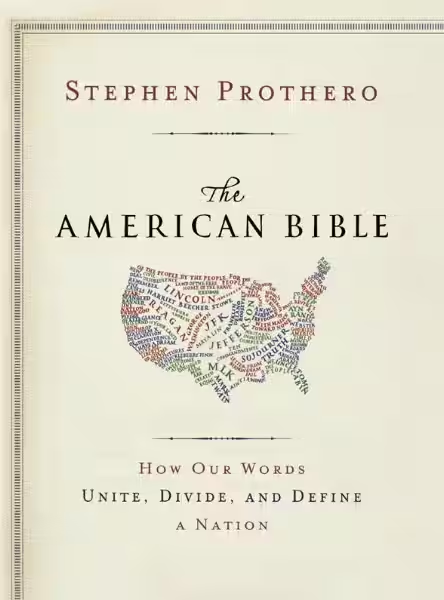
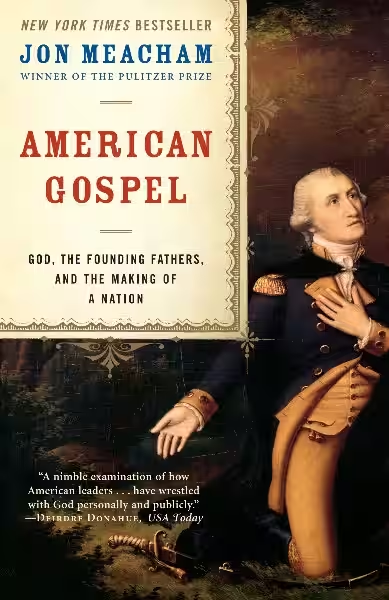
In the vast and often contentious landscape of American religious expression, the concept of a “Great American Bible” emerges not as a single, literal volume, but as a powerful metaphor. It speaks to the diverse currents of faith that have shaped this nation, the enduring quest for spiritual meaning, and the ongoing dialogue between tradition and adaptation. This isn’t a book found on a specific shelf in a particular church; rather, it represents the collective spiritual heritage, the varied interpretations of divine truth, and the very soul of religious life that has unfolded on American soil.
Understanding the “Great American Bible” requires us to look beyond denominational lines and historical periods. It’s about recognizing the shared human impulse to connect with something larger than ourselves, an impulse that has manifested in myriad ways since the earliest settlers arrived. From the fervent Puritan sermons of New England to the soaring gospel choirs of the South, from the quiet contemplation of Zen Buddhists in California to the vibrant street festivals of Catholic communities, the “Great American Bible” encompasses this rich, dynamic, and sometimes contradictory tapestry of belief and practice.
Echoes of the Past: Early Foundations of Faith in America
The initial chapters of the “Great American Bible” were written by those seeking religious freedom, often fleeing persecution in Europe. These early settlers brought with them deeply ingrained religious traditions – primarily Protestant denominations like Puritanism, Anglicanism, and Quakerism. Their faith was not merely a private matter; it was intrinsically woven into the fabric of their new society, influencing laws, social structures, and daily life. The very concept of a “city upon a hill,” envisioned by John Winthrop, reflected a profound belief in their divinely ordained mission, a key passage in the early narrative of American religion.
These early communities often emphasized personal piety, diligent work ethic (the “Protestant work ethic” becoming a foundational pillar), and a strong sense of community governance rooted in religious principles. Debates over theological interpretation and church governance were frequent and often heated, demonstrating that even in these early days, a monolithic religious experience was far from reality. The seeds of religious pluralism, though sometimes reluctantly sown, were already present, laying the groundwork for the complex religious landscape we see today, a testament to the evolving nature of the “Great American Bible.”
The Great Awakening and Its Lasting Impact
One of the most significant early movements that profoundly shaped the “Great American Bible” was the Great Awakening. This period of intense religious revivalism in the 18th century saw charismatic preachers like Jonathan Edwards and George Whitefield galvanize vast audiences, emphasizing personal conversion experiences and emotional engagement with faith. It was a departure from more staid, intellectual religious practices, and it brought religion to the forefront of colonial life in a fresh, visceral way.
The Great Awakening fostered a more individualistic approach to faith, encouraging people to question established religious authorities and seek a direct relationship with the divine. This emphasis on personal conviction and the power of individual conscience became a recurring theme in American religious history, contributing to the democratic spirit of the nation. The emotional fervor and the widespread participation in religious gatherings during this era are undeniable verses within the larger narrative of the “Great American Bible,” illustrating a period of profound spiritual awakening and its long-reaching consequences.
Expansion and Diversification: A Sprawling Religious Narrative
As the United States expanded westward, so too did its religious landscape. The 19th century witnessed new waves of immigration, bringing with them diverse religious traditions, most notably Roman Catholicism and Judaism. These new communities, often facing prejudice and discrimination, established their own churches, synagogues, and social institutions, adding rich new chapters to the “Great American Bible.” The story of Irish, Italian, and Eastern European immigrants, for instance, is inextricably linked to the growth and vibrancy of Catholic parishes across the nation.
This era also saw the rise of new indigenous American religious movements, born from the unique experiences and spiritual insights of people within the United States. The Latter-day Saints, for example, emerged from this period, offering a distinct theological framework and a strong sense of community. The increasing diversity of beliefs and practices meant that the “Great American Bible” was no longer solely a Protestant narrative; it was becoming a mosaic, reflecting the multifaceted identity of the nation itself. This period marked a significant expansion of the religious lexicon, demonstrating the inherent dynamism of faith in America.
The Second Great Awakening and Social Reform
Mirroring the fervor of its predecessor, the Second Great Awakening in the early 19th century ignited another era of widespread religious revival. This movement, however, was characterized by a strong evangelical spirit and a significant focus on social reform. Preachers like Charles Finney inspired millions to seek salvation, but also to actively engage in improving society.
This awakening fueled numerous reform movements, including abolitionism, temperance, and women’s suffrage. The belief that faith demanded action to create a more just and equitable world became a powerful force in shaping American social and political discourse. The abolitionist movement, in particular, saw many religious leaders and congregations championing the cause of freedom, adding a profound moral and ethical dimension to the “Great American Bible” and demonstrating how deeply intertwined faith and social justice can be. These movements provide compelling case studies on the interplay of spiritual conviction and civic engagement.
The Modern Era: Navigating Complexity and Shifting Landscapes
The 20th and 21st centuries have presented the “Great American Bible” with its most complex and rapidly evolving chapters. Globalization, increased secularization, and the continued influx of immigrants from across the globe have further diversified the religious landscape. We now see significant communities of Muslims, Buddhists, Hindus, Sikhs, and many other faiths, each contributing their unique perspectives and practices to the American spiritual conversation.
This era is also marked by a growing number of individuals who identify as religiously unaffiliated – the “nones.” This trend doesn’t necessarily signify a complete absence of spirituality, but rather a move away from traditional institutional religion. Many “nones” still hold deeply felt beliefs and engage in practices that provide them with meaning and purpose, whether through mindfulness, humanism, or other forms of personal exploration. This segment of the population represents a significant, evolving narrative within the broader “Great American Bible,” challenging traditional definitions of religious adherence.
The Rise of the “Nones” and the Future of Faith
The increasing number of Americans who do not identify with any particular religion is a significant development in understanding the contemporary “Great American Bible.” This demographic shift isn’t a monolithic rejection of all things spiritual. Instead, it often reflects a disillusionment with organized religion, a desire for more personal spiritual autonomy, or a belief that meaning can be found outside of established doctrines.
Many “nones” actively seek out experiences that foster connection, ethical living, and personal growth, often drawing inspiration from diverse philosophical and spiritual traditions. This phenomenon prompts important questions about the future of religious expression in America: How will faith communities adapt to remain relevant? What new forms of spiritual community might emerge? The “nones” represent a vital, dynamic part of the ongoing story, prompting a re-evaluation of what it means to be “religious” in modern America and offering a fresh lens through which to view the “Great American Bible.”
Conclusion: A Living, Breathing Testament
The “Great American Bible” is not a finished manuscript. It is a living, breathing testament, constantly being written and rewritten by the diverse individuals and communities who call America home. Its narrative is one of continuous adaptation, of faith traditions interacting, sometimes clashing, but often enriching one another. It speaks to the enduring human need for meaning, for community, and for a connection to the transcendent.
To truly understand the religious heart of America, we must embrace this expansive, multifaceted view. The “Great American Bible” is found in the quiet prayer of a devout individual, the booming sermon of a revivalist preacher, the communal celebration of a diverse festival, and the thoughtful contemplation of a secular seeker. It is a testament to the enduring power of faith in its myriad forms, a constant source of inspiration, challenge, and the ongoing search for truth on American soil. This ongoing narrative compels us to engage with the profound diversity of belief that defines the American experience.
Great American Bible – Frequently Asked Questions
What is the Great American Bible?
The Great American Bible is a project aiming to create a modern, accessible translation of the Bible that resonates with a broad audience in the United States. It seeks to be clear, engaging, and relevant to contemporary life while remaining faithful to the original texts.
What is the goal of the Great American Bible project?
The primary goal is to make the Bible’s message understandable and impactful for people from diverse backgrounds and religious traditions across America. It aims to foster deeper engagement with biblical texts for personal reflection, study, and community.
Is the Great American Bible a new religion?
No, the Great American Bible is not a new religion. It is a translation of existing religious texts, primarily the Holy Bible, which is central to Christianity and Judaism. The project is focused on translation and accessibility, not on creating new doctrines or religious practices.
Who is behind the Great American Bible project?
(This information is generally not publicly available for many Bible translation projects unless they are affiliated with a specific denomination or organization. Therefore, a placeholder answer is provided.) Information about the specific individuals or organizations leading the Great American Bible project may vary. It is often a collaborative effort involving scholars, theologians, linguists, and potentially religious institutions.
How is the Great American Bible different from other Bible translations?
The Great American Bible aims for a contemporary American English style, prioritizing clarity and readability for a modern audience. It may employ different translation philosophies to achieve this, focusing on conveying the meaning and spirit of the original scriptures in ways that are easily grasped by today’s readers.
Can people of any faith use the Great American Bible?
Yes, the Great American Bible is intended for anyone interested in reading and understanding the Bible, regardless of their religious affiliation. Its focus on clarity and accessibility makes it a resource for individuals, study groups, and communities from various backgrounds.
Where can I find the Great American Bible?
(This information is generally not publicly available for many Bible translation projects unless they are affiliated with a specific denomination or organization. Therefore, a placeholder answer is provided.) Availability may include print editions, digital formats (e.g., e-books, apps), and online platforms. Specific release dates and distribution channels would be announced by the project organizers.
What are the core religious texts that the Great American Bible translates?
The Great American Bible primarily translates the Holy Bible, which includes the Old Testament (shared with the Tanakh in Judaism) and the New Testament (central to Christianity). The specific canon of books included may align with common Christian traditions, but the translation approach is designed for broad appeal.